Question
Consider two particles A and B having equal charges and placed at some distance. The particle A is slightly displaced towards B. Does the force on B increase as soon as the particle A is displaced? Does the force on the particle A increase as soon as it is displaced?
Answer

Electrostatic force follows the inverse square law, $\text{F}=\frac{\text{k}}{\text{r}^2}.$ This means the the force on two particles carrying charges increases on decreasing the distance between them. Therefore, as particle A is slightly displaced towards B, the force on B as well as a A will increase.

Need a full question paper?

Generate a complete, print-ready paper with questions like this in minutes — across 16+ boards, with answer keys.

Start Generating Free

Similar questions

Does a body at 20°C radiate in a room, where the room temperature is 30°C? If yes, why does its temperature not fall further?
A body builder exerts a force of 150N against a bullworker and compresses it by 20cm. Calculate the spring constant of the spring in the bullworker.
Write the importance of Huygens principle. What are the two assumptions of this theory?
Explain the changes occuring in the wave length, speed and frequency when light enters from one mudium to the other medium.
A capacitor of capacitance C is given a charge Q. At t = 0, it is connected to an ideal battery of emf $\in$ through a resistance R. Find the charge on the capacitor at time t.
Considering the case of a parallel plate capacitor being charged, show how one is required to generalize Ampere’s circuital law to include the term due to displacement current.
Spring fitted doors close by themselves when released. You want to keep the door open for a long time, say for an hour. If you put a half kg stone in front of the open door, it does not help. The stone slides with the door and the door gets closed. However, if you sandwitch a 20g piece of wood in the small gap between the door and the floor, the door stays open. Explain why a much lighter piece of wood is able to keep the door open while the heavy stone fails.
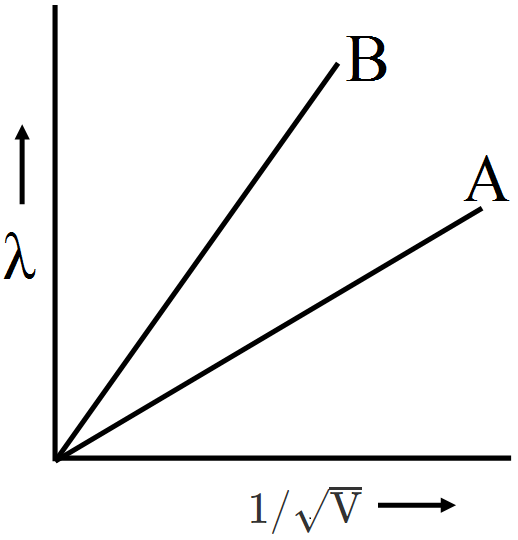
Two lines A and B shown in the graph represent the de Broglie wavelength $(\lambda)$ as a function of $\frac{1}{\sqrt{\text{V}}}$ (V is the accelerating potential) for two particles having the same charge. Which of the two represents the particle of smaller mass?

An electric field $\vec{\text{E}}=(\vec{\text{i}}20+\vec{\text{j}}30)\text{N}\text{C}^{-1}$ exists in the space. If the potential at the origin is taken to be zero, find the potential at (2m, 2m).
The radius of the innermost electron orbit of a hydrogen atom is 5.3×10⁻¹¹ m. What are the radii of the n = 2 and n = 3 orbits?