Question
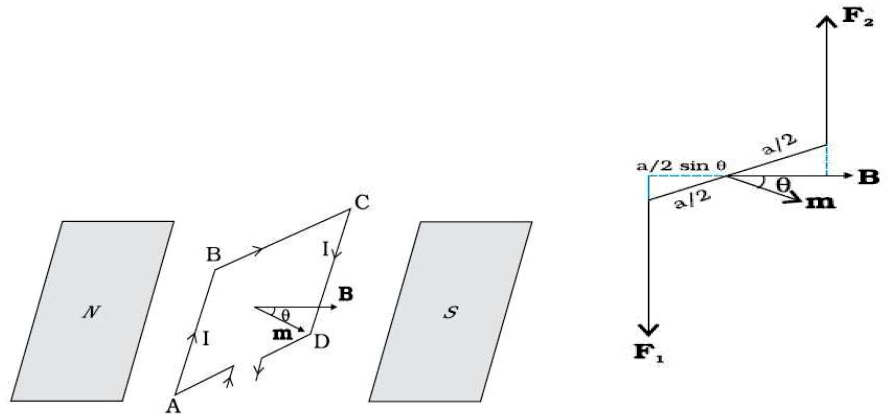
Deduce the expression for the torque $\overrightarrow{\tau}$ acting on a planar loop of area $\overrightarrow{\text{A}}$ and carrying current I placed in a uniform magnetic field $\overrightarrow{\text{B}}.$ If the loop is free to rotate, what would be its orientation in stable equilibrium?
Answer


Force on each perpendicular arm:
$?_1 = ?_2 = ?\ ?\ ?$
Moment of couple = ? ? ?. ? sin ?
$? = ?\ ??\ ?\ ????$
? = I ?? ???? $\overrightarrow{\tau} =\overrightarrow{\text{IA}}\times\overrightarrow{\text{B}}$
When the plane of the loop is perpendicular to the magnetic field, the loop will be in stable equilibrium.$(\overrightarrow{\text{A}}||\overrightarrow{\text{B}}) , \Rightarrow\theta = 0^{\circ}$
$\overrightarrow{\text{M}} = $ Equivalent magnetic moment of the planer loop $ = \overrightarrow{\text{IA}}$
$\therefore \text{Torque} =\overrightarrow{\text{M}}\times\overrightarrow{\text{B}} = \overrightarrow{\text{IA}}\times\overrightarrow{\text{B}}$
$\text{|??????|} = \text{IAB}\sin\theta$.

Need a full question paper?

Generate a complete, print-ready paper with questions like this in minutes — across 16+ boards, with answer keys.

Start Generating Free

Similar questions

Explain how the image is formed by thin convex lens and derive $-\frac{1}{u}+\frac{1}{v}=\left(n_{21}-1\right)\left[\frac{1}{R_1}-\frac{1}{ R _2}\right] \#\#\# $ Derive lens maker's formula for thin convex lens.
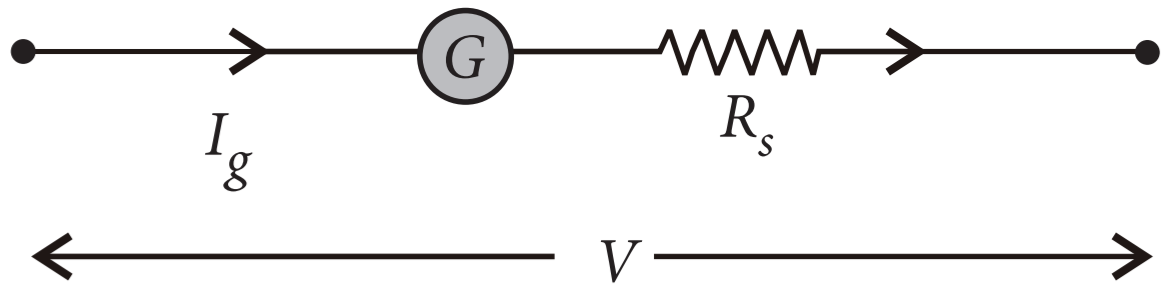
A galvanometer can be converted into voltmeter of given range by connecting a suitable resistance R, in series with the galvanometer, whose value is given by,
$\text{R}_\text{s}=\frac{\text{V}}{\text{I}_\text{g}}-\text{G}$
where Vis the voltage to be measured, lg is the current for full scale deflection of galvanometer and G is the resistance of galvanometer.

Series resistor(R,) increases range of voltmeter and the effective resistance of galvanometer. It also protects the galvanometer from damage due to large current. Voltmeter is a high resistance instrument and it is always connected in parallel with the circuit element across which potential difference is to be measured. An ideal voltmeter has infinite resistance. In order to increase the range of voltmeter n times the value of resistance to be connected in series with galvanometer is $R_s = (n - 1)G.$
  1. 10mA current can pass through a galvanometer of resistance $25\Omega$ What resistance in series should be connected through it, so that it is converted into a voltmeter of 100V?
  1. $0.975\Omega$
  2. $99.75\Omega$
  3. $975\Omega$
  4. $9975\Omega$
  1. There are 3 voltmeter A, B, C having the same range but their resistance are $15000\Omega,10000\Omega$, and $5000\Omega$ respectively. 'Tile best voltmeter amongst them is the one whose resistance is
  1. $5000\Omega$
  2. $10000\Omega$
  3. $15000\Omega$
  4. all are equally good.
  1. A milliammeter of range 0 to 25mA and resistance of $10\Omega$ is to be converted into a voltmeter with a range of 0 to 25V. 'Tile resistance that should be connected in series will be:
  1. $930\Omega$
  2. $960\Omega$
  3. $990\Omega$
  4. $1010\Omega$
  1. To convert a moving coil galvanometer (MCG) into a voltmeter:
  1. A high resistance R is connected in parallel with MCG.
  2. A low resistance R is connected in parallel with MCG.
  3. A low resistance R is connected in series with MCG.
  4. A high resistance R is connected in series with MCG.
  1. To increase the current sensitivity of a moving coil galvanometer, we should decrease:
  1. Zero.
  2. Low.
  3. High.
  4. Infinity.
A magnetic dipole of magnetic moment $0.72A-m^2$ is placed horizontally with the north pole pointing towards bsouth. Find the position of the neutral point if the horizontal component of the earth's magnetic field is $18\mu\text{T.}$
A car starts from rest on a half kilometer long bridge. The coefficient of friction between the tyre and the road is 1.0. Show that one cannot drive through the bridge in less than 10s.
A bird while flying takes a left turn, where does it get the centripetal force from?
According to de-Broglie, a moving material particle sometimes acts as a wave and sometimes as a particle or a wave associated with moving material particle which controls the particle in every respect. The wave associated with moving particle is called matter wave or de-Broglie wave where wavelength called de-Broglie wavelength, rs given by $\lambda=\frac{\text{h}}{\text{mv}}$.
  1. If a proton and an electron have the same de Broglie wavelength, then:
  1. Kinetic energy of electron < kinetic energy of proton.
  2. Kinetic energy of electron = kinetic energy of proton.
  3. Momentum of electron = momentum of proton.
  4. momentum of electron < momentum of proton.
  1. Which of these particles having the same kinetic energy has the largest de Broglie wavelength?
  1. Electron
  2. Alpha particle
  3. Proton
  4. Neutron
  1. Two particles $A_1$ and $A_2$ of masses $m_1, m_2 (m_1 > m_2)$ have the same de Broglie wavelength. Then:
  1. Their momenta are the same.
  2. Their energies are the same.
  3. Momentum of $A_1$ is less than the momentum of $A_1$.
  4. Energy of $A_1$ is more than the energy of $A_2.$
  1. When the velocity of an electron increases, its de Broglie wavelength:
  1. Increases.
  2. Decreases.
  3. Remains same.
  4. May increase or decrease.
  1. Proton and $\alpha$ - particle have the same de-Broglie wavelength. What is same for both of them?
  1. Time period
  2. Energy
  3. Frequency
  4. Momentum
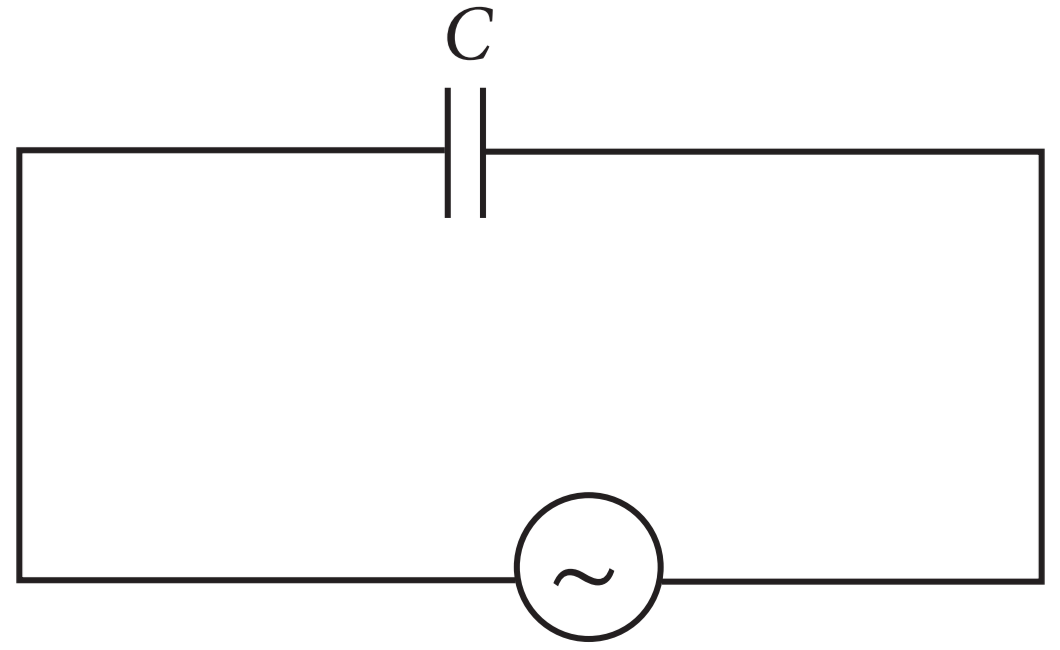
Let a source of alternating e.m.f. $\text{E} = \text{E}_\circ\sin\omega\text{t}$ be connected to a capacitor of capacitance C. If 'I' is the instantaneous value of current in the circuit at instant t, then $\text{I}=\frac{\text{E}_0}{\frac{1}{\omega\text{C}}}\sin\Big(\omega\text{t}+\frac{\pi}{2}\Big).$ The capacitive reactance limits the amplitude of current in a purely capacitive circuit and it is given by $\text{X}_\text{C}=\frac{1}{\omega\text{C}}.$
  1. What is the unit of capacitive reactance?
  1. Farad
  2. Ampere
  3. Ohm
  4. $Ohm^{-1}$
  1. The capacitive reactance of a $5\mu\text{F}$ capacitor for a frequency of $10^6Hz$ is:
  1. $0.032\Omega$
  2. $2.52\Omega$
  3. $1.25\Omega$
  4. $4.51\Omega$
  1. In a capacitive circuit, resistance to the flow of current is offered by:
  1. Resistor
  2. Capacitor
  3. Inducto
  4. Frequency
  1. In a capacitive circuit, by what value of phase angle does alternating current leads the e.m.f?
  1. $45^\circ$
  2. $90^\circ$
  3. $75^\circ$
  4. $60^\circ$
  1. One microfarad capacitor is joined to a 200V, 50Hz alternator. The rrns current through capacitor is:
  1. $6.28 \times 10^{-2}A$
  2. $7.5 \times 10^{-4}A$
  3. $10.52 \times 10^{-2}A$
  4. $15.25 \times 10^{-2}A$
Point charge q is placed (i)at the mid-point of the core of a cube of side a meter (ii)centrally on a plane of a cube of side a meter. Calculate the total flux associated with the cube. Also find out how many surfaces of the cube will be the total flux associated?
A person goes to bed at sharp 10:00 pm every day. Is it an example of periodic motion? If yes, what is the time period? If no, why?