Maharashtra BoardEnglish MediumSTD 11 SciencePhysicsMathematical Methods4 Marks
Question
Define and explain vector product of two vectors with suitable examples.
✓
Answer
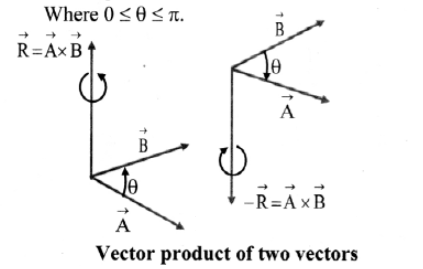
i. The vector product of two vectors is a third vector whose magnitude is equal to the product of magnitude of the two vectors and sine of the smaller angle θ between the two vectors. ii. Vector product is also called cross product of vectors because cross sign is used to represent vector product. iii. Explanation: a. The vector product of two vectors$\overrightarrow{ A }$ and $\overrightarrow{ AB}$, is a third vector $\overrightarrow{ R }$ and is written as, $\overrightarrow{ R }$ = $\overrightarrow{ A }$ × $\overrightarrow{ B }$ = AB sin $\theta \hat{ u }_{ r }$ where, $\hat{ u }_{ r }$ is unit vector in direction of $\overrightarrow{ R }$, i.e., perpendicular to plane containing two vectors. It is given by right handed screw rule. c. Examples of vector product: 1. Force experienced by a charge q moving with velocity $\overrightarrow{ V }$ in uniform magnetic field of induction (strength) $\overrightarrow{ B }$ is given as $\overrightarrow{ F }$ = $q \vec{V}$ × $\overrightarrow{ B}$ 2. Moment of a force or torque$\binom{\rightarrow}{\tau}$ is the vector product of the position vector $(\vec{r})$ and the force $(\overrightarrow{ F })$. i.e., $\vec{\tau}=\overrightarrow{ r } \times \overrightarrow{ F }$ 3. The instantaneous velocity $(\vec{v})$ of a rotating particle is equal to the cross product of its angular velocity $(\vec{\omega})$ and its position $(\overrightarrow{ r })$ from axis of rotation. $\overrightarrow{ v }=\overrightarrow{ r } \times \vec{\omega}$
Need a full question paper?
Generate a complete, print-ready paper with questions like this in minutes — across 16+ boards, with answer keys.