A metre stick is balanced on a knife edge at its centre. When two coins, each of mass 5g are put one on top of the other at the 12.0cm mark, the stick is found to be balanced at 45.0cm. What is the mass of the metre stick?
Exercise
Download our app for free and get started
Let W and W′ be the respective weights of the metre stick and the coin. 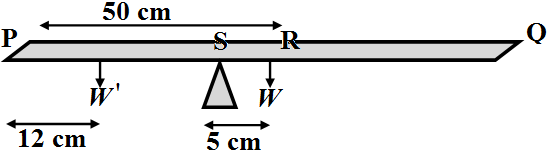 The mass of the metre stick is concentrated at its mid-point, i.e., at the 50cm mark. Mass of the meter stick = m' Mass of each coin, m = 5g When the coins are placed 12cm away from the end P, the centre of mass gets shifted by 5cm from point R toward the end P. The centre of mass is located at a distance of 45cm from point P. The net torque will be conserved for rotational equilibrium about point R. $10\times\text{g}(45-12)-\text{m}'\text{g}(50-45)=0$ $\therefore\ \text{m}'=\frac{10\times33}{5}=66\text{g}$ Hence, the mass of the metre stick is 66g.
The mass of the metre stick is concentrated at its mid-point, i.e., at the 50cm mark. Mass of the meter stick = m' Mass of each coin, m = 5g When the coins are placed 12cm away from the end P, the centre of mass gets shifted by 5cm from point R toward the end P. The centre of mass is located at a distance of 45cm from point P. The net torque will be conserved for rotational equilibrium about point R. $10\times\text{g}(45-12)-\text{m}'\text{g}(50-45)=0$ $\therefore\ \text{m}'=\frac{10\times33}{5}=66\text{g}$ Hence, the mass of the metre stick is 66g.
Download our appand get started for free
Experience the future of education. Simply download our apps or reach out to us for more information. Let's shape the future of learning together!No signup needed.*
Similar Questions
- 1A meter stick held vertically, with one end on the ground, is then allowed to fall. What is the value of the radial and tangential acceleration of the top end of the stick when the stick has turned through on angle $\theta?$ What is the speed with which the top end of the stick hits the ground? Assume that the end of the stick in. contact with the ground does not slip.View Solution
- 2The oxygen molecule has a mass of $5.30 \times 10^{-26}kg$ and a moment of inertia of $1.94 \times 10^{-46}kgm^2$ about an axis through its centre perpendicular to the lines joining the two atoms. Suppose the mean speed of such a molecule in a gas is $500m/s$ and that its kinetic energy of rotation is two thirds of its kinetic energy of translation. Find the average angular velocity of the molecule.View Solution
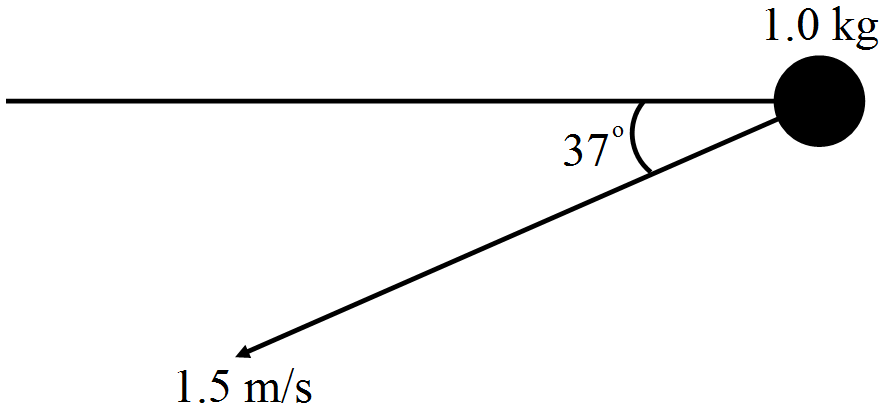
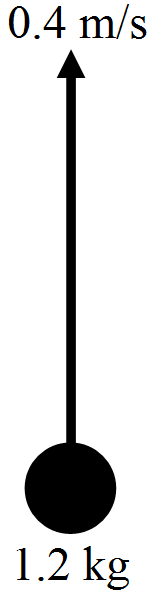
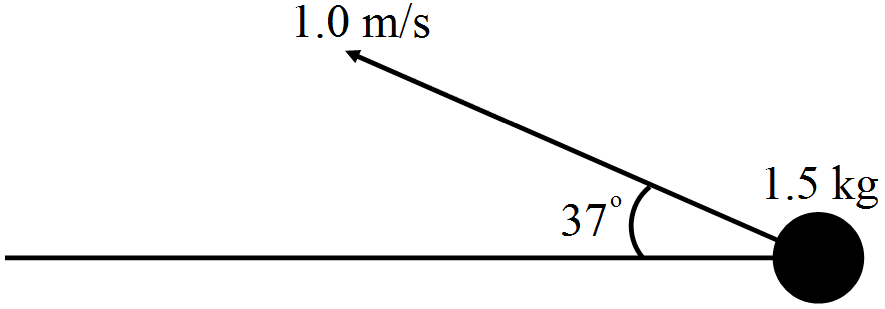
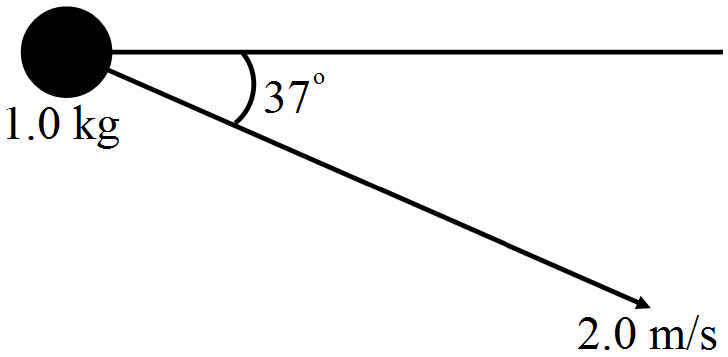
- 3View SolutionCalculate the velocity of the centre of mass of the system of particles shown in figure.

- 4View SolutionThe door of an almirah is 6ft high, 1.5ft wide and weighs 8kg. The door is supported by two hinges situated at a distance of 1ft from the ends. If the magnitudes of the forces exerted by the hinges on the door are equal, find this magnitude.
- 5In the HCl molecule, the separation between the nuclei of the two atoms is about $1.27\mathring{\text{A}}\big(1\mathring{\text{A}}= 10^{-10} \text{m}\big).$ Find the approximate location of the CM of the molecule, given that a chlorine atom is about 35.5 times as massive as a hydrogen atom and nearly all the mass of an atom is concentrated in its nucleus.View Solution
- 6A car weighs $1800kg$. The distance between its front and back axles is $1.8m$. Its centre of gravity is $1.05m$ behind the front axle. Determine the force exerted by the level ground on each front wheel and each back wheel.View Solution
- 7Three point masses m,, m, and m, are located at the vertices of an equilateral triangle of side length a. What is the moment of inertia about an axis along the altitude of the triangle passing through $m_1$?View Solution
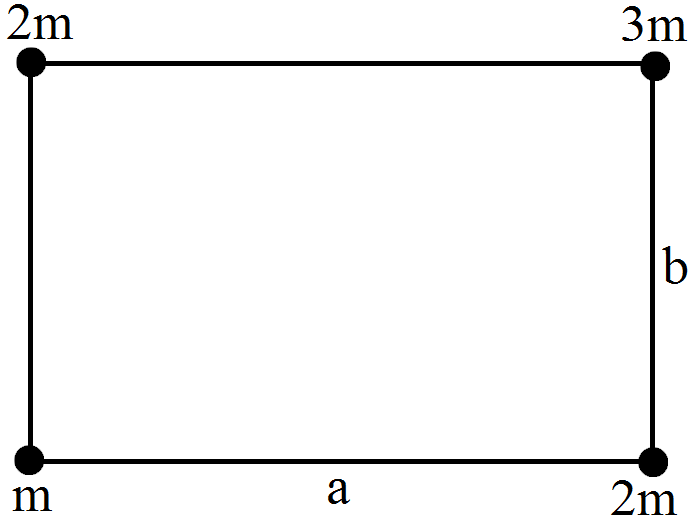
- 8View SolutionFour bodies have been arranged at the corners of a rectangle shown in figure. Find the centre of mass of the system.
- 9View SolutionA cylinder is suspended by two strings wrapped around the cylinder near each end, the free ends of the string being attached to hooks on the ceiling, such that the length of the cylinder is horizontal. From the position of rest, the cylinder is allowed to roll down as suspension strings unwind. Calculate: (i) the downward linear acceleration of the cylinder and (ii) tension in the strings. Mass of cylinder is 12kg.
- 10View SolutionWhat do you mean by the term "equilibrium"? What are equilibrium of rest and equilibrium of motion? State the conditions for complete equilibrium of a body.