Question
  1. Define mutual inductance and write its $S.I$. unit.
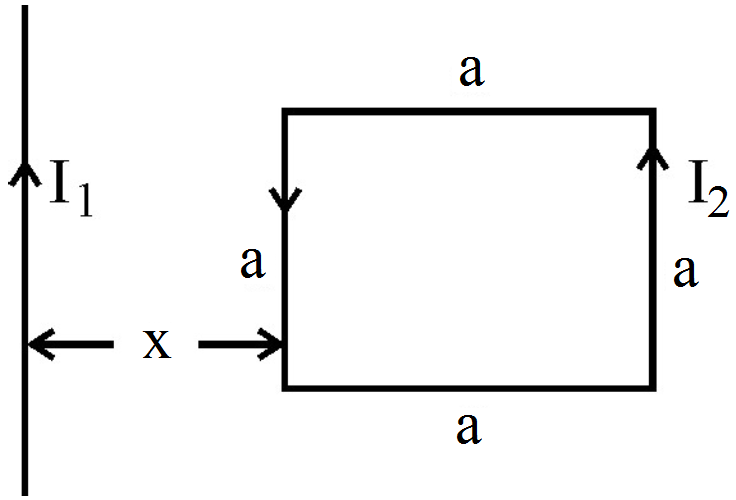
  2. A square loop of side $'a\ '$carrying a current $I_2$ is kept at distance $x$ from an infinitely long straight wire carrying a current $ I_1$ as shown in the figure. Obtain the expression for the resultant force acting on the loop.
Answer

  1. Mutual inductance is where the magnetic field generated by a coil of wire induces voltage in an adjacent coil of wire. $A$ transformer is a device constructed of two or more coils in close proximity to each other, with the express purpose of creating a condition of mutual inductance between the coils. It's $SI$ unit is: $\frac{\text{Wb}}{\text{A}}$
  2.  

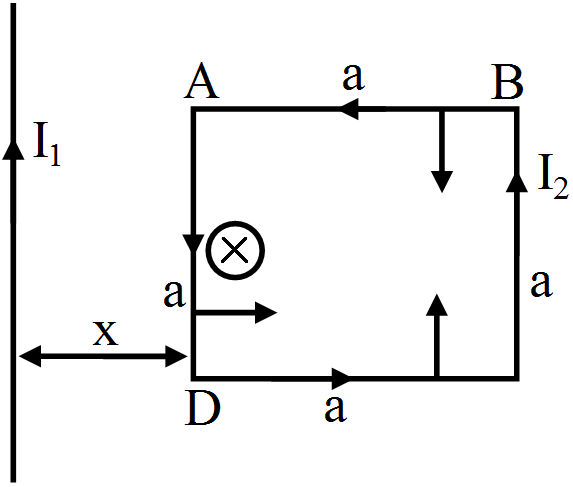
According to the right $-$ hand screw rule, the magnetic field will be into the plane across the loop.
Force on length $AD$ :
$F =$ Bil
$\text{F}_1=\frac{\mu_0\text{I}_1\text{I}_2\text{a}}{2\pi\text{x}} \ ($Towards Right$)$
Force on length $AD$ :
$F =$ Bil
$\text{F}_2=\frac{\mu_0\text{I}_1\text{I}_2\text{a}}{2\pi(\text{x}+\text{a})} \ ($Towards Left$)$
Force on $AB$ and $CD$ will be equal and opposite.
Hence, they'll cancel out.
Force on the loop:
$\text{F}_\text{Net}=\text{F}_1-\text{F}_2$
$=\frac{\mu_0\text{I}_1\text{I}_2\text{a}}{2\pi}\Big[\frac{1}{\text{x}}-\frac{1}{(\text{x}+\text{a})}\Big]$
$\text{F}_\text{Net}=\frac{\mu_0\text{I}_1\text{I}_2\text{a}}{2\pi}\Big[\frac{\text{x}+\text{a}-\text{x}}{(\text{x}+\text{a})\text{x}}\Big]=\frac{\mu_0\text{I}_1\text{I}_2\text{a}^2}{2\pi(\text{x}+\text{a})\text{x}}$
$\text{F}_\text{Net}=\frac{\mu_0\text{I}_1\text{I}_2\text{a}^2}{2\pi\text{x}(\text{x}+\text{a})}  \ ($Towards left$)$

Need a full question paper?

Generate a complete, print-ready paper with questions like this in minutes — across 16+ boards, with answer keys.

Start Generating Free

Similar questions

A small conducting sphere (radius r ) is placed concentrically inside a larger conducting hollow sphere of radius $R$. The big and small spheres are charged with $Q$ and $q(Q>q)$ respectively and kept separate from each other. Calculate the potential difference between the spheres.
How many time constants will elapse before the charge on a capacitors falls to 0.1% of its maximum value in a discharging RC circuit?
The current through a wire depends on time as $\text{i}=\text{i}_0+\alpha\text{t},$
Where $\text{i}_0=10\text{A}$ and $\alpha=4\text{A/ s}.$ Find the charge that crosses through a section of the wire in 10 seconds.
Carbon $(Z = 6)$ with mass number $11$ decays to boron $(Z = 5).$
  1. Is it a $\beta^+-\text{decay}$ or a $\beta^--\text{decay}?$
  2. The half-life of the decay scheme is $20.3$ minutes. How much time will elapse before a mixture of $90\%$ carbon$-11$ and $10\%$ boron$-11\ ($by the number of atoms$)$ converts itself into a mixture of $10\%$ carbon$-11$ and $90\%$ boron$-11?$
A heating element using nichrome connected to a 230 V supply draws an initial current of 3.2 A which settles after a few seconds to a steady value of 2.8 A. What is the steady temperature of the heating element if the room temperature is 27${ }^{\circ} C$ ? Temperature coefficient of resistance of nichrome averaged over the temperature range involved is $1.70 \times 10^{-4}{ }^{\circ} C ^{-1}$.
The earth’s surface has a negative surface charge density of $10^{-9} Cm^{-2}.$ The potential difference of $400 kV$ between the top of the atmosphere and the surface results $($due to the low conductivity of the lower atmosphere$)$ in a current of only $1800 A$ over the entire globe. If there were no mechanism of sustaining atmospheric electric field, how much time $($roughly$)$ would be required to neutralise the earth’s surface? $($This never happens in practice because there is a mechanism to replenish electric charges, namely the continual thunderstorms and lightning in different parts of the globe$). ($Radius of earth $= 6.37 \times 10^6 m.)$
A uniform rod of mass 300g and length 50cm rotates at a uniform angular speed of 2rad/s about an axis perpendicular to the rod through an end. Calculate:
  1. The angular momentum of the rod about the axis of rotation.
  2. The speed of the centre of the rod.
  3. Its kinetic energy.
A resistance of $R$ draws current from a potentiometer. The potentiometer wire, $AB,$ has a total resistance of $R_o$. A voltage $V$ is supplied to the potentiometer. Derive an expression for the voltage across $R$ when the sliding contact is in the middle of potentiometer wire.
How is a wavefront defined? Using Huygen’s construction draw a figure showing the propagation of a plane wave refracting at a plane surface separating two media. Hence verify Snell’s law of refraction.
A circular coil of radius $8.0\ cm$ and $20$ turns is rotated about its vertical diameter with an angular speed of $50$ rad $s^{–1}$ in a uniform horizontal magnetic field of magnitude $3.0 \times 10^{–2}T$. Obtain the maximum and average emf induced in the coil. If the coil forms a closed loop of resistance $10\Omega ,$ calculate the maximum value of current in the coil. Calculate the average power loss due to Joule heating. Where does this power come from?