Question
  1. Define viscosity. Write SI units of coefficient of viscosity.
  2. Define terminal velocity. Establish an expression for it.

Answer

  1. Viscosity: The opposing force that exists between the layers of a liquid and the inner walls of the tube in which it flows, is called viscous drag or viscous force and the property is called viscosity. The viscous force directly depends on the area of the layer and the velocity gradient.
$\text{F}=-\eta\text{A}\frac{\text{dv}}{\text{dx}}$
The negative(-) sign shows the opposing nature and n refers to the coefficient of viscosity. The SI unit of coefficient of viscosity is $Nsm^{-2}$.
  1. Terminal Velocity: The constant velocity with which a body drops down after initial acceleration in a dense liquid or fluid is called terminal velocity. This is attained when the apparent weight is compensated by the viscous force. It is given by,
$\text{v}=\frac29\frac{\text{r}^2\text{g}}{\eta}(\rho-\sigma),$ where $\rho$ and $\sigma$ are densities of the body and liquid respectively, n is the coefficient of viscosity of the liquid and r is the radius of the spherical body.
Expression for velocity of streamlined flow: The net force on the sphere becomes zero as the viscous force equals the apparent weight (weight in air-upthrust).
Consider a lengthy column of a dense liquid like glycerine. As the ball or spherical ball is dropped in it, the forces experienced are,
  1. Weight (W) $=\text{mg}=\frac43\pi\text{r}^3\rho\text{g}$
Where $\rho$ is the density of ball.
  1. Upthrust due to buoyancy, $F_T$ = Weight of the medium displaced
$=\frac{4}{3}\pi\text{r}^3\rho_\text{l}\text{g}$
Where p, is the density of liquid.
  1. Viscous force, $\text{F}_\text{v}=6\pi\eta\text{ rv} $
Where v is the terminal velocity.
When terminal velocity is attained, acceleration should be zero and the net force should be zero.
$\therefore\text{mg}-\text{F}_\text{T}-\text{F}_\text{v}=0$
$\Rightarrow\frac43\pi\text{r}^3\rho\text{g}-\frac43\pi\text{r}^3\rho_\text{l}\text{g}-6\pi\eta\text{ rv}=0$
$\therefore\text{v}=\frac{\frac43\pi\text{r}^3\text{g}(\rho-\rho_\text[l]}{6\pi\eta\text{ r}}$
$=\frac{2}{9}\frac{\text{r}^2\text{g}(\rho-\rho_\text{l})}{\eta}$

Need a full question paper?

Generate a complete, print-ready paper with questions like this in minutes — across 16+ boards, with answer keys.
Start Generating Free

Similar questions

What is the excess pressure inside a bubble of soap solution of radius $5.00mm$, given that the surface tension of soap solution at the temperature $(20^\circ C)$ is $2.50 \times 10–2 Nm^{–1}$? If an air bubble of the same dimension were formed at depth of $40.0cm$ inside a container containing the soap solution (of relative density $1.20$), what would be the pressure inside the bubble? (1 atmospheric pressure is $1.01 \times 105Pa$).
A gas mixture consists of molecules of A, B and C with masses $m_A > m_B > m_c$. Rank the three types of molecules in decreasing order of (a) average KE, (b) rms speeds.
A vector has magnitude and direction. Does it have a location in space? Can it vary with time? Will two equal vectors a and b at different locations in space necessarily have identical physical effects? Give examples in support of your answer.
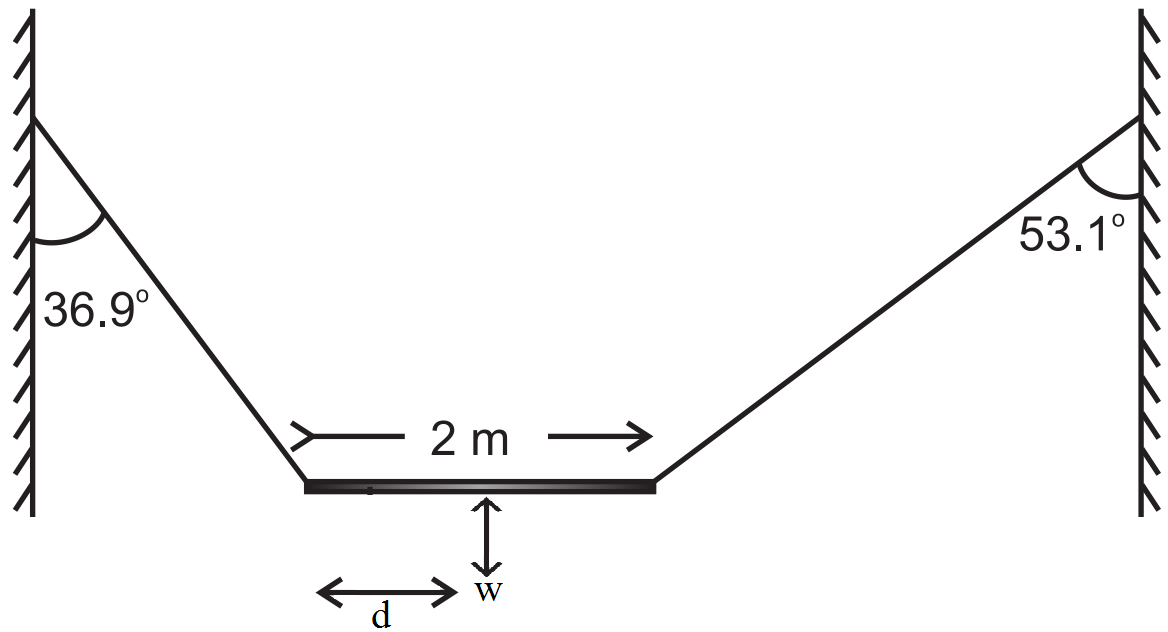
A non-uniform bar of weight W is suspended at rest by two strings of negligible weight as shown in. The angles made by the strings with the vertical are $36.9°$ and $53.1°$ respectively. The bar is $2m$ long. Calculate the distance d of the centre of gravity of the bar from its left end.
A block of mass M is kept on a rough horizontal surface. The coefficient of static friction between the block and the surface is $\mu.$ The block is to be pulled by applying a force to it. What minimum force is needed to slide the block? In which direction should this force act?
Two trains each having a speed of $30\ km/ hr$ are headed at each other on the same track. A bird that can fly at $60\ km/ hr$ flies off from one train, when they are $60\ km$ apart, and heads directly for the other train. On reaching the other train, it flies directly back to the first, and so forth.
  1. How many trips can the bird make from one train to the other before they crash?
  2. What is the total distance the bird travels?
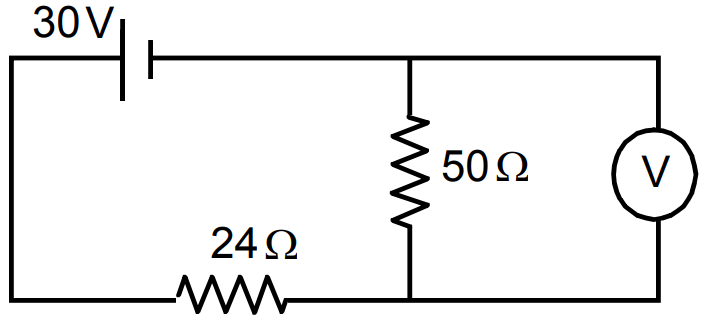
The voltmeter shown in the figure. reads 18V across the $50\Omega$ resistor. Find the resistance of the voltmeter.
A train, standing at the outer signal of a railway station blows a whistle of frequency $400Hz$ in still air.
  1. What is the frequency of the whistle for a platform observer when the train (a) approaches the platform with a speed of $10m s^{–1}$, (b) recedes from the platform with a speed of $10m s^{–1}$?
  2. What is the speed of sound in each case? The speed of sound in still air can be taken as $340m s^{–1}$.
Calculate the angular momentum and rotational kinetic energy of earth about its own axis. How long could this amount of energy supply one kilowatt power to each of the $3.5 \times 10^9$ persons on earth? (Mass of earth = $6.0 \times 1024kg$ and radius = $6.4 \times 10^{24}km)$.
Write the definition of angular momentum. Obtain the formula for the angular momentum of a rigid body rotating about a fixed axis. What is the unit of angular momentum?