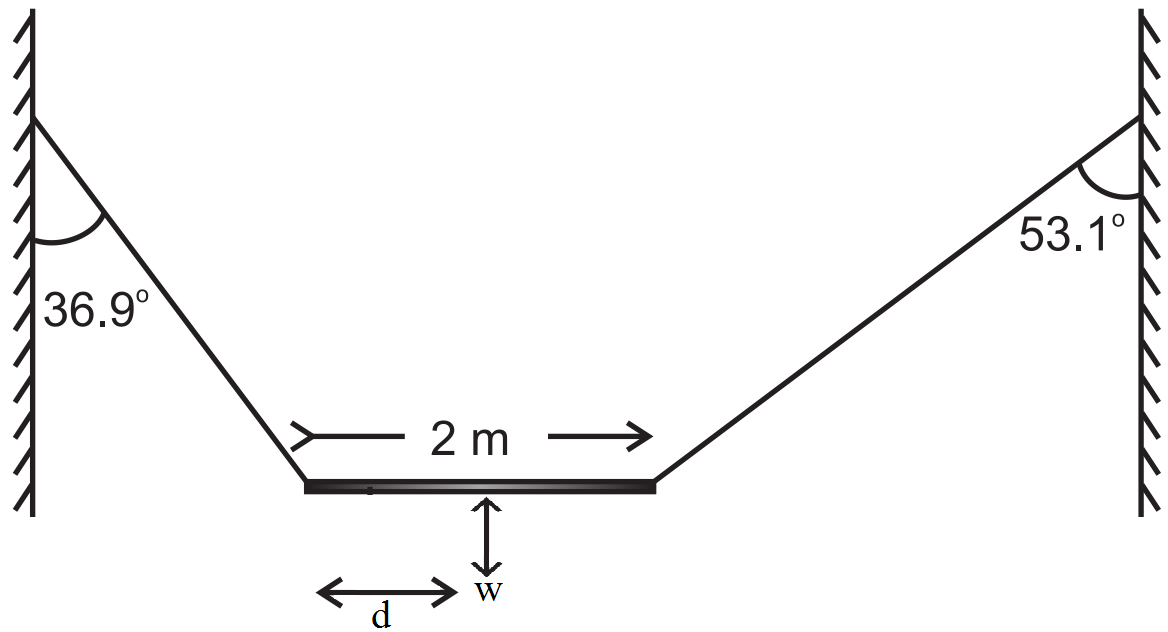
A non-uniform bar of weight W is suspended at rest by two strings of negligible weight as shown in. The angles made by the strings with the vertical are $36.9°$ and $53.1°$ respectively. The bar is $2m$ long. Calculate the distance d of the centre of gravity of the bar from its left end.
Exercise
Download our app for free and get started
The free body diagram of the bar is shown in the following figure:
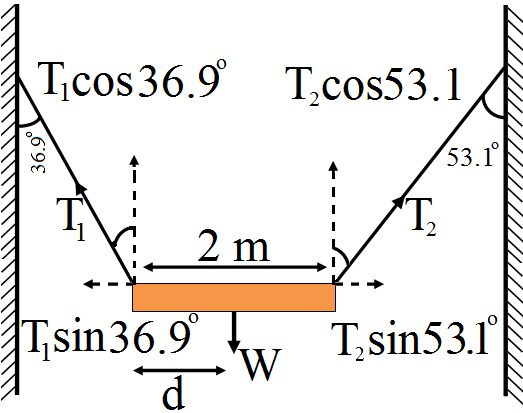
Length of the bar, $l = 2m T_1$ and $T_2$ are the tensions produced in the left and right strings respectively. At translational equilibrium, we have, $\text{T}_1\sin36.9^{\circ}=\text{T}_2\sin53.1$
$\frac{\text{T}_1}{\text{T}_2}=\frac{\sin53.1^{\circ}}{\sin36.9}$
$=\frac{0.800}{0.600}=\frac{4}{3}$
$\text{T}_1=\frac{4}{3}\text{T}_2$ For rotational equilibrium, on taking the torque about the centre of gravity, we have, $\text{T}_1\cos36.9\times\text{d}=\text{T}_2\cos53.1(2-\text{d})$
$\text{T}_1\times0.800\text{d}=\text{T}_20.600(2-\text{d})$
$\frac{4}{3}\times\text{T}_2\times0.800\text{d}=\text{T}_2\big[0.600\times2-0.600\text{d}\big]$
$1.067\text{d}+0.6\text{d}=1.2$
$\therefore\ \text{d}=\frac{1.2}{1.67}$
$=0.72\text{m}$ Hence, the C.G. (centre of gravity) of the given bar lies 0.72m from its left end.
Length of the bar, $l = 2m T_1$ and $T_2$ are the tensions produced in the left and right strings respectively. At translational equilibrium, we have, $\text{T}_1\sin36.9^{\circ}=\text{T}_2\sin53.1$
$\frac{\text{T}_1}{\text{T}_2}=\frac{\sin53.1^{\circ}}{\sin36.9}$
$=\frac{0.800}{0.600}=\frac{4}{3}$
$\text{T}_1=\frac{4}{3}\text{T}_2$ For rotational equilibrium, on taking the torque about the centre of gravity, we have, $\text{T}_1\cos36.9\times\text{d}=\text{T}_2\cos53.1(2-\text{d})$
$\text{T}_1\times0.800\text{d}=\text{T}_20.600(2-\text{d})$
$\frac{4}{3}\times\text{T}_2\times0.800\text{d}=\text{T}_2\big[0.600\times2-0.600\text{d}\big]$
$1.067\text{d}+0.6\text{d}=1.2$
$\therefore\ \text{d}=\frac{1.2}{1.67}$
$=0.72\text{m}$ Hence, the C.G. (centre of gravity) of the given bar lies 0.72m from its left end.

Download our appand get started for free
Experience the future of education. Simply download our apps or reach out to us for more information. Let's shape the future of learning together!No signup needed.*
Similar Questions
- 1Particles of masses $1g, 2g, 3g, ........, 100g$ are kept at the marks $1cm, 2cm, 3cm, ........, 100cm$ respectively on a metre scale. Find the moment of inertia of the system of particles about a perpendicular bisector of the metre scale.View Solution
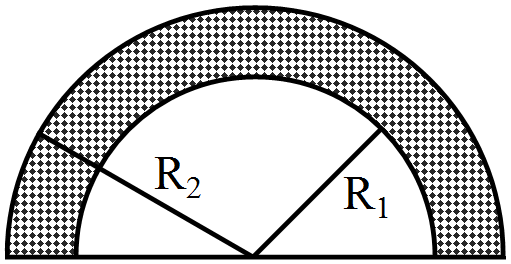
- 2Find the centre of mass of a uniform plate having semicircular inner and outer boundaries of radii $R_1$ and $R_2$.View Solution
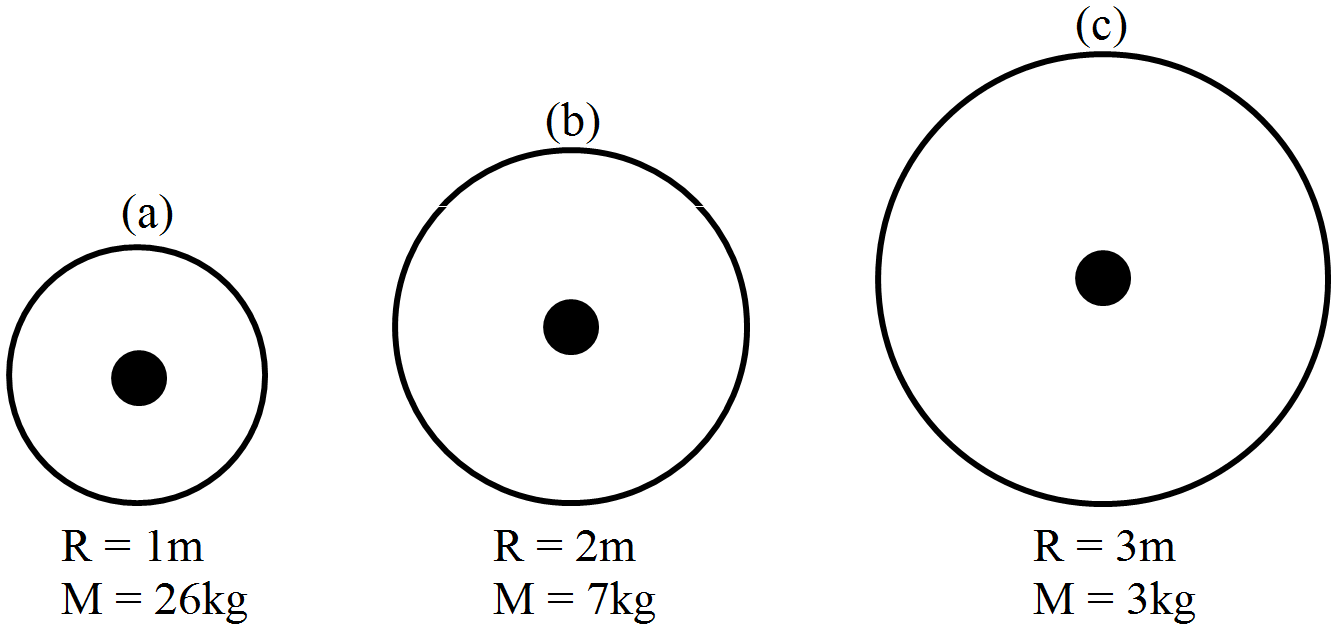
- 3View SolutionFigure shows three uniform discs, along with their radii R and masses M. Rank the discs according to their rotational inertia about their central axes, greatest first.
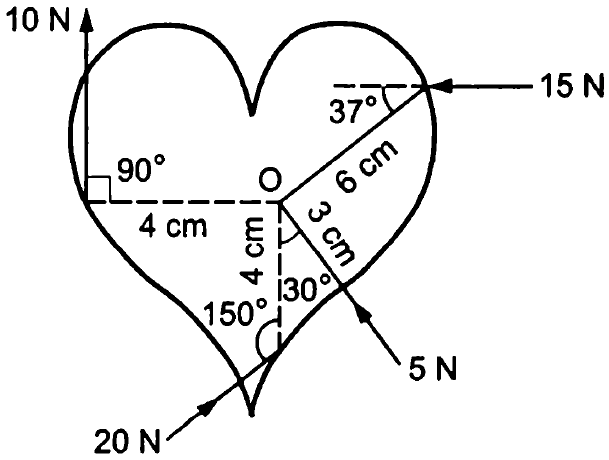
- 4View SolutionCalculate the total torque acting on the body shown in figure about the point O.
- 5View SolutionDefine radius of gyration and give the physical significance of moment of inertia.
- 6A cord of negligible mass is wound round the rim of a fly wheel of mass $20 \ kg$ and radius $20 \ cm$. A steady pull of $25 N$ is applied on the cord as shown in Fig. $6.31$. The flywheel is mounted on a horizontal axle with frictionless bearings.View Solution
$(a)$ Compute the angular acceleration of the wheel.
$(b)$ Find the work done by the pull, when $2m$ of the cord is unwound.
$(c)$ Find also the kinetic energy of the wheel at this point. Assume that the wheel starts from rest.
$(d)$ Compare answers to parts $(b)$ and $(c).$ - 7View SolutionFind the components along the x, y, z axes of the angular momentum l of a particle, whose position vector is r with components x, y, z and momentum is p with components px, py and pz. Show that if the particle moves only in the x-y plane the angular momentum has only a z-component.
- 8Establish the relation $\theta=\omega_0\text{t}+\frac{1}{2}\alpha\text{t}^2$ where the letters have their usual meanings.View Solution
- 9A uniform rod pivoted at its upper end hangs vertically. It is displaced through an angle of $60°$ and then released. Find the magnitude of the force acting on a particle of mass dm at the tip of the rod when the rod makes an angle of $37°$ with the vertical.View Solution
- 103 A man stands on a rotating platform, with his arms stretched horizontally holding a 5kg weight in each hand. The angular speed of the platform is 30 revolutions per minute. The man then brings his arms close to his body with the distance of each weight from the axis changing from 90cm to 20cm. The moment of inertia of the man together with the platform may be taken to be constant and equal to $7.6kgm^2$.View Solution
- What is his new angular speed? (Neglect friction).
- Is kinetic energy conserved in the process? If not, from where does the change come about?