Define wavefront of a travelling wave. Using Huygens principle, obtain the law of refraction at a plane interface when light passes from a denser to rarer medium.
CBSE 55-1-3 PAPER SET 2020
Download our app for free and get started
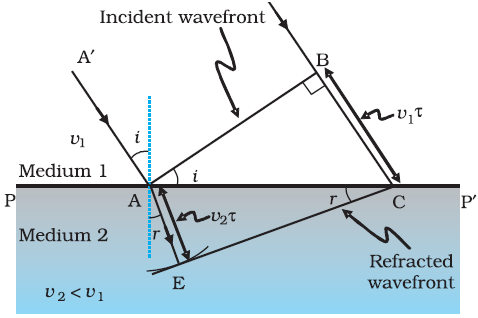
A plane wavefront $A B$ is incident in rarer medium at instant $t=0$ on interface $X Y$ separating it from a denser medium. When wavelet $A$ is on interface, $B$ is at a distance $B B$, from it. It takes $t$ time to cover the distance $B B_1=v_1 t$ $=$ to reach on interface $X Y$. Mean while, the wavelet from $A$ reaches to point $A_1$ covering a distance $A A_1=v_2 t$ in denser medium.
To locate $A_1$, draw a secondary wavelet with radius $A_1=v_2 t \&$ centre $A$. Draw tangent from $B$, into this sec. wavelet intersecting at $\mathrm{A}_1$.
$A_1 B_1$ is refracted wavefront at instant $t$.
$\mathrm{i}=$ angle of incidence,
$r=$ angle of refraction.
$\therefore\triangle\text{ABB}_1$
$\Rightarrow\sin\text{i}=\frac{\text{BB}_1}{\text{AB}_1}$
$\triangle\text{AA}_1\text{B}_1$
$\Rightarrow\sin\text{r}=\frac{\text{AA}_1}{\text{AB}_1}$
$\therefore\frac{\sin\text{i}}{\sin\text{r}}=\frac{\text{BB}_1}{\text{AA}_1}=\frac{\text{v}_1\text{t}}{\text{v}_2\text{t}}=\frac{\text{v}_1}{\text{v}_2}$
$\therefore\frac{\sin\text{i}}{\sin\text{r}}=\frac{\text{v}_1}{\text{v}_2}=\text{constant}$
Also, $\text{n}_1=\frac{\text{c}}{\text{v}_1}\text{n}_2=\frac{\text{c}}{\text{v}_2}$
$\frac{\text{n}_1}{\text{n}_2}=\frac{\text{v}_2}{\text{v}_1}$
$\Rightarrow\frac{\sin\text{i}}{\frac{\sin\text{r}}{}}=\frac{\text{n}_2}{\text{n}_1}=\text{constant}$
Which is Snell's law.

Download our appand get started for free
Experience the future of education. Simply download our apps or reach out to us for more information. Let's shape the future of learning together!No signup needed.*
Similar Questions
- 1View SolutionDistinguish between polarised and unpolarized light. Does the intensity of polarised light emitted by a Polaroid depend on its orientation? Explain briefly.
The vibrations in a beam of polarised light make an angle of 60° with the axis of the polaroid sheet. What percentage of light is transmitted through the sheet? - 2In a Young's double slit experiment $\lambda=500\text{nm},$ d = 1.0mm and D = 1.0m. Find the minimum distance from the central maximum for which the intensity is half of the maximum intensity.View Solution
- 3View SolutionWhen are two objects just resolved? Explain. How can the resolving power of a compound microscope be increased? Use relevant formula to support your answer.
- 4View SolutionState Brewster’s law.
The value of Brewster angle for a transparent medium is different for light of different colours. Give reason. - 5View SolutionA transparent paper (refractive index = 1.45) of thickness 0.02mm is pasted on one of the slits of a Young's double slit experiment which uses monochromatic light of wavelength 620nm. How many fringes will cross through the centre if the paper is removed?
- 6View SolutionState one feature by which the phenomenon of interference can be distinguished from that of diffraction.
A parallel beam of light of wavelength 600 nm is incident normally on a slit of width ‘a’. If the distance between the slit and the screen is 0.8 m and the distance of 2nd order maximum from the centre of the screen is 15 mm, calculate the width of the slit. - 7View SolutionCan two identical and independent sodium lamps act as coherent sources? Give reason for your answer.
- 8View SolutionAnswer the following question:
In a single slit diffraction experiment, the width of the slit is made double the original width. How does this affect the size and intensity of the central diffraction band? - 9View Solution
- When a wave is propagating from a rarer to a denser medium, which characteristic of the wave does not change and why?
- What is the ratio of the velocity of the wave in the two media of refractive indices $\mu_{1}$ and $\mu_{2}$?
- 10View SolutionIn a Young's double slit experiment, two narrow vertical slits placed 0.800mm apart are illuminated by the same source of yellow light of wavelength 589nm. How far are the adjacent bright bands in the interference pattern observed on a screen 2.00m away?