Question
Define
1. Scalar quantities.
2. Vector quantities. Give two differences between scalar and vector quantities.

Answer

(i) Scalar quantities: The physical quantities which are expressed in magnitude only are called scalar quantities.
For example: Mass, length, time, distance, density, energy etc.
(ii) Vector quantities: The physical quantities which are 'expressed in magnitude as well as direction are called vector quantities.
For example: Displacement, velocity, acceleration, momentum, force etc. Differences between scalar and vector quantities.
SCALARS:
1. Scalars are specified by one quantity only i.e. magnitude.
2. Scalars change by change in magnitude along.
3. Scalars are written or represented by ordinary letters.
4. Scalars are added by just algebraic addition or subtraction.
5. Mass, length, time, speed, etc. are some example of scalars.
VECTORS:
1. Vectors are specified by two quantities (i) magnitude and (ii) direction.
2. Vectors change when there is change in either magnitude or direction or both.
3. Vectors are written (shown) in bold face letters or letters having arrows heads on them.
4. Vectors are added or subtracted by using triangle law, parallelogram law or polygon law.
5. Displacement, velocity acceleration are some examples of vectors.
Need a full question paper?

Generate a complete, print-ready paper with questions like this in minutes — across 16+ boards, with answer keys.

Start Generating Free

Similar questions

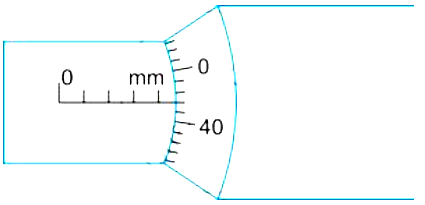
Fig., below shows the reading obtained while measuring the diameter of a wire with a screw gauge. The screw advances by 1 division on the main scale when circular head is rotated once.

Find:
(i) Pitch of the screw gauge,
(ii) Least count of the screw gauge and
(iii) The diameter of the wire.
Describe an experiment to demonstrate that air exerts pressure.
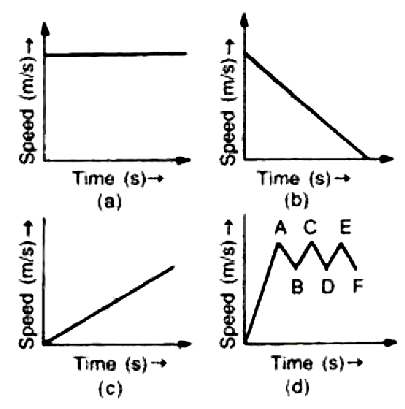
Given on th e side are a few speed - time graphs for various objects moving along a stra ight line. Refer below figure. (a), (b), (c) and (d).

Which of these graphs represent
(a) Uni form motion
(b) Motion with speed increasing
(c) Motion with speed decreasing and
(d) Motion with speed oscillating.?
State four differences between the sound wave and the light wave.
Derive th e equation of motion.
$
S=u t+\frac{1}{2} at ^2
$
Where the symbols have their usual meanings
A space craft flying in a straight course with velocity of $75 km s ^{-1}$ fires its rocket motors for 6.0 s . At the end of this time its speed is $120 km s ^{-1}$ in the same direction. Find (i) The space craft's average acceleration while the motors were firing (ii) The distance travelled by the space craft in the first 10 s after the rocket motors were started, the motors being in action for only 6 s .
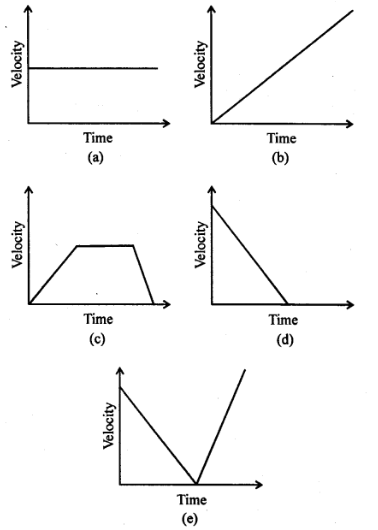
Can you suggest real life examples about the motion of a body from the following velocity - time graphs?
Image
A balloon of volume $1000 m^3$ is filled with a mixture of hydrogen and helium of density $0.32 kgm ^{-3}$. If the fabric of balloon weighs 40 kgf and the density of cold air is $1.32 kgm ^{-3}$, find the tension in the tope, which is holding the balloon to ground.
What do you understand by the following terms as applied to micrometre screw gauge?
1. Sleeve cylinder
2. Sleeve scale
3. Thimble
4. Thimble scale
5. Base line.
Describe various methods of magnetising a piece of iron.