Question
Given on th e side are a few speed - time graphs for various objects moving along a stra ight line. Refer below figure. (a), (b), (c) and (d).
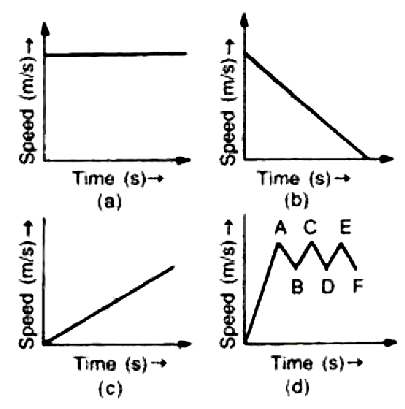
Which of these graphs represent
(a) Uni form motion
(b) Motion with speed increasing
(c) Motion with speed decreasing and
(d) Motion with speed oscillating.?
Answer


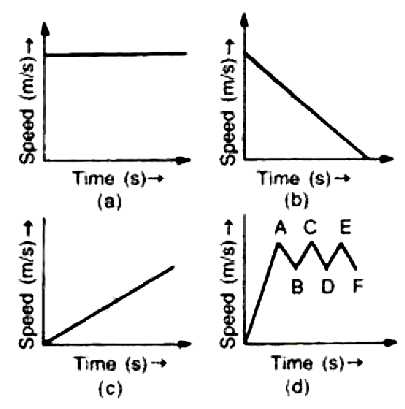
(i) In speed time graph uniform motion is given by a straight line parallel to x axis so figure (a) denotes the uniform motion.
(ii) In speed time graph motion with increasing speed is shown by straight line with positive slope so figure (c) denotes the motion with speed increasing.
(iii) In speed time graph motion with decreasing speed is shown by straight line with negative slope so figure {b) denotes the motion with speed decreasing.
(iv) In speed time graph motion with oscillating speed is shown by zigzag line so figure {d) denotes the motion with speed oscillating.

Need a full question paper?

Generate a complete, print-ready paper with questions like this in minutes — across 16+ boards, with answer keys.

Start Generating Free

Similar questions

A piece of stone of mass 15.1 g is first immersed in a liquid and it weighs 10.9 gf. Then on immersing the piece of stone in water, it weighs 9.7 gf. Calculate:
  1. The weight of the piece of stone in air,
  2. The volume of the piece of stone,
  3. The relative density of stone,
  4. The relative density of the liquid.
What is meant by zero error of a vernier caliper? How is it determined? Draw neat diagrams to explain it. How is it taken into account to get the correct measurement?
Different bars are brought near each pole of a compass needle. Complete the following table:
Nature of bar Action on the compass needle
North pole South pole
(i) Glass No action __________
(ii) _________ Attracted Attracted
(iii) North pole of a bar magnet __________ ___________
(iv) The south pole of a bar magnet __________ repulsion
What is a barometer? How is a simple barometer constructed?
Name an instrument based on this principle. State two uses of the instrument that you describe.
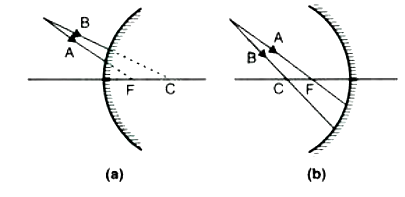
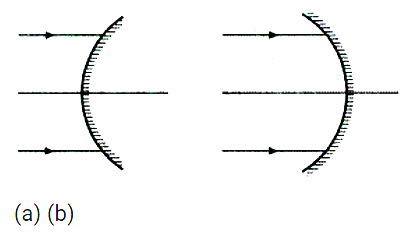
In each case (a) and (b), draw reflected rays for the given incident rays and mark focus by the symbol F.
Complete the following diagrams shown in Fig. by drawing the reflected ray for each of the incident ray A and B.
The distance-time values for an object moving along straight line are given below:
Time (s) Distance (m)
$0$ $0$
$1$ $1$
$2$ $8$
$3$ $27$
How does the time period (T) of a simple pendulum depend on its length (l)? Draw a graph showing the variation of $T^2$ with l. How will you use this graph to determine the value of g (acceleration due to gravity)?
What do you understand by the term acceleration due to gravity? What is its value in C.G.S. and S.I. systems?