Question
Describe an experiment to demonstrate that air exerts pressure.

Answer

Air exerts pressure and this can be demonstrated by this experiment.
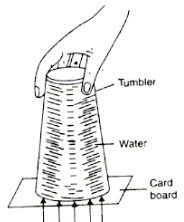
Image
Take a glass tumbler. Fill it to the brim with water, with water overflowing the rim of the tumbler. Cover it with a piece of cardboard. Press the cardboard so that it touches the rim of the tumbler at all points. This will ensure that no air is left inside.
With the hand on the cardboard, invert the tumbler gently and remove the hand. Both cardboard and water shall not fall. This shows that air exerts pressure on the lower surface of the cardboard in the upward as shown in the figure. The upward thrust acting on the cardboard due to air pressure supports the combined weight of cardboard and water in the tumbler.
So, this shows that air exerts pressure.
Need a full question paper?

Generate a complete, print-ready paper with questions like this in minutes — across 16+ boards, with answer keys.

Start Generating Free

Similar questions


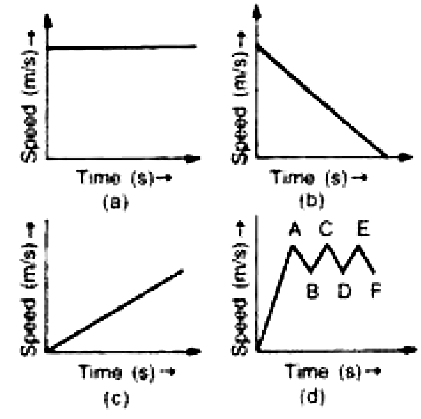
(i) In speed time graph uniform motion is given by a straight line parallel to x axis so figure (a) denotes the uniform motion.
(ii) In speed time graph motion with increasing speed is shown by straight line with positive slope so figure (c) denotes the motion with speed increasing.
(iii) In speed time graph motion with decreasing speed is shown by straight line with negative slope so figure (b) denotes the motion with speed decreasing.
(iv) In speed time graph motion with oscillating speed is shown by zigzag line so figure {d) denotes the motion with speed oscillating.
Define the least count of vernier callipers. How do you determine it?
The main scale of a vernier callipers is calibrated in mm and $19$ divisions of main scale are equal in length to $20$ divisions of the vernier scale. In measuring the diameter of a cylinder by this instrument, the main scale reads $35$ divisions and $4$th division of vernier scale coincides with a main scale division. Find
(i) Least count and (ii) Radius of a cylinder.
(a) What should be the minimum size of a plane mirror, so that a person 182 cm high can see himself completely?
(b) A boy stands 4 m away from plane mirror. If the boy moves $1 / 2 m$ towards mirror, what is now the distance between the boy and his image? Give a reason for your answer.
What do you understand by the term magnetic declination?
Define the following terms in relation to concave mirror.
1. Pole
2. Centre of curvature
3. Principal axis
4. Principal focus
5. Focal length
6. Radius of curvature
7. Aperture
The following table gives the displacement of a car at different instants of time.
Time (s) 0 1 2 3 4
Displacement (m) 0 5 10 15 20
(a) Draw the displacement-time sketch and find the average velocity of the car. (b) What will be the displacement of the car at (i) 2.5 s and (ii) 4.5 s?
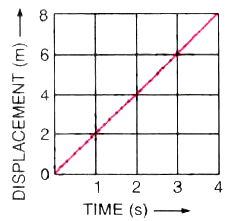
Figure (a) shows the displacement-time graph for the motion of a body. Use it to calculate the velocity of the body at t = 1 s, 2 s and 3 s, and then draw the velocity-time graph in Figure (b) for it.
(a) (b)
By giving one example each, define
1. variable velocity.
2. average velocity.
3. uniform velocity.
State the laws of reflection and describe an experiment to verify them .