Question
  1. Derive the expression for the torque acting on a current carrying loop placed in a magnetic field.
  2. Explain the significance of a radial magnetic field when a current carrying coil is kept in it.
Answer

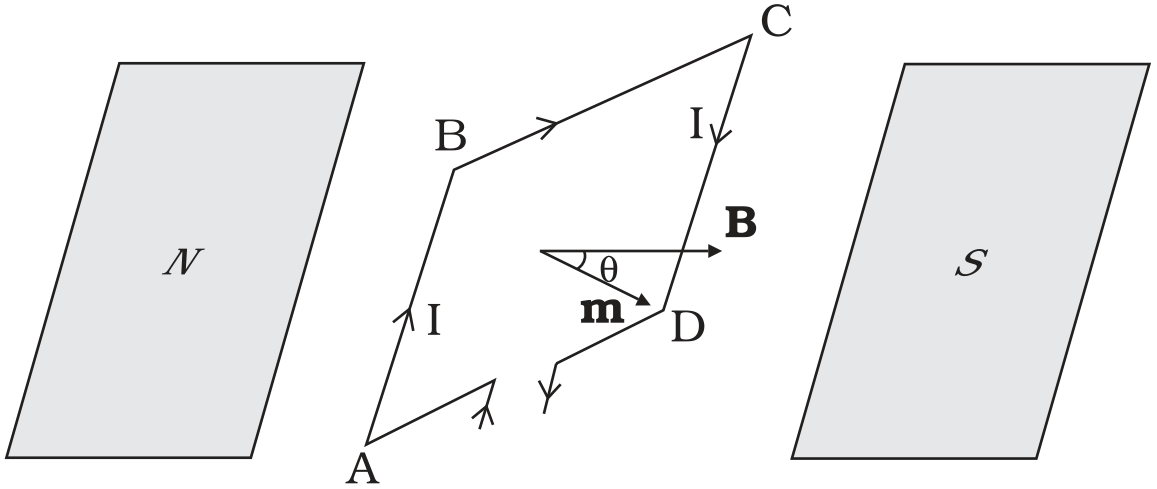
  1. The plane of the loop is not along the magnetic field but makes an angle with it.

Let the dimension of the rectangular coil $\text{ABCD},$ be $AB \times BC = a \times b$
The angle between the field and the normal is $\theta $.
Forces on $BC$ and $DA$ are equal and opposite and they cancel each other as they are collinear.
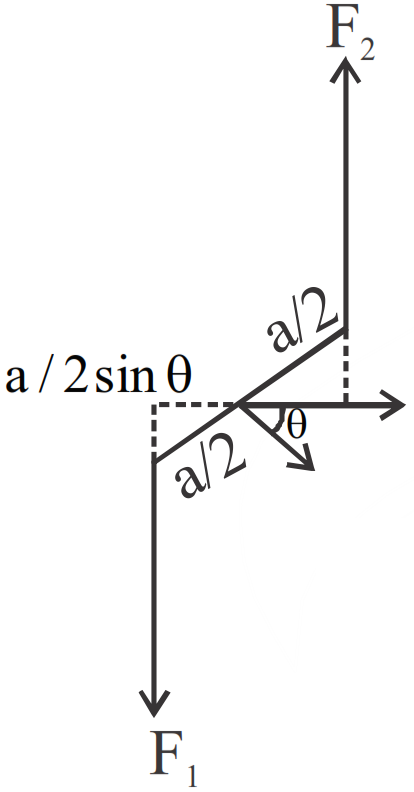
Force on $AB$ is $F_1$ and force on $CD$ is $F_2.$
$F_1 = F_2 = IbB$
The magnitude of the torque on the loop as in the figure:

$\therefore\tau=\text{F}_1\frac{\text{a}}{2}\sin\theta+\text{F}_2\frac{\text{a}}{2}\sin\theta$
$=\text{lab}\text{ B}\sin\theta$
$\tau=\text{lab}\sin\theta$
If there are $'n\ '$ such turns the torque will be $\text{n}\text{ lab}\sin\theta$
The magnetic moment of the current, $m = lA$
$\therefore\overrightarrow{\tau}=\overrightarrow{\text{m}}\times\overrightarrow{\text{B}}$
  1. The uniform radial magnetic field keeps the plane of the coil always parallel to the direction of the magnetic field. that is, the angle between the plane of the coil and the magnetic field is zero in all the orientation of the coil.

Need a full question paper?

Generate a complete, print-ready paper with questions like this in minutes — across 16+ boards, with answer keys.
Start Generating Free

Similar questions

Write relation between $B , H , I , \chi$ and $\mu$.
Using Gauss’s law in electrostatics, deduce an expression for electric field intensity due to a uniformly charged infinite plane sheet. If another identical sheet is placed parallel to it, show that there is no electric field in the region between the two sheets.
  1. Write the basic nuclear process involved in the emission of$\beta^{+}$ in a symbolic form, by a radioactive nuclear.
  2. in the reactions given below:
  1. $^{11}_{6}\text{C}\rightarrow ^{\text{z}}_{\text{y}}\text{B} + \text{x} + \text{v}$
  2. $^{12}_{6}\text{C}\rightarrow ^{12}_{6}\text{C}\rightarrow^{20}_{\text{a}}\text{Ne} + ^{c}_{b}\text{He}$
Find the values of x,y, and z and a,b and c.
How is the mutual inductance of a pair of coils affected when:
  1. Separation between the coils is increased?
  2. The number of turns of each coil is increased?
  3. A thin iron sheet is placed between the two coils, other factors remaining the same? Explain your answer in each case.
The diameter of the sun is $1.4 \times 10^9m$ and its distance from the earth is $1.5 \times 10^{11}m$. Find the radius of the image of the sun formed by a lens of focal length $20\ cm.$
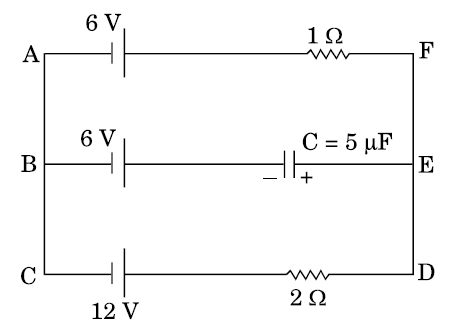
In the given circuit, with steady current, calculate the potential difference across the capacitor and the charge stored in it.
A violin player riding on a slow train plays a $440\ Hz$ note. Another violin player standing near the track plays the same note. When the two are close by and the train approaches the person on the ground, he hears $4.0$ beats per second. The speed of sound in air $= 340m/s.$
  1. Calculate the speed of the train.
  2. What beat frequency is heard by the player in the train?
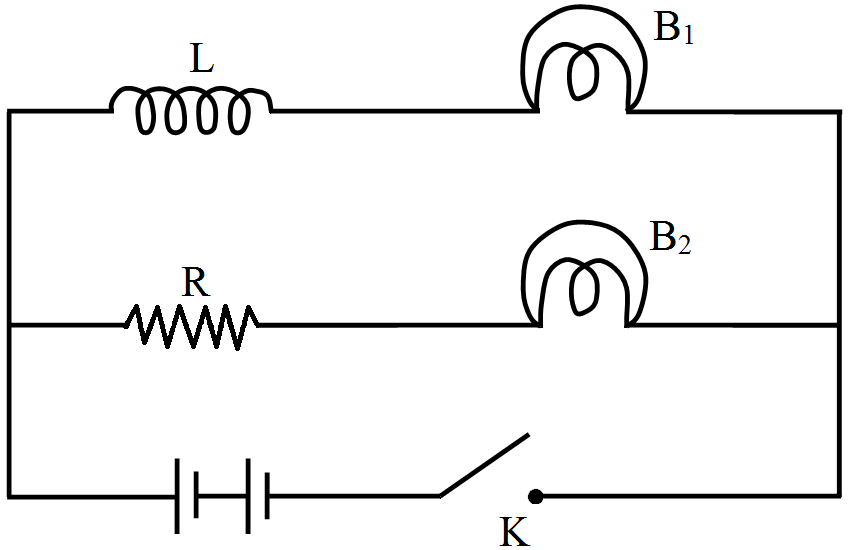
In the given circuit, the value of resistance effect of the coil $L$ is exactly equal to the resistance $R.$ Bulbs $B_1$ and $B_2$ are exactly identical. Answer the following questions based on above information:
  1. Which one of the two bulbs lights up earlier, when key $K$ is closed and why?
  2. What will be the comparative brightness of the two bulbs after sometime if the key $K$ is kept closed and why?
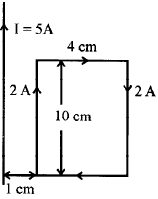
A rectangular loop of wire of size 4cm × 10cm carries a steady current of 2A. A straight long wire carrying 5A current is kept near the loop as shown. If the loop and  the wire are coplanar, find
  1. The torque acting on the loop and.
  2. The magnitude and direction of the force on the loop due to the current carrying wire.
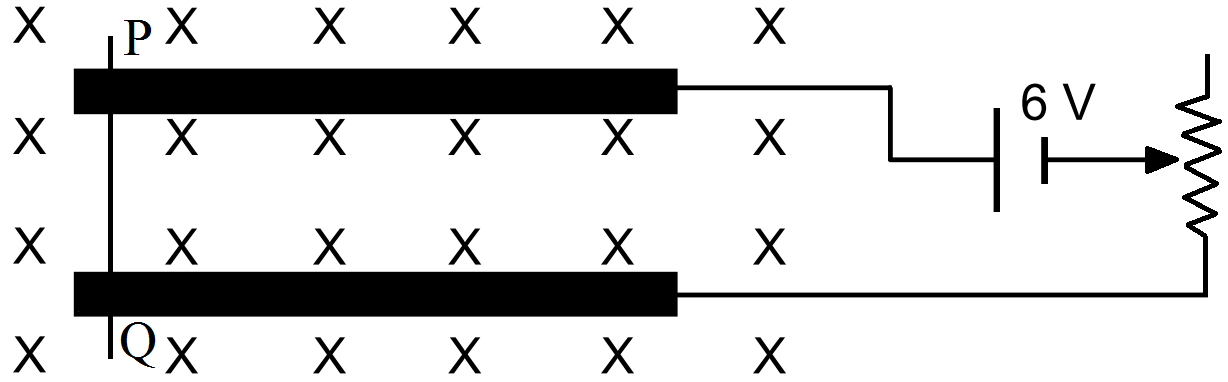
A metal wire PQ of mass 10g lies at rest on two horizontal metal rails separated by 4.90cm A vertically-downward magnetic field of magnitude 0.800T exists in the space. The resistance of the circuit is slowly decreased and it is found that when the resistance goes below 20.0Ω, the wire PQ starts sliding on the rails. Find the coefficient of friction.