Question
Derive the position$-$velocity relation for uniformly accelerated motion from $v-t$ graph. $OR$
  1. Acceleration is defined as the rate of change of velocity. Suppose we call the rate of change of acceleration as $\text{SLAP}$, then what is the unit of $\text{SLAP}$?
  2. A body travels a distance $s_1$ with velocity $v_1$ and distance $s_2$ with velocity $v_2$ in the same direction. Calculate the average velocity of the body.
Answer

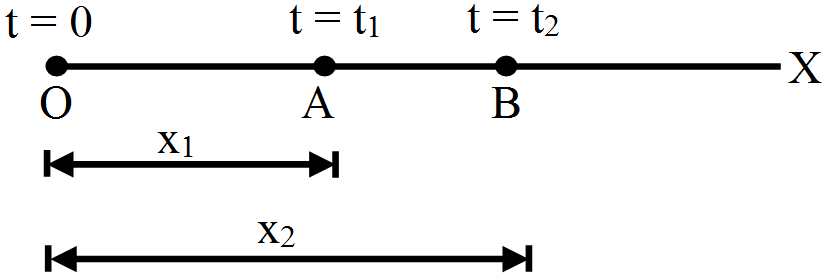
Position$-$velocity relation: Consider an object, moving with a uniform acceleration a along a straight line $OX$, with origin at $0$.

Let the object reach at points $A$ and $B$ at instants $t_1$ and $t_2$.
Let $x_1$ and $x_2$ be the displacements of the objects at time $t_1$ and $t_2$ respectively and $v_1$ and $v_2$ be the velocities of the object at positions $A$ and $B$ respectively.
Acceleration of the object $=\frac{\text{Change in velocity}}{\text{time taken}}$
$\text{a}=\frac{\text{v}_2-\text{v}_1}{\text{t}_2-\text{t}_1}$
$\Rightarrow \text{v}_2-\text{v}_1=\text{a}(\text{t}_2-\text{t}_1)$
$\Rightarrow\text{t}_2-\text{t}_1=\frac{(\text{v}_2-\text{v}_1)}{\text{a}}\ \dots(\text{i})$
From position$-$time relation,
we have $\text{x}_2-\text{x}_1=\Big(\frac{\text{v}_1-\text{v}_2}{2}\Big)(\text{t}_2-\text{t}_2)\ \dots(\text{ii})$
Substituting the value of $(t_2 - t_1)$ in the above equation $(ii)$,
we get $\text{x}_2-\text{x}_1=\Big(\frac{\text{v}_2+\text{v}_1}{2}\Big)\Big(\frac{\text{v}_2-\text{v}_1}{\text{a}}\Big)=\frac{\text{v}^2_2-\text{v}^2_1}{2\text{a}}$
$\text{v}^2_2-\text{v}^2_1=2\text{a}(\text{x}_2-\text{x}_1)\ \dots(\text{iii})$
If $u$ and $v$ are the velocities of an object at position $x_0$ and $x$ respectively,
then using $v_1 = u, v_2= v, x_1 = x_0$ and $x_2 = x$ in $(iii)$,
we get $\text{v}^2-\text{u}^2=2\text{a}(\text{x}_0-\text{x})\ \dots(\text{iv})$ If $\text{x}_0-\text{x}=\text{s},$
then $\text{v}^2-\text{u}^2=2\text{as}$
The above equation is the required position velocity relation.Alternate answer
  1. Given $\text{SLAP} =\frac{\text{Change in acceleration}}{\text{time taken}}$
Unit of $\text{SLAP} =\frac{\text{ms}^{-2}}{\text{s}}=\text{ms}^{-3}$
  1. Given: distanve $-\text{s}_1,\text{s}_2$
Velocities $-\text{v}_1,\text{v}_2$
$\because \text{v}=\frac{\text{s}}{\text{t}}$
$\therefore \text{t}_1=\frac{\text{s}_1}{\text{v}_1},\text{t}_2=\frac{\text{s}_2}{\text{v}_2}$
Total time, t $=\text{t}_1+\text{t}_2=\frac{\text{s}_1}{\text{v}_1}+\frac{\text{s}_2}{\text{v}_2}$
Total distance, $\text{s}=\text{s}_1+\text{s}_2$
$\therefore$ Average velocity $(\text{v}_\text{avg})=\frac{\text{s}}{\text{t}}$
$\Rightarrow \text{v}_\text{avg}=\frac{\text{s}_1+\text{s}_2}{\frac{\text{s}_1}{\text{v}_1}+\frac{\text{s}_2}{\text{v}_2}}$

Need a full question paper?

Generate a complete, print-ready paper with questions like this in minutes — across 16+ boards, with answer keys.

Start Generating Free

Similar questions

Find the total energy of the particle executing S.H.M. and show graphically the variation of P.E. and K.E. with time in S.H.M. What is the frequency of these energies with respect to the frequency of the particle executing S.H.M?
Define elastic and inelastic collisions. Write their basic characteristics. A bullet is fired into a block of wood. If it gets totally embedded in it and the system moves together as one entity, then state what happens to the initial kinetic energy and linear momentum of the bullet?
The container shown in Fig. has two chambers, separated by a partition, of volumes $\mathrm{V}_1=2.0$ litre and $\mathrm{V}_2=3.0$ litre. The chambers contain $\mu_1=4.0$ and $\mu_2=5.0$ moles of a gas at pressures $\mathrm{p}_1=1.00 \mathrm{~atm}$ and $\mathrm{p}_2=2.00 \mathrm{~atm}$. Calculate the pressure after the partition is removed and the mixture attains equilibrium.
Mercury has an angle of contact equal to $140^{\circ}$ with soda lime glass. A narrow tube of radius $1.00$ mm made of this glass is dipped in a trough containing mercury. By what amount does the mercury dip down in the tube relative to the liquid surface outside? Surface tension of mercury at the temperature of the experiment is $0.465 \mathrm{~N} \mathrm{~m}^{-1}$. Density of mercury $=13.6 \times 10^3 \mathrm{~kg} \mathrm{~m}^{-3}$.
A neutron star has a density equal to that of the nuclear matter. Assuming the star to be spherical, find the radius of a neutron star whose mass is $4.0 \times 10^{30} \mathrm{~kg}$ (twice the mass of the sun).
Find the centre of mass of a uniform plate having semicircular inner and outer boundaries of radii $R_1$ and $R_2$.
A mica strip and a polysterene strip are fitted on the two slits of a double slit apparatus. The thickness of the strips is $0.50mm$ and the separation between the slits is $0.12cm$. The refractive index of mica and polysterene are $1.58$ and $1.55$ respectively for the light of wavelength $590nm$ which is used in the experiment. The interference is observed on a screen a distance one meter away.
  1. What would be the fringe-width?
  2. At what distance from the centre will the first maximum be located?
Three particles of masses 1.0kg, 2.0kg and 3.0kg are placed at the corners A, B and C respectively of an equilateral triangle ABC of edge 1m. Locate the centre of mass of the system.
A calorimeter contains $50 g$ of water at $50^{\circ} \mathrm{C}$. The temperature falls to $45^{\circ} \mathrm{C}$ in 10 minutes. When the calorimeter contains $100 g$ of water -at $50^{\circ} 0$, it takes $18$ minutes for the temperature to become $45^{\circ} \mathrm{C}$. Find the water equivalent of the calorimeter.
Consider the situation shown in figure. The system is released from rest and the block of mass $1.0kg$ is found to have a speed $0.3m/s$ after it has descended through a distance of $1m$. Find the coefficient of kinetic friction between the block and the table.