Question
Describe the activity that shows that a current-carrying conductor experiences a force perpendicular to its length and the external magnetic field. How does Fleming’s left-hand rule help us to find the direction of the force acting on the current carrying conductor?

Answer

The activity is as follows:Take a small aluminium rod AB. Using two connecting wires suspend it horizontally from a stand, as shown in figure given below.
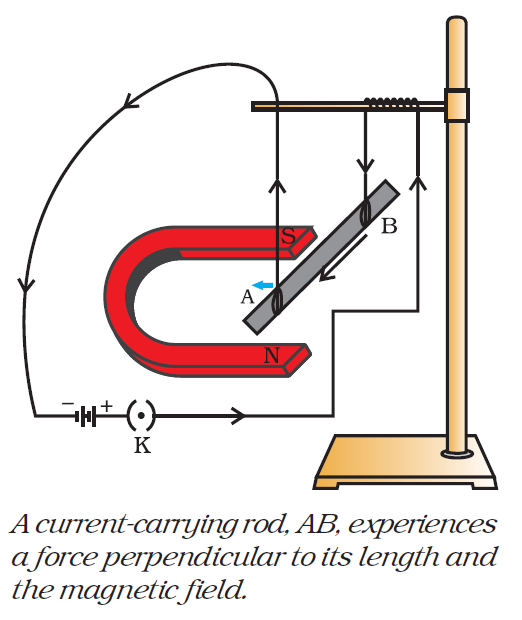
Place a strong horse-shoe magnet in such a way that the rod lies between the two poles with the magnetic field directed upwards. For this put the North Pole of the magnet vertically below and South Pole vertically above the aluminium rod.
Connect the aluminium rod in series with a battery, a key and a rheostat.
Now pass a current through the aluminium rod from end B to end A.
It is observed that the rod is displaced towards the left and rod gets displaced.
Reverse the direction of current flowing through the rod and observe the direction of its displacement. It is now towards the right.

Need a full question paper?

Generate a complete, print-ready paper with questions like this in minutes — across 16+ boards, with answer keys.

Start Generating Free

Similar questions

What do you mean by multiple covalent bonding? Explain with the help of examples.
Gas A, which is the major cause of global warming, combines with hydrogen oxide B in nature in the presence of an environmental factor C and a green material D to form a six carbon organic compounds E and a gas F. The gas F is necessary for breathing.
  1. What is gas A?
  2. What is the common name of B?
  3. What do you think could be C?
  4. What is material D? Where is it found?
  5. Name the organic compound E.
  6. What is gas F? Name the natural process during which it is released.
Explain the mechanism of photosynthesis.
  1. Distinguish between ionic and covalent compounds under the following properties:
  1. Strength of forces between constituent elements’.
  2. Solubility of compounds in water.
  3. Electrical conduction in substances.
You are given a hammer, a battery, a bulb, wires and a switch.
  1. How could you use them to distinguish between samples of metals and non-metals?
  2. Assess the usefulness of these tests in distinguishing between metals and non-metals.
Metal A burns in air, on heating, to form an oxide $A _2 O _3$ whereas another metal B burns in air only on strong heating to form an oxide BO . The two oxides $A _2 O _3$ and BO can react with hydrochloric acid as well as sodium hydroxide solution to form the corresponding salts and water.
a. What is the nature of oxide $A _2 O _3$ ?
b. What is the nature of oxide $B O$ ?
c. Name one metal like A.
d. Name one metal like B.
What can you as an individual do to reduce your consumption of the various natural resources?
An object is placed at a distance of 60cm from a concave lens of focal length 30cm.
  1. Use lens formula to find the distance of the image from the lens.
  2. List four characteristics of the image (nature, position, size, erect/ inverted) formed by the lens in this case.
  3. Draw ray diagram to justify your answer of part (ii).
When an object made of metal A is kept in air for a considerable time, it loses its shine and becomes almost black due to the formation of a layer of substance B. When an object made of another metal C is kept in damp air for a considerable time, it gets covered with a green layer of substance D. Metal A is the best conductor of electricity whereas metal C is the next best conductor of electricity.
  1. What is metal A?
  2. What is metal C?
  3. Name the substance B.
  4. Name the substance D.
  5. What type of chemical can be used to remove the green layer from metal C and clean it? Why?
X is a wild animal which eats only the flesh of other animals whereas Y is a domestic animal which feeds mainly on green grass.
  1. What are animals like X known as?
  2. What are animals Y known as?
  3. Which animal, X or Y, has a longer small intestine? Why?
  4. Name one animal which is like X.
  5. Name one animal which is like Y.