Describe with the help of a ray diagram the nature, size and position of the image formed when an object is placed in front of a convex lens between focus and optical centre. State three characteristics of the image formed.
Download our app for free and get started
In the diagram, the object is placed in front of a convex lens between focus and optical centre. The image is formed on the same side as the object as shown below.
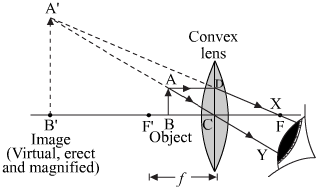
Characteristics of image formed:
Characteristics of image formed:
- Image is virtual and erect.
- Image is larger than the object Image is formed behind the object.

Download our appand get started for free
Experience the future of education. Simply download our apps or reach out to us for more information. Let's shape the future of learning together!No signup needed.*
Similar Questions
- 1View SolutionThe diverging lens in part (a) is replaced by a converging lens also of focal length 100mm. The object remains in the same position and an image is formed by the converging lens. Compare two properties of this image with those of the image formed by the diverging lens in part (a).
- 2View SolutionA lens of focal length 20cm is used to produce a ten times magnified image of a film slide on a screen. How far must the slide be placed from the lens ?
- 3View SolutionDraw the ray diagram and also state the position, the relative size and the nature of image formed by a concave mirror when the object is placed at the centre of curvature of the mirror.
- 4View SolutionDraw ray-diagrams to show the formation of images when the object is placed in front of a concave mirror (converging mirror):
- Between its pole and focus.
- Between its centre of curvature and focus Describe the nature, size and position of the image formed in each case.
- 5View SolutionAn object of height 6 cm is placed perpendicular to the principal axis of a concave lens of focal length 5 cm. use lens formula to determine the position, size and nature of the image if the distance of the object from the lens is 10 cm.
- 6View SolutionAt what distance from a concave mirror of focal length 10cm should an object 2cm long be placed in order to get an erect image 6cm tall?
- 7View SolutionA man stands 10m in front of a large plane mirror. How far must the walk before he is 5m away from his image?
- 8View SolutionDraw labelled ray diagrams to show the formation of images in cases (i) and (ii)above (The diagrams may not be according to scale).
- 9View SolutionA shop security mirror 5.0m from certain items displayed in the shop produces one-tenth magnification.
- What is the type of mirror?
- What is the radius of curvature of the mirror?
- 10View SolutionA spherical mirror produces an image of magnification -1.0 on a screen placed at a distance of 30 cm from the pole of the mirror.
- Write the type of mirror in this case.
- What is the focal length of the mirror?
- What is the nature of the image formed?
- Draw the ray diagram to show the image formation in this case.