Differentiate between full employment and underemployment equilibrium.
Download our app for free and get started
|
S.
No.
|
Full Employment Equilibrium
|
Basis
|
Underemployment Equilibrium
|
|
1.
|
Full employment equilibrium refers to the situation where aggregate demand is equal to aggregate supply, and all those who are able to work and willing to work (at the existing wage rate) are getting work.
|
Meaning
|
Underemployment equilibrium refers to the situation where AD is equal to AS, but all those who are able to work and willing to work (at the existing wage rate) are not getting work.
|
|
2.
|
Full employment equilibrium is a stable equilibrium and real output| reaches at its maximum point.
|
Stable/ Untable
|
Underemployment equilibrium is not a stable equilibrium (unstable equilibrium) and real output does not reach to its maximum.
|
|
3.
|
Departure from full employment equilibrium may cause inflationary Igap or deflationary gap.
|
Departure
|
Departure from underemployment equilibrium does not cause inflationary or deflationary gap.
|

Download our appand get started for free
Experience the future of education. Simply download our apps or reach out to us for more information. Let's shape the future of learning together!No signup needed.*
Similar Questions
- 1View SolutionWhat is APC? How is it calculated?
- 2View SolutionWhat is investment multiplier? Explain its working using a suitable numerical example.
- 3View SolutionAn economy is in equilibrium. Find 'autonomous consumption' from the following:
National Income = 1,000 Marginal Propensity to consume = 0.8 investment expenditure = 100 - 4View SolutionWhat do you understand by 'parametric shift of a line'? How does a line shift when its:
- Slope decreases,
- Its intercept decreases?
- 5View SolutionThe savings function of an economy is S = -200 + 0.25Y. The economy is in equilibrium when income is equal to ₹ 2,000.
Calculate:- Investment expenditure at equilibrium level of income.
- Autonomous consumption.
- 6View SolutionExplain the determination of equilibrium level of income using AD = AS approach.
OR
Explain with the help of a diagram, how aggregate demand and aggregate supply determine the equilibrium level of income. - 7View SolutionWhat are the reasons or causes for deficient demand?
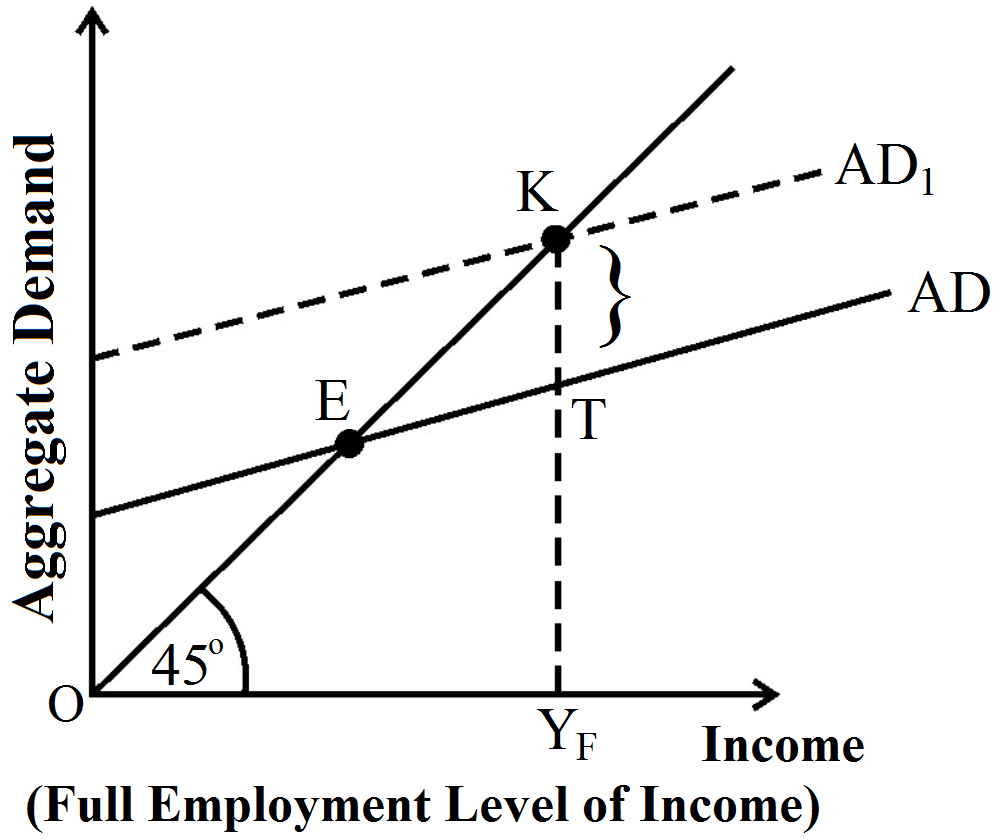
- 8View SolutionIn the given figure, what does the gap ‘KT’ represent? State any two fiscal measures to correct the situation.
- 9View SolutionDistinguish between average propensity to consume and average propensity to save. What is the relation between the two?
- 10View SolutionAn economy is in equilibrium. Calculate the Investment Expenditure from the following:
National Income = 800
Marginal Propensity to Save = 0·3
Autonomous Consumption = 100