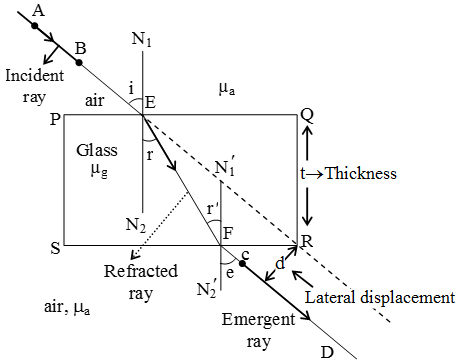
Does the incident and emergent ray coincide in the process of refraction through glass slab? Give reason.
Download our app for free and get started
NO, the incident ray and emergent ray does not coincide in a glass slab after refraction because in refraction, the incident ray is falling on the slab and the emergent ray will parallel to each other.

Download our appand get started for free
Experience the future of education. Simply download our apps or reach out to us for more information. Let's shape the future of learning together!No signup needed.*
Similar Questions
- 1View SolutionA doctor has prescribed a corrective lens of power +1.5 D. Find the focal length of the lens. Is the prescribed lens diverging or converging?
- 2View SolutionDraw a ray diagram to show the formation of a virtual magnified image of an object by a convex lens. In your diagram, the position of object and image with respect to the principal focus should be shown clearly.
- 3View SolutionRefractive indices of four media A, B, C and D are given below:
In which of these four media is the speed of light:MediumRefractive indexABCD1.331.441.521.65- Maximum, and
- Minimum?
- 4View SolutionDraw ray diagrams showing the image formation by a convex lens when an object is placed:Between focus and twice the focal length of the lens.
- 5View SolutionWhen an object is placed at a distance of 36cm from a convex lens, an image of the same size as the object is formed. What will be the nature of image formed when the object is placed at a distance of:
- 10cm from the lens?
- 20cm from the lens?
- 6View SolutionA wall reflects light and a mirror also reflects light. What difference is there in the way they reflect light?
- 7View SolutionThe linear magnification produced by a spherical mirror is +3. Analyse this value and state the (i) type of mirror and (ii) position of the object with respect to the pole of the mirror. Draw ray diagram to show the formation of image in this case.
- 8View SolutionName the two types of spherical mirrors. What type of mirror is represented by the:
- Back side of a shining steel spoon?
- Front side of a shining steel spoon?
- 9View SolutionA lens is cut into two equal halves: Along the principal axis.
What will be the focallength of each half? - 10View SolutionWhat is the minimum number of rays required for locating the image formed by a concave mirror for an object. Draw a ray diagram to show the formation of a virtual image by a concave mirror.