Doppler shift in frequency does not depend upon
Easy
Download our app for free and get started
Change of frequency due to the Doppler effect is : $=n(\quad)$. This is independent of distance between source and observer.

Download our appand get started for free
Experience the future of education. Simply download our apps or reach out to us for more information. Let's shape the future of learning together!No signup needed.*
Similar Questions
- 1In a large room, a person receives direct sound waves from a source $120$ metres away from him. He also receives waves from the same source which reach him, being reflected from the $25$ metre high ceiling at a point halfway between them. The two waves interfere constructively for wavelength ofView Solution
- 2A man, standing between two cliffs, claps his hands and starts hearing a series of echoes at intervals of one second. If the speed of sound in air is $340 ms^{-1}$, the distance between the cliffs is .... $m$View Solution
- 3Two close organ pipe having length $20\,cm$ and $20.5\, cm$ produce $5\, beats/sec$. Determine the frequency of both organ pipeView Solution
- 4The persistence of sound in a room after the source of sound is turned off is called reverberation. The measure of reverberation time is the time required for sound intensity to decrease by $60 \,dB$. It is given that the intensity of sound falls off as $I_0 \exp \left(-c_1 \alpha\right)$ where $I_0$ is the initial intensity, $c_1$ is a dimensionless constant with value $1 / 4$. Here, $\alpha$ is a positive constant which depends on the speed of sound, volume of the room, reverberation time, and the effective absorbing area $A_e$. The value of $A_e$ is the product of absorbing coefficient (with value between $0$ and $1,1$ being a perfect absorber) and the area of the room. For a concert hall of volume $600 \,m ^3$, the value of $A_e$ (in $m ^2$ ) required to give a reverberation time of $1 s$ is closest to (speed of sound in air $=340 \,m / s$ )View Solution
- 5A gas is filled in an organ pipe and it is sounded with an organ pipe in fundamental mode. Choose the correct statement(s) : ($T$ = constant)View Solution
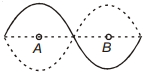
- 6In the standing wave shown, particles at the positions $A$ and $B$ have a phase difference ofView Solution
- 7The extension in a string, obeying Hooke's law, is $x$. The speed of sound in the stretched string is $v$. If the extension in the string is increased to $1.5x$, the speed of sound will beView Solution
- 8The relation between time and displacement for two particles is given byView Solution
${y_1} = 0.06\sin 2\pi (1.04t + {\phi _1})$,
${y_2} = 0.03\sin 2\pi (1.04t + {\phi _2})$
The ratio of the intensity of the waves produced by the vibrations of the two particles will be
- 9A wave travelling along the $x-$axis is described by the equation $y\left( {x,t} \right) = 0.005cos\left( {\alpha x - \beta t} \right)$ If the wavelength and the time period of the wave are $0.08\ m$ and $2.0\ s$, respectively, then $\alpha$ and $\beta$ in appropriate units areView Solution
- 10A man standing on a platform observes that the frequency of the sound of a whistle emitted by a train drops by $140 Hz$. If the velocity of sound in air is $330 \,m / s$ and the speed of the train is $70 \,m / s$, the frequency of the whistle is .......... $Hz$View Solution