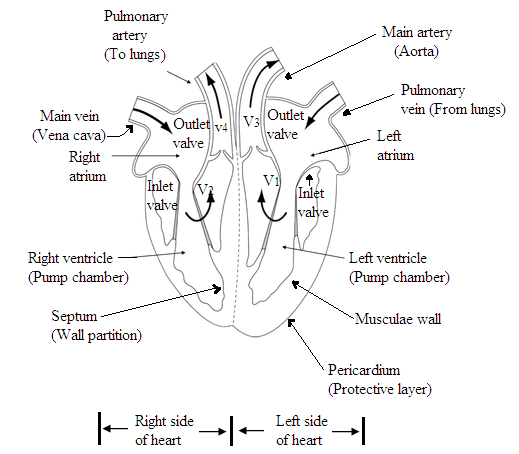
Draw a diagram of the human heart and label its parts.
Download our app for free and get started

Download our appand get started for free
Experience the future of education. Simply download our apps or reach out to us for more information. Let's shape the future of learning together!No signup needed.*
Similar Questions
- 1View SolutionValves are present in between the auricles and ventricles of the heart. Give one reason.
- 2View SolutionHow are fats digested in our bodies? Where does this process take place?
- 3View SolutionDescribe the working of human blood circulatory system with the help of a suitable diagram which shows all the steps involved.
- 4View SolutionBreathing cycle is an essential process for the exchange of gases’. Justify this statement.
- 5View SolutionHow do carbohydrates, proteins and fats get digested in human beings?
- 6View SolutionAn organism A which cannot move from one place to another, makes a simple food B from the substances C and D available in the environment. This food is made in the presence of a green coloured substance E present in organs F in the presence of light energy in a process called G. Some of the simple food B also gets converted into a complex food H for storage purposes. The food H gives a blue-black colour with dilute iodine solution.
- What is (i) organism A, (ii) food B and (iii) food H?
- What are C and D?
- Name (i) green coloured substance E, and (ii) organ F.
- What is the process G?
- 7View SolutionThe organisms A, B and C can obtain their food in three different ways. Organism A derives its food from the body of another living organism which is called its D, without killing it. The organism B takes in the solid food by the process of ingestion, digests a part of this food and throws out undigested food in the process called E. The organism C obtains its food from dead and decaying plants.
- What is the mode of nutrition of (i) organism A (ii) organism B, and (iii) organism C?
- What is the organism like D called?
- Name the process E.
- Give one example each of organisms like A, B and C.
- What is the general name of three modes of nutrition exhibited by organisms A, B and C?
- 8View SolutionExplain the principle of dialysis with the help of a labelled diagram.
- 9View SolutionExplain the mechanism of photosynthesis.
- 10View SolutionDescribe the structure and functioning of nephrons.