Question
Draw a labelled diagram of an astronomical telescope.

Answer

Get the step-by-step solution for this question inside the Vidyadip app.

Get the answer in the app

Need a full question paper?

Generate a complete, print-ready paper with questions like this in minutes — across 16+ boards, with answer keys.
Start Generating Free

Similar questions

Is it possible to add two vectors of unequal magnitudes and get zero? Is it possible to add three vectors of equal magnitudes and get zero?
Obtain the expression of electric field at any point by continuous distribution of charge on a volume.
Answer the following question:
In viewing through a magnifying glass, one usually positions one’s eyes very close to the lens. Does angular magnification change if the eye is moved back?
A wire is bent in the form of a regular hexagon and a total charge q is distributed uniformly on it. What is the electric field at the centre? You may answer this part without making any numerical calculations.
Write laws of reflection.
Explain dielectric strength and dielectric breakdown.
Is a slow process always isothermal? ls a quick process always adiabatic?
A wire, carrying a current i, is kept in the x−y plane along the curve $\text{y}=\text{A}\sin\Big(\frac{2\pi}{\lambda}\text{x}\Big).$ A magnetic field B exists in the z direction. Find the magnitude of the magnetic force on the portion of the wire between $\text{x}=0$ and $\text{x}=\lambda.$
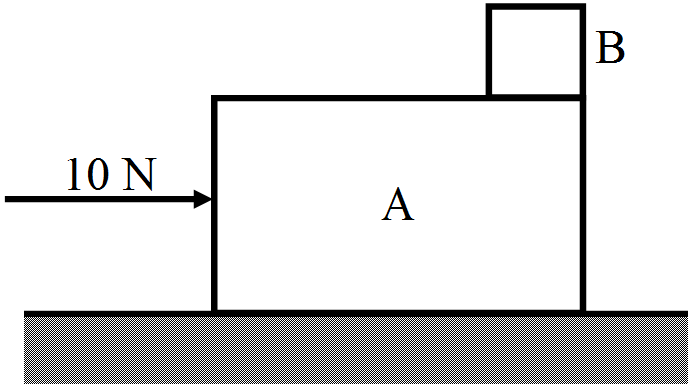
$A$ small block $B$ is placed on another block $A$ of mass $5\ kg$ and length $20\ cm.$ Initially the block $B$ is near the right end of block $A. A$ constant horizontal force of $10N$ is applied to the block $A$. All the surfaces are assumed frictionless. Find the time elapsed before the block $B$ separates from $A.$
Plot a graph showing the variation of stopping potential with the frequency of incident radiation for two different photosensitive materials having work functions $W_1$ and $W_2 \ (W_1 > W_2).$ On what factors does the $(i)$ slope and $(ii)$ intercept of the lines depend?