Question

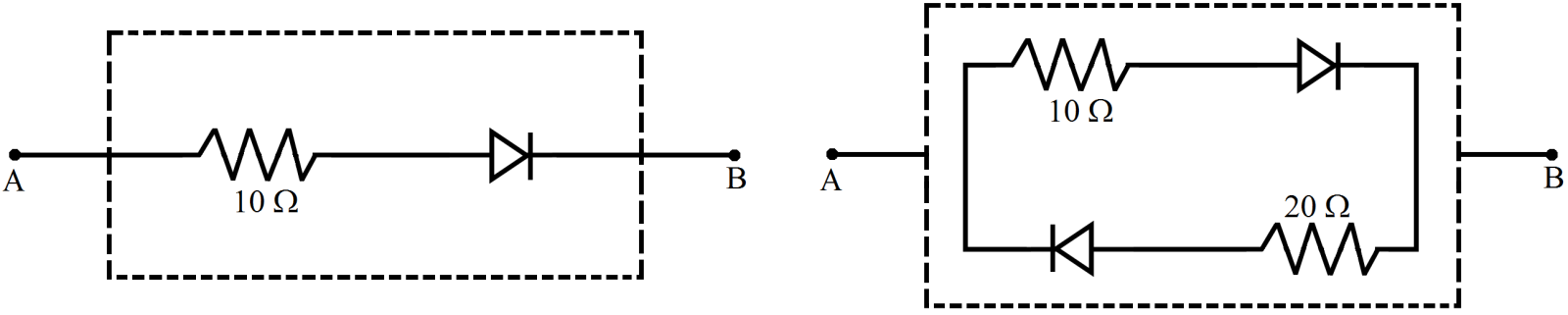
Draw the current-voltage characteristics for the device shown in figure. between the terminals A and B.

Answer

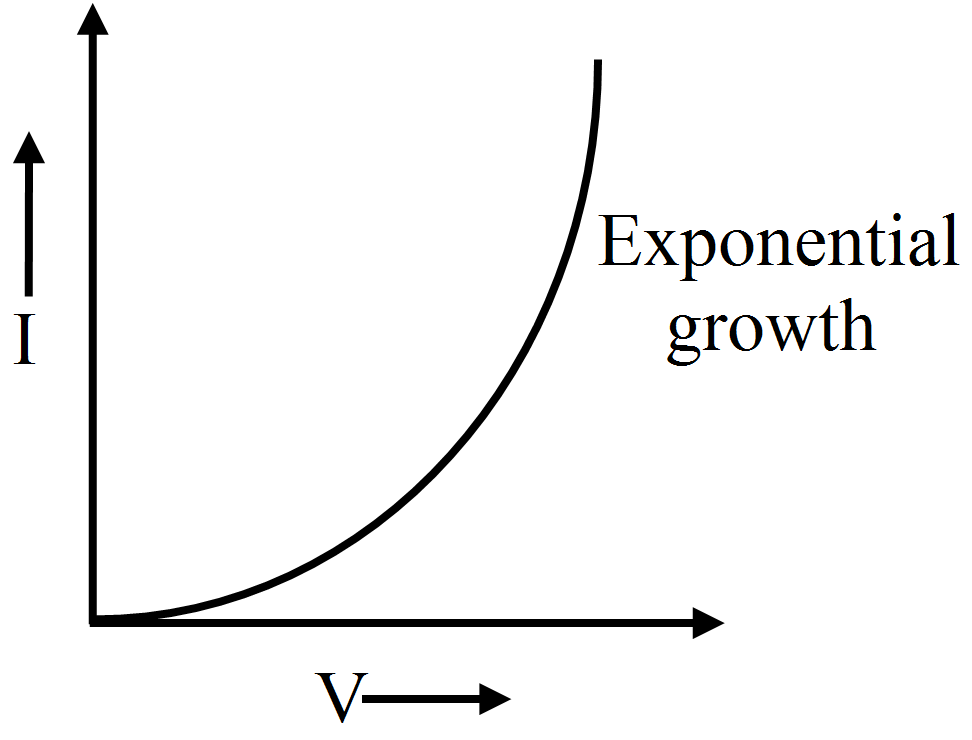
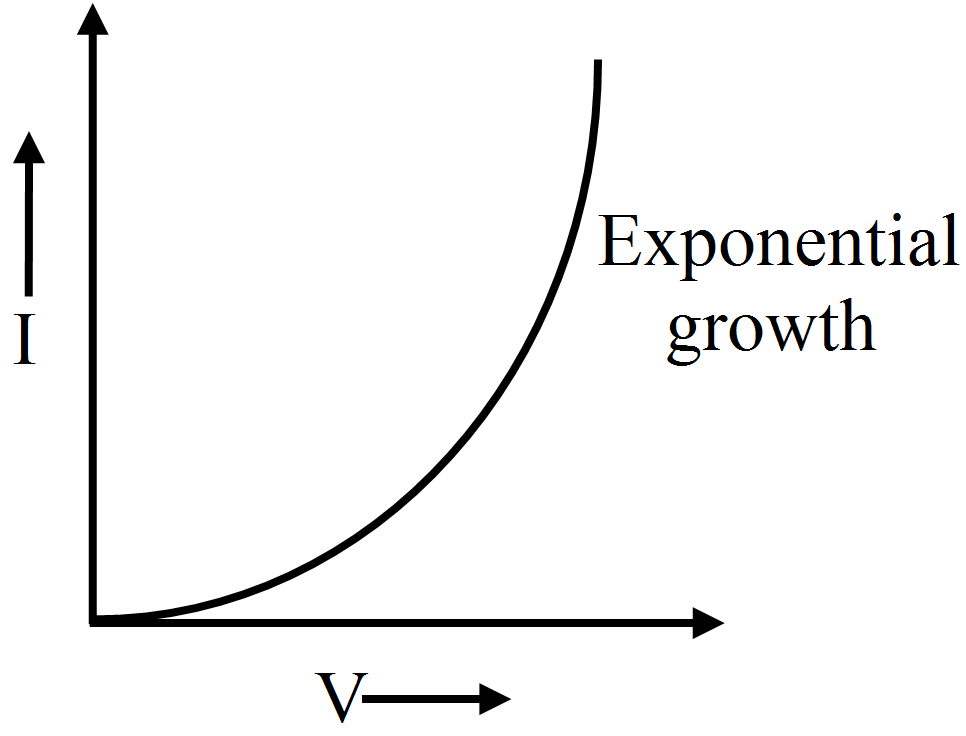
  1. If a battery is connected between terminals A and B, with positive terminal connected to point A and negative terminal connected to point B, then the diode will get forward biassed by the applied voltage. So, the current voltage graph for this circuit will be the same as that of the characteristic curves of a forward-biassed diode.
  1. If a battery is connected between terminals A and B, with positive terminal connected to point A and negative terminal connected to point B, then the upper diode will get forward biassed and the lower diode will get reverse biassed by the applied voltage. So, this lower branch can be replaced by an open circuit; hence, the current flow through this branch will be zero. The current flows only through the upper diode, so the circuit on simplification will become identical to the circuit in part (a). Hence, the current voltage graph for this circuit will be the same as that of the characteristic curves of a forward-biassed diode.

Need a full question paper?

Generate a complete, print-ready paper with questions like this in minutes — across 16+ boards, with answer keys.
Start Generating Free

Similar questions

Two coherent point sources $S_1$ and $S_2$ vibrating in phase emit light of wavelength $\lambda$. The separation between the sources is $2\lambda$. Consider a line passing through $S_2$ and perpendicular to the line $S_1S_2$. What is the smallest distance from $S_2$ where a minimum of intensity occurs?
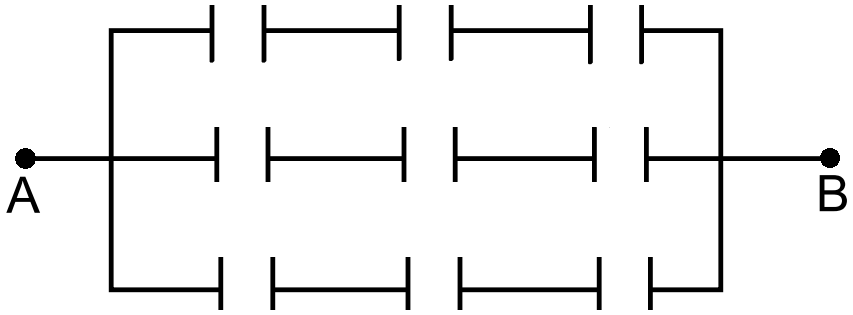
Each of the capacitors shown in figure has a capacitance of $2\mu\text{F}.$ Find the equivalent capacitance of the assembly between the points A and B. Suppose, a battery of emf 60 volts is connected between A and B. Find the potential difference appearing on the individual capacitors.
Two spherical bodies, each of mass 50kg, are placed at a separation of 20cm. Equal charges are placed on the bodies and it is found that the force of Coulomb repulsion equals the gravitational attraction in magnitude. Find the magnitude of the charge placed on either body.
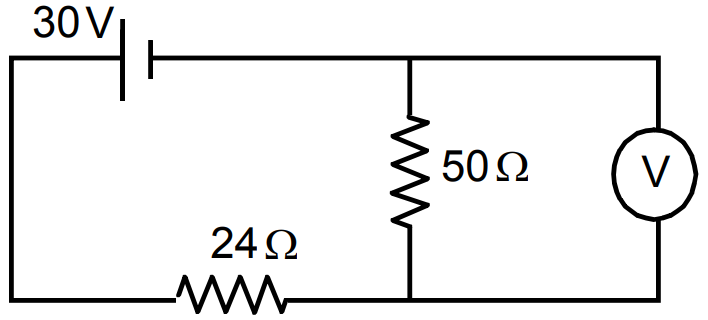
The voltmeter shown in the figure. reads 18V across the $50\Omega$ resistor. Find the resistance of the voltmeter.
Poynting vectors S is defined as a vector whose magnitude is equal to the wave intensity and whose direction is along the direction of wave propogation. Mathematically, it is given by $\text{S}=\frac{1}{\mu_0}\text{E}\times\text{B}$. Show the nature of S vs t graph.
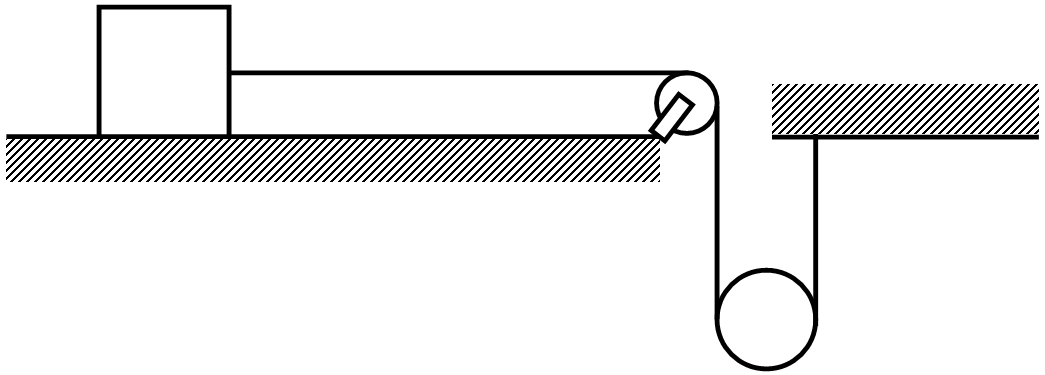
The descending pulley shown in figure has a radius $20\ cm$ and moment of inertia $0.20\ kg-m^2.$ The fixed pulley is light and the horizontal plane frictionless. Find the acceleration of the block if its mass is $1.0\ kg.$​​​​​​​
Figure shows a small body of mass m placed over a larger mass $M$ whose surface is horizontal near the smaller mass and gradually curves to become vertical. The smaller mass is pushed on the longer one at a speed $v$ and the system is left to itself. Assume that all the surfaces are frictionless.
  1. Find the speed of the larger block when the smaller block is sliding on the vertical part.
  2. Find the speed of the smaller mass when it breaks off the larger mass at height h.
  3. Find the maximum height $($from the ground$)$ that the smaller mass ascends.
  4. Show that the smaller mass will again land on the bigger one. Find the distance traversed by the bigger block during the time when the smaller block was in its flight under gravity.
Two particles A and B, each having a charge Q, are placed a distance d apart. Where should a particle of charge q be placed on the perpendicular bisector of AB so that it experiences maximum force What is the magnitude of this maximum force?

Identify which logic gate OR, AND and NOT is represented by the circuits in the dotted line boxes 1, 2 and 3. Give the truth table for the entire circuit for all possible values of A and B.
Can $\text{L}_\alpha$ X-ray of one material have shorter wavelength than $\text{K}_\alpha$ X-ray of another?