Electric charges of $ + 10\,\mu C,\; + 5\,\mu C,\; - 3\,\mu C$ and $ + 8\,\mu C$ are placed at the corners of a square of side $\sqrt 2 \,m$. the potential at the centre of the square is
Medium
Download our app for free and get started
(c) Length of each side of square is $\sqrt 2 \,m$ so distance of it’s centre from each corner is $\frac{{\sqrt 2 }}{{\sqrt 2 }} = 1\,m.$
Potential at the centre
$V = 9 \times {10^9}\left[ {\frac{{10\, \times {{10}^{ - 6}}}}{1} + \frac{{5 \times {{10}^{ - 6}}}}{1} - \frac{{3 \times {{10}^{ - 6}}}}{1} + \frac{{8 \times {{10}^{ - 6}}}}{1}} \right]$
$= 1.8 \times 10^5 \,V$
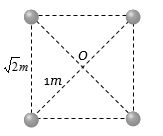
Potential at the centre
$V = 9 \times {10^9}\left[ {\frac{{10\, \times {{10}^{ - 6}}}}{1} + \frac{{5 \times {{10}^{ - 6}}}}{1} - \frac{{3 \times {{10}^{ - 6}}}}{1} + \frac{{8 \times {{10}^{ - 6}}}}{1}} \right]$
$= 1.8 \times 10^5 \,V$

Download our appand get started for free
Experience the future of education. Simply download our apps or reach out to us for more information. Let's shape the future of learning together!No signup needed.*
Similar Questions
- 1A capacitor of capacity $'C'$ is connected to a cell of $'V'\, volt$. Now a dielectric slab of dielectric constant ${ \in _r}$ is inserted in it keeping cell connected thenView Solution
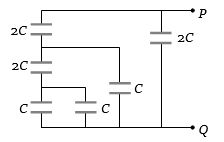
- 2View SolutionThe resultant capacitance of given circuit is
- 3Assume that an electric field $\vec E = 30{x^2}\hat i$ exists in space. Then the potential difference $V_A-V_O$ where $V_O$ is the potential at the origin and $V_A$ the potential at $x = 2\ m$ is....$V$View Solution
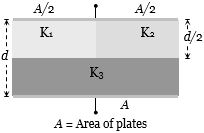
- 4View SolutionIn the figure a capacitor is filled with dielectrics. The resultant capacitance is
- 5Charge $q_{2}$ is at the centre of a circular path with radius $r$. Work done in carrying charge $q_{1}$, once around this equipotential path, would beView Solution
- 6A parallel plate air capacitor has capacity $C,$ distance of separation between plates is $d$ and potential difference $V$ is applied between the plates. Force of attraction between the plates of the parallel plate air capacitor isView Solution
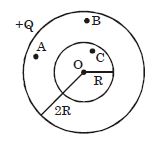
- 7A hollow conducting sphere of inner radius $R$ and outer radius $2R$ is given a charge $Q$ as shown in the figure, then the :View Solution
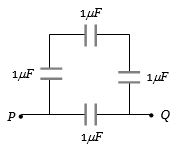
- 8Four capacitors are connected as shown in the equivalent capacitance between the points $P$ and $Q$ is.......$\mu F$View Solution
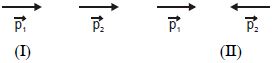
- 9View SolutionFor shown situation of two dipoles the nature of forces between them are
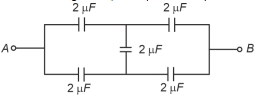
- 10In the following circuit, the equivalent capacitance between terminal $A$and terminal $B$ is :View Solution