Question
Electromagnetic waves travel only through.

Answer

  1. oscillating electric and magnetic fields whose directions are perpendicular to each other
Explanation:
Electromagnetic waves travel through oscillating electric and magnetic fields whose directions are perpendicular to each other.

Need a full question paper?

Generate a complete, print-ready paper with questions like this in minutes — across 16+ boards, with answer keys.
Start Generating Free

Similar questions

The number of wavelengths in the visible spectrum(a) 4000   (b) 6000(c) 2000   (d) Infinite
       
Assertion : The electrical conductivity of earth’s atmosphere decrease with altitude.
Reason     : The high energy particles (i.e. g-rays and cosmic rays) coming from outer space and entering our earth’s atmosphere causes ionisation of the atoms of the gases present there and the pressure of gases decreases with increase in altitude.(a) If both assertion and reason are true and the reason is the correct explanation of the assertion.(b) If both assertion and reason are true but reason is not the correct explanation of the assertion.(c) If assertion is true but reason is false.(d) If assertion is false but reason is true.


The separation between the plates of a charged parallel-plate capacitor is increased. Which of the following quantities will change?
How can the brightness of the pattern on the screen of cathode ray tube be changed?
The observed wavelength of light coming from a distant galaxy is found to be increased by $0.5\%$ as compared with that coming from a terrestrial source. The galaxy is
Light of frequency $4n_0$ is incident on the metal of the threshold frequency $n_0$. The maximum kinetic energy of the emitted photoelectrons is
A ray of light travelling inside a rectangular glass block of refractive index $\sqrt{2}$ is incident on the glass$–$air surface at an angle of incidence of $45^\circ $. The refractive index of air is $1.$ Under these conditions the ray
If the two ends of a p-n junction are joined by a wire:
A unit charge moves on an equipotential surface from a point A to point B, then:
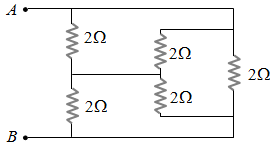
Find the equivalent resistance across $AB$