Question
What is the difference between Magnification and Magnifying power ?

Answer

MagnificationMagnifying power
(i) It is a liner magnificant which is equal to $\frac{h_2}{h_1}$.It is an angular magnification which is equals to $\frac{\angle \beta}{\angle \alpha}$.
(ii) Its value increases with the increase in V.Its value decreases with the increase in V.
(iii) Its value may be between $-\infty$ to $+\infty$.Its value may be between $\frac{ D }{f}$ and $l+\frac{ D }{f}$.
(iv) Under certain condition it is equal to magnifying power.It is a special condition of magnification when ve = D.

Need a full question paper?

Generate a complete, print-ready paper with questions like this in minutes — across 16+ boards, with answer keys.
Start Generating Free

Similar questions

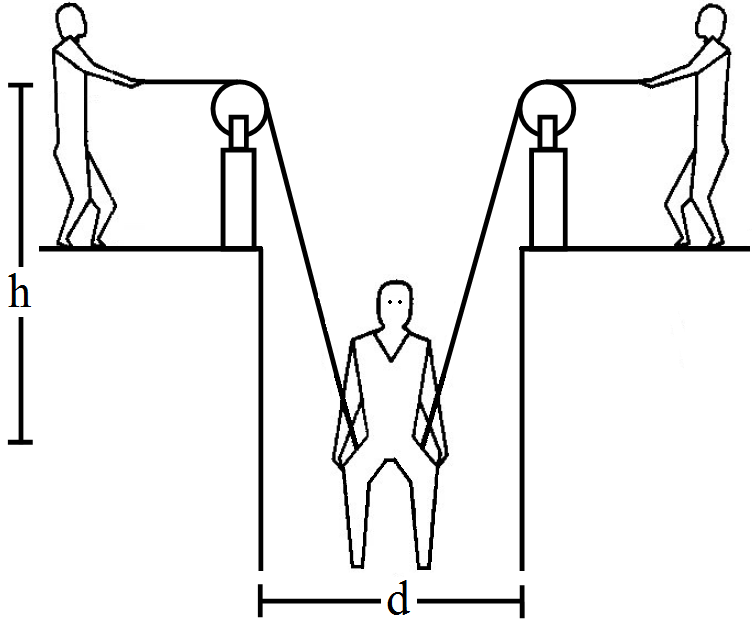
A man has fallen into a ditch of width d and two of his friends are slowly pulling him out using a light rope and two fixed pulleys as shown in figure. Show that the force (assumed equal for both the friends) exerted by each friend on the road increases as the man moves up. Find the force when the man is at a depth h.
When a ferromagnetic material goes through a hysteresis loop, its thermal energy is increased. Where does this energy come from?
To keep valuable instruments away from the earth's magnetic field, they are enclosed in iron boxes. Explain.
Cloudy nights are warmer than the nights with clean sky. Explain.
While watering a distant plant, a gardener partially water than in fresh closes the exit hole of the pipe by putting his finger on it. Explain why this results in the water stream goirig to a larger distance.
The combination of two bar magnets makes 10 oscillations per second in an oscillation magnetometer when like poles are tied together and 2 oscillations per second when unlike poles are tied together. Find the ratio of the magnetic moments of the magnets. Neglect any induced magnetism.
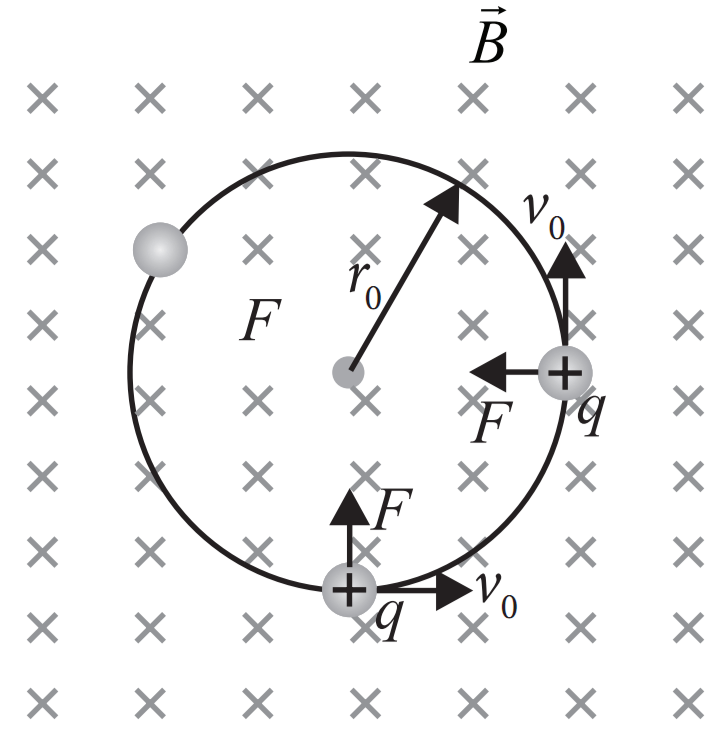
An electron with speed $v_0 << c$ moves in a circle of radius $r_0$ in a uniform magnetic field. This electron is able to traverse a circular path as magnetic field is perpendicular to the velocity of the electron. A force acts on the particle perpendicular to both $\vec{\text{v}}_0$ and $\vec{\text{B}},$ This force continuously deflects the particle sideways without changing its speed and the particle will move along a circle perpendicular to the field. The time required for one revolution of the electron is $T_0$.
  1. If the speed of the electron is now doubled to $2v_0$. The radius of the circle will change to :
  1. $4r_0$
  2. $2r_0$
  3. $r_0$
  4. $\frac{\text{r}_0}{2}$
  1. If $v_0 = 2v_0$ then the time required for one revolution of the electron will change to:
  1. $4T_0$
  2. $2T_0$
  3. $T_0$
  4. $\frac{\text{T}_0}{2}$
  1. A charged particles is projected in a magnetic field $\vec{\text{B}}=(2\hat{\text{i}}+4\hat{\text{j}})\times10^2\text{ T}.$ The acceleration of the particle is found to be $\vec{\text{a}}=(\text{x}\hat{\text{i}}+2\hat{\text{j}})\text{m s}^{-2}$ Find the value of $x$.
  1. $4ms^{-2}$
  2. $-4ms^{-2}$
  3. $-2ms^{-2}$
  4. $2ms^{-2}$
  1. If the given electron has a velocity not perpendicular to $B,$ then trajectory of the electron is :
  1. Straight line.
  2. Circular.
  3. Helical.
  4. Zig$-$zag.
  1. If this electron of charge $(e)$ is moving parallel to uniform magnetic field with constant velocity $v,$ the force acting on the electron is:
  1. Bev
  2. $\frac{\text{Be}}{\text{v}}$
  3. $\frac{\text{B}}{\text{ev}}$
  4. Zero
When light of sufficiently high frequency is incident on a metallic surface, electrons are emitted from the metallic surface. $TI1$ is phenomenon is called photoelectric emission. Kinetic energy of the emitted photoelectrons depends on the wavelength of incident tight and is independent of the intensity of light. Number of emitted photoelectrons depends on intensity. $(\text{h}\upsilon-\phi)$ is the maximum kinetic energy of emitted photoelectrons $($where $\phi$ is the work function of metallic surface$)$. Reverse effect of photo emission produces $X-$ ray. $X-$ ray is not deflected by electric and magnetic fields. Wavelength of a continuous $X-$ ray depends on potential difference across the tube. Wavelength of characteristic $X-$ ray depends on the atomic number.
  1. Einstein's photoelectric equation is:
  1. $\text{E}_\text{max}=\text{h}\upsilon-\phi$
  2. $\text{E}=\text{mc}^2$
  3. $\text{E}^2=\text{p}^2\text{c}^2+\text{m}_0^2\text{c}^4$
  4. $\text{E}=\frac{1}{2}\text{mv}^2$
  1. Light of wavelength $\lambda$ which is less than threshold wavelength is incident on a photosensitive material. If incident wavelength is decreased so that emitted photoelectrons are moving with some velocity then stopping potential will:
  1. Increase.
  2. Decrease.
  3. Be zero.
  4. Become exactly half.
  1. When ultraviolet rays incident on metal plate then photoelectric effect does not occur, it occur by incident of:
  1. Infrared rays
  2. $X-$ rays
  3. Radio wave
  4. Micro wave
  1. If frequency $(\upsilon>\upsilon_0)$ of incident light becomes $n$ times the initial frequency $(\upsilon)$, then $K.E$. of the emitted photoelectrons becomes $(\upsilon_0$ threshold frequency$)$.
  1. $N$ times of the initial kinetic energy.
  2. More than n times of the initial kinetic energy.
  3. Less than n times of the initial kinetic energy.
  4. Kinetic energy of the emitted photoelectrons remains unchanged.
  1. A monochromatic light is used in a photoelectric experiment. The stopping potential.
  1. Is related to the mean wavelength.
  2. Is related to the shortest wavelength.
  3. Is not related to the minimum kinetic energy of emitted photoelectrons.
  4. Intensity of incident tight.
Step $-$ down transformers are used to decrease or step $-$ down voltages. These are used when voltages need to be lowered for use in homes and factories. A small town with a demand of $800kW$ of electric power at $220V$ is situated $15\ km$ away from an electric plant generating power at $440V$. The resistance of the two wire line carrying power is $0.5Q$ per $\ km$. The town gets power from the line through a $4000 - 220V$ step $-$ down transformer at a sub $-$ station in the town.
  1. The value of total resistance of the wires is:
  1. $25\Omega$
  2. $30\Omega$
  3. $35\Omega$
  4. $15\Omega$
  1. The line power loss in the form of heat is:
  1. $550kW$
  2. $650kW$
  3. $600kW$
  4. $700kW$
  1. How much power must the plant supply, assuming there is negligible power loss due to leakage?
  1. $600kW$
  2. $1600kW$
  3. $500W$
  4. $1400kW$
  1. The voltage drop in the power line is:
  1. $1700V$
  2. $3000V$
  3. $2000V$
  4. $2800V$
  1. The total value of voltage transmitted from the plant is:
  1. $500V$
  2. $4000V$
  3. $3000V$
  4. $7000V$
The magnetic field due to the earth has a horizontal component of $26\mu\text{T}$ at a place where the dip is 60°. Find the vertical component and the magnitude of the field.