Maharashtra BoardEnglish MediumSTD 11 ScienceChemistryBasic Principles of Organic Chemistry6 Marks
Question
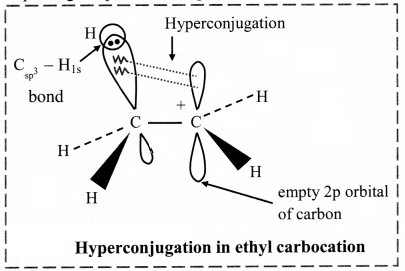
Explain hyperconjugation in ethyl carbocation.
✓
Answer
$i.$ In ethyl cation $CH _3 \stackrel{+}{ CH }_2$, positively charged carbon atom is attached to a methyl group.
$ii.$ The positively charged carbon atom has six electrons; it is $sp^2$ hybridized and has an empty $p$ orbital available for hyperconjugation.
$iii.$ One of the $C – H$ bonds of the methyl group can align in plane of the empty $p$ orbital. The sigma electrons constituting the $C – H$ bond can be delocalized into this empty $p$ orbital.
$iv.$ Therefore, hyperconjugation arises due to the partial overlap of a $C-H$ bond with the empty $p$ orbital of an adjacent positively charged carbon atom. Thus, hyperconjugation is a $\sigma -\pi$ conjugation.
$v.$ Hyperconjugation structures in ethyl carbocation can be represented as:
$vi.$ In the contributing structures, there is no covalent bond shown between the carbon and one of the $\alpha -$hydrogens. Hence, hyperconjugation is also called as ‘no bond resonance’.
$vii.$ This type of overlap stabilizes the cation, because the electron density from the adjacent a bond helps in dispersing the positive charge.
Need a full question paper?
Generate a complete, print-ready paper with questions like this in minutes — across 16+ boards, with answer keys.