Question
Explain isotopes, isobars, isotones and isomers by giving examples.

Answer

→ (i) Isotopes :
 The atoms which have atomic number Z same but atomic mass number A different, then such type of atoms are called the isotopes of each other.
For example :
Isotopes of hydrogen are ${ }_1 H ^1,{ }_1 H ^2,{ }_1 H ^3$
•${ }_1 H ^1$ - there is one proton but having no neutron.
• ${ }_1 H ^2$ - there is one proton one neutron.
• ${ }_1 H ^3$ - there is one proton and two neutrons.
Isotopes of carbon are ${ }_6 C ^{12},{ }_6 C ^{13},{ }_6 C ^{14}$
Isotopes of uranium are ${ }_{92} U ^{233},{ }_{92} C ^{235},{ }_{92} C ^{238}$
→ (ii) Isobar :
Atoms having same atomic mass number A , but different atomic number Z are called the isobars of each other.
→ For example :
${ }_1 H ^3$ and ${ }_2 He ^3$
${ }_{82} Pb^{214}$ and ${ }_{83} Bi ^{214}$
(iii) Isotone :
The atoms for which the neutron number N is the same but atomic number Z and mass number A are different are called isotones to each other.
For example :
${ }_{80} Hg ^{198} \text { and }{ }_{79} Au ^{197}$
→ (iv) Isomer :
→The atoms for which the atomic number Z and mass number A are same but their radioactive properties are different are called isomers of each other.
→For example :
${ }_{35} Br ^{80}$ contains a pair of isomers.

Need a full question paper?

Generate a complete, print-ready paper with questions like this in minutes — across 16+ boards, with answer keys.
Start Generating Free

Similar questions

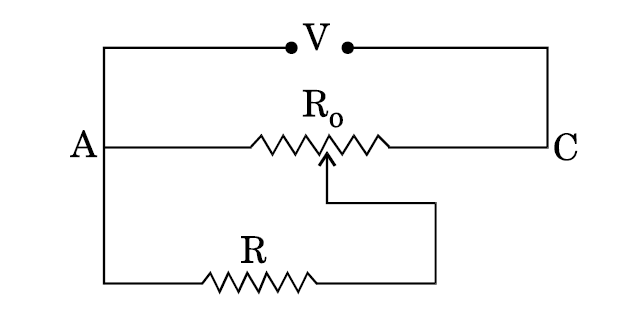
A resistance of $R \Omega$ draws current from a potentiometer as shown in the figure. The potentiometer has a total resistance $R_o\Omega$ . A voltage $V$ is supplied to the potentiometer. Derive an expression for the voltage across $R$ when the sliding contact is in the middle of the potentiometer.
Draw the circuit diagram of a common emitter amplifier using $n-p-n$ transistor. What is the phase differnece between the input signal and output voltage? State two reasons why a common emitter amplifier is preferred to a common base amplifier.
A jet plane is travelling towards west at a speed of $1800\ km/h.$ What is the voltage difference developed between the ends of the wing having a span of $25m,$ if the Earth’s magnetic field at the location has a magnitude of $5 \times 10^{–4}T$ and the dip angle is $30^\circ .$
A simple pendulum of length (l) is pulled aside to make an angle $\theta$ with the vertical. Find the magnitude of the torque of the weight (w) of the bob about the point of suspension. When is the torque zero?
A capacitor of capacitance $10\mu\text{F}$ is connected across a battery of emf 6.0V through a resistance of $20\text{k}\Omega$ for 4.0s. The battery is then replaced by a thick wire. What will be the charge on the capacitor 4.0s after the battery is disconnected?
Obtain the resonant frequency and $\text{Q}-$factor of a series $\text{LCR}$ circuit with $\text{L} = 3.0\text{H, C} = 27\ \mu \text{F},$ and $\text{R} = 7.4\Omega$ . It is desired to improve the sharpness of the resonance of the circuit by reducing its ‘full width at half maximum’ by a factor of $2$. Suggest a suitable way.
If the separation between the slits in a Young's double slit experiment is increased, what happens to the fringe-width? If the separation is increased too much, will the fringe pattern remain detectable?
A particle moves in a circle of diameter $1.0\ cm$ under the action of a magnetic field of $0.40T$. An electric field of $200\ Vm^{-1}$ makes the path straight. Find the charge/ mass ratio of the particle.
A wire $AB$ is carrying a steady current of $12 A$ and is lying on the table. Another wire $CD$ carrying $5A$ is held directly above $AB$ at a height of $1 mm.$ Find the mass per unit length of the wire $CD$ so that it remains suspended at its position when left free. Give the direction of the current flowing in $CD$ with respect to that in $AB.$ $[$Take the value of $g = 10 ms^{–2}]$
By the Gauss's law, derive the expression of the electric field at any point due to a similar charged straight wire of infinite length. Draw necessary diagram.