A capacitor of capacitance $10\mu\text{F}$ is connected across a battery of emf 6.0V through a resistance of $20\text{k}\Omega$ for 4.0s. The battery is then replaced by a thick wire. What will be the charge on the capacitor 4.0s after the battery is disconnected?
Download our app for free and get started
$\text{C} = 100\mu\text{F, emf} = 6\text{V}, \text{ R} = 20 \text{K}\Omega, \text{t} = 4 \text{S}.$
Charging: $\text{Q}=\text{CV}\Big(1-\text{e}^{\frac{-\text{t}}{\text{RC}}}\Big)\ \bigg[\frac{-\text{t}}{\text{RC}}=\frac{4}{2\times10^4\times10^{-4}}\bigg]$
$=6\times10^{-4}\big(1-\text{e}^{-2}\big)=5.187\times10^{-4}\text{C}=\text{Q}$
Discharging: $\text{q}=\text{Q}\Big(\text{e}^{\frac{-\text{t}}{\text{RC}}}\Big)=5.184\times10^{-4}\times\text{e}^{-2}$
$=0.7\times10^{-4}\text{C}=70\mu\text{c}.$
Charging: $\text{Q}=\text{CV}\Big(1-\text{e}^{\frac{-\text{t}}{\text{RC}}}\Big)\ \bigg[\frac{-\text{t}}{\text{RC}}=\frac{4}{2\times10^4\times10^{-4}}\bigg]$
$=6\times10^{-4}\big(1-\text{e}^{-2}\big)=5.187\times10^{-4}\text{C}=\text{Q}$
Discharging: $\text{q}=\text{Q}\Big(\text{e}^{\frac{-\text{t}}{\text{RC}}}\Big)=5.184\times10^{-4}\times\text{e}^{-2}$
$=0.7\times10^{-4}\text{C}=70\mu\text{c}.$

Download our appand get started for free
Experience the future of education. Simply download our apps or reach out to us for more information. Let's shape the future of learning together!No signup needed.*
Similar Questions
- 1View SolutionDefine relaxation time of the free electrons drifting in a conductor. How is it related to the drift velocity of free electrons? Use this relation to deduce the expression for the electrical resistivity of the material.
- 2View SolutionHow many time constants will elapse before the charge on a capacitors falls to 0.1% of its maximum value in a discharging RC circuit?
- 3View SolutionThe specification on a heater coil is 250V, 500W. Calculate the resistance of the coil. What will be the resistance of a coil of 1000W to operate at the same voltage?
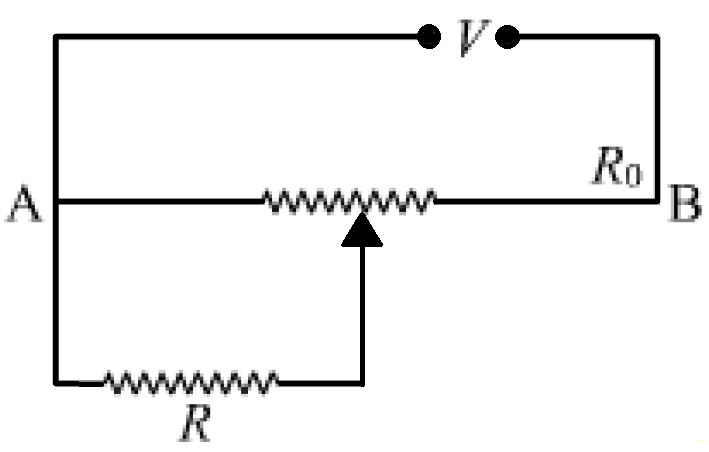
- 4A resistance of R draws current from a potentiometer. The potentiometer wire $, AB, $ has a total resistance of $R_o. A$ voltage $V$ is supplied to the potentiometer. Derive an expression for the voltage across $R$ when the sliding contact is in the middle of potentiometer wire.View Solution
- 5The number density of free electrons in a copper conductor estimated in Example $3.1$ is $8.5 \times 10^{28}m^{-3}.$ How long does an electron take to drift from one end of a wire $3.0 m$ long to its other end? The area of cross$-$section of the wire is $2.0 \times 10^{-6} m^2$ and it is carrying a current of $3.0 A.$View Solution
- 6A plate of area $10\ cm^2$ is to be electroplated with copper $($density $9000\ kg/m^3)$ to a thickness of $10$ micrometres on both sides, using a cell of $12V$. Calculate the energy spent by the cell in the process of deposition. If this energy is used to heat $100g$ of water, calculate the rise in the temperature of the water. $\ce{ECE}$ of copper $= 3 \times 10^{-7}kg C^1 $ and specific heat capacity of water $= 4200Jkg^1.$View Solution
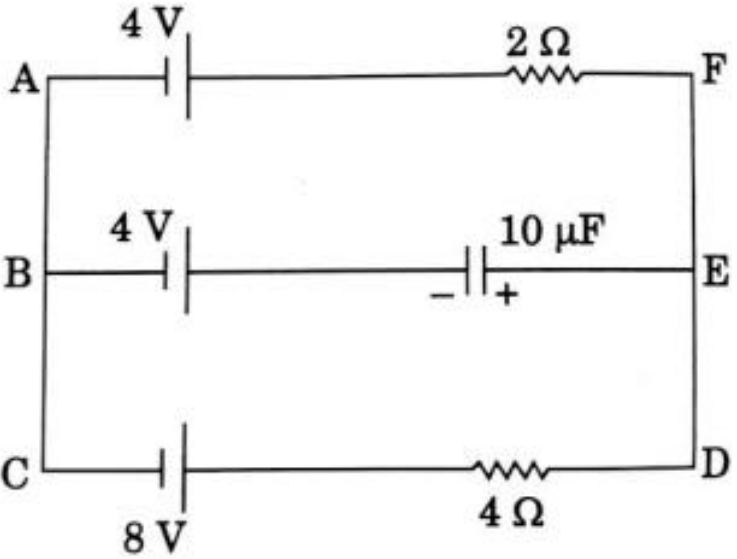
- 7View SolutionIn the given circuit, with steady current, calculate the potential drop across the capacitor and the charge stored in it.
- 8A wire $AB$ is carrying a steady current of $12 A$ and is lying on the table. Another wire $CD$ carrying $5A$ is held directly above $AB$ at a height of $1 mm.$ Find the mass per unit length of the wire $CD$ so that it remains suspended at its position when left free. Give the direction of the current flowing in $CD$ with respect to that in $AB.$ $[$Take the value of $g = 10 ms^{–2}]$View Solution
- 9View SolutionA voltage of 30V is applied across a carbon resistor with first, second and third rings of blue, black and yellow colours respectively. Calculate the value of current in mA, through the resistor.
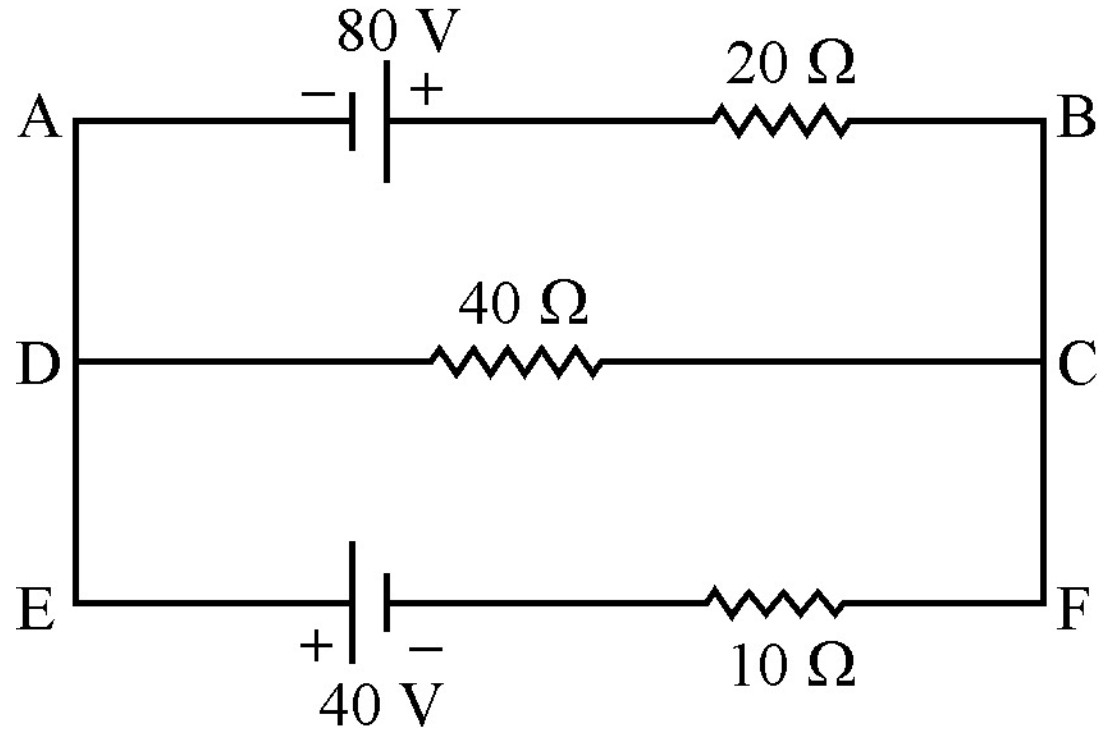
- 10Using Kirchhoff’s rules, calculate the current through the $40\Omega$ and $20\Omega$ resistors in the following circuit:View Solution