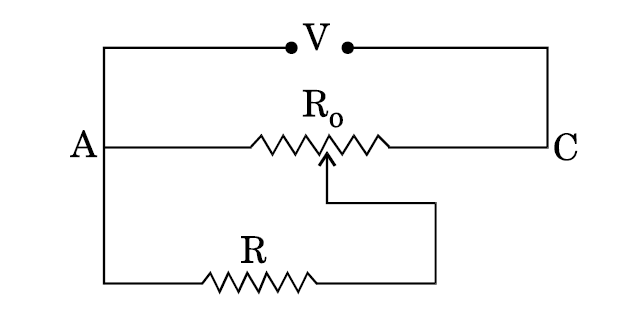
A resistance of $R \Omega$ draws current from a potentiometer as shown in the figure. The potentiometer has a total resistance $R_o\Omega$ . A voltage $V$ is supplied to the potentiometer. Derive an expression for the voltage across $R$ when the sliding contact is in the middle of the potentiometer.
CBSE OUTSIDE DELHI - SET 3 2014
Download our app for free and get started
$\text{R}_{total} = \frac{\text{R}_{o}}{2} + \frac{\frac{\text{R}_{o}}{2}.\text{R}}{\frac{\text{R}_{o}}{2} + \text{R}}$
$ = \frac{\text{R}(\text{R}_{o} + 4\text{R})}{2(\text{R}_{o} + 2 \text{R})}$
$\text{I}_{(total)} = \frac{\text{V}}{\text{R}_{total}}$
Current through $R = I_{2 } = \text{I}_{total}\text{ x}\frac{\frac{\text{R}_{o}}{2}}{\frac{\text{R}_{o}}{2}+\text{R}}$
$ = \text{I}_{total}\text{ x}\frac{\text{R}_{o}}{\text{R}_{o} + 2 \text{R}}$
$ = \frac{\text{V}.2(\text{R}_{o} + 2 \text{R})}{\text{R}(\text{R}_{o} + 4\text{R})}\text{x}\frac{\text{R}_{o}}{\text{R}_{o} + 2 \text{R}}$
$ = \frac{2\text{VR}_{o}}{\text{R}(\text{R}_{o} + 4 \text{R})}$
Voltage across $R = I_2 R = \bigg(\frac{2\text{VR}_{o}}{\text{R}_{o} + 4 \text{R}}\bigg).$
$ = \frac{\text{R}(\text{R}_{o} + 4\text{R})}{2(\text{R}_{o} + 2 \text{R})}$
$\text{I}_{(total)} = \frac{\text{V}}{\text{R}_{total}}$
Current through $R = I_{2 } = \text{I}_{total}\text{ x}\frac{\frac{\text{R}_{o}}{2}}{\frac{\text{R}_{o}}{2}+\text{R}}$
$ = \text{I}_{total}\text{ x}\frac{\text{R}_{o}}{\text{R}_{o} + 2 \text{R}}$
$ = \frac{\text{V}.2(\text{R}_{o} + 2 \text{R})}{\text{R}(\text{R}_{o} + 4\text{R})}\text{x}\frac{\text{R}_{o}}{\text{R}_{o} + 2 \text{R}}$
$ = \frac{2\text{VR}_{o}}{\text{R}(\text{R}_{o} + 4 \text{R})}$
Voltage across $R = I_2 R = \bigg(\frac{2\text{VR}_{o}}{\text{R}_{o} + 4 \text{R}}\bigg).$

Download our appand get started for free
Experience the future of education. Simply download our apps or reach out to us for more information. Let's shape the future of learning together!No signup needed.*
Similar Questions
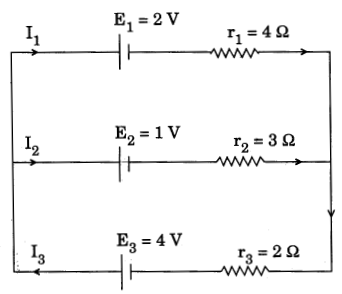
- 1State Kirchhoff’s rules. Use these rules to write the expressions for the currents $I_1, I_2$ and $I_3$ in the circuit diagram shown.View Solution
- 2View Solution
- Derive an expression for drift velocity of free electrons.
- How does drift velocity of electrons in a metallic conductor vary with increase in temperature? Explain.
- 3View SolutionA (i) series (ii) parallel combination of two given resistors is connected, one by one, across a cell. In which case will the terminal potential difference, across the cell have a higher value?
- 4The current through a wire depends on time as $\text{i}=\text{i}_0+\alpha\text{t},$View Solution
Where $\text{i}_0=10\text{A}$ and $\alpha=4\text{A/ s}.$ Find the charge that crosses through a section of the wire in 10 seconds. - 5The potential difference across a resistor $‘r\ ’$ carrying current $‘I\ ’$ is $Ir.$View Solution
- Now if the potential difference across $‘r\ ’$ is measured using a voltmeter of resistance $‘RV\ ’,$ show that the reading of voltmeter is less than the true value
- Find the percentage error in measuring the potential difference by a voltmeter.
- At what value of $RV,$ does the voltmeter measures the true potential difference?
- 6A capacitor of capacitance $10\mu\text{F}$ is connected across a battery of emf 6.0V through a resistance of $20\text{k}\Omega$ for 4.0s. The battery is then replaced by a thick wire. What will be the charge on the capacitor 4.0s after the battery is disconnected?View Solution
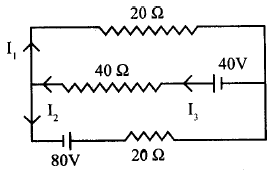
- 7View SolutionState Kirchhoff's rules of current distribution in an electrical network. Using these rules determine the value of the current I1 in the electric circuit given below.
- 8View SolutionThe following circuit shows the use of potentiometer to measure the internal resistance of a cell:
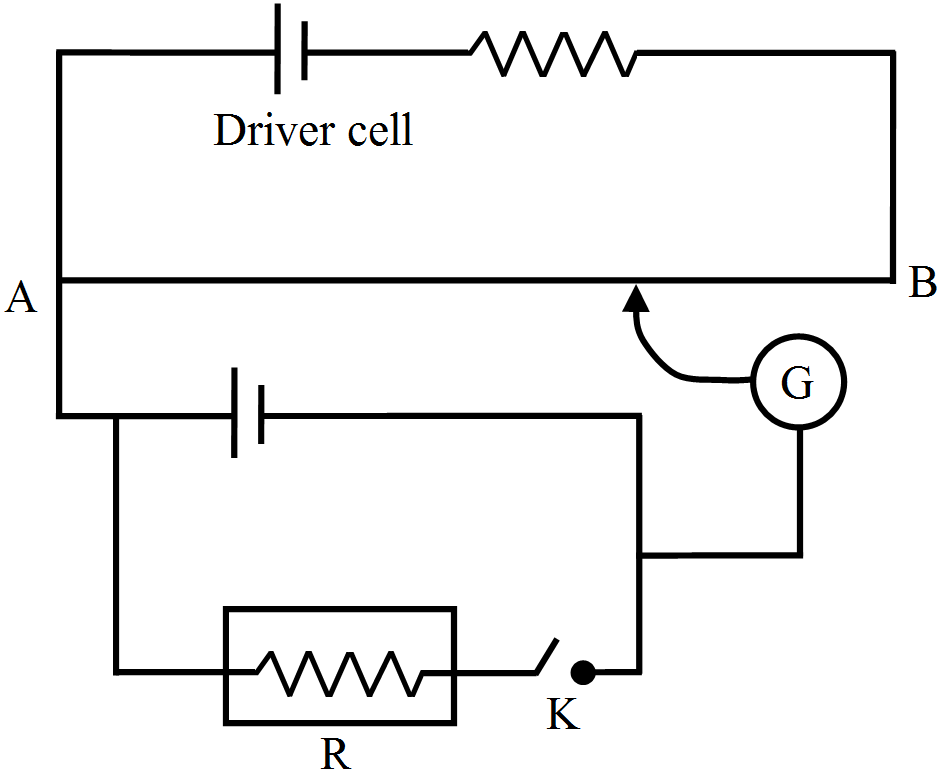
- When the key is open, how does the balance point change, if the current from the driver cell decreases?
- When the key K is closed, how does the balance point change if R is increased keeping current from the driver cell constant?
- 9The number density of free electrons in a copper conductor estimated in Example $3.1$ is $8.5 \times 10^{28}m^{-3}.$ How long does an electron take to drift from one end of a wire $3.0 m$ long to its other end? The area of cross$-$section of the wire is $2.0 \times 10^{-6} m^2$ and it is carrying a current of $3.0 A.$View Solution
- 10A wire of length 1m and radius 0.1mm has a resistance of $100\Omega.$ Find the resistivity of the material.View Solution