States of Matter — Chemistry STD 11 Science — Question
Maharashtra BoardEnglish MediumSTD 11 ScienceChemistryStates of Matter6 Marks
Question
Explain the relation between intermolecular forces and thermal energy.
✓
Answer
Thermal energy is the measure of kinetic energy of the particles of matter that arises due to movement of particles.
It is directly proportional to the temperature; that means, thermal energy increases with increase in temperature and vice versa.
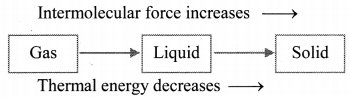
Three states of matter are the consequence of a balance between the intermolecular forces of attraction and the thermal energy of the molecules.
If the intermolecular forces are very weak, molecules do not come together to make liquid or solid unless thermal energy is decreased by lowering the temperature.
When a substance is to be converted from its gaseous state to solid state, its thermal energy (or temperature) has to be reduced. At this stage, the intermolecular forces become more important than thermal energy of the particles.
Need a full question paper?
Generate a complete, print-ready paper with questions like this in minutes — across 16+ boards, with answer keys.