Question
Explain why A spinning cricket ball in air does not follow a parabolic trajectory.

Answer

A spinning cricket ball has two simultaneous motions – rotatory and linear. These two types of motion oppose the effect of each other. This decreases the velocity of air flowing below the ball. Hence, the pressure on the upper side of the ball becomes lesser than that on the lower side. An upward force acts upon the ball. Therefore, the ball takes a curved path. It does not follow a parabolic path.

Need a full question paper?

Generate a complete, print-ready paper with questions like this in minutes — across 16+ boards, with answer keys.
Start Generating Free

Similar questions

Use the formula $\text{v}=\sqrt{\frac{\gamma\text{P}}{\rho}}$ to explain why the speed of sound in air:
Increases with temperature,
If $x, y$ and $z$ are distances moved by a particle moving with a constant acceleration during the $l^{th}, m^{th}$ and $n^{th}$ second of its motion respectively. Show that, $x(m - n) + y(n - l) + z(l - m) = 0$
A mass attached to a spring is free to oscillate, with angular velocity $\omega,$ in a horizontal plane without friction or damping. It is pulled to a distance $x_0$ and pushed towards the centre with a velocity $\upsilon_0$ at time t = 0. Determine the amplitude of the resulting oscillations in terms of the parameters $\omega,x_0$ and $υ_0$. [Hint: Start with the equation $\text{x}=\text{a}\cos(\omega\text{t}+\theta)$ and note that the initial velocity is negative.]
 
The displacement vector of a particle of mass m is given by $\text{r}\text{(t})=\hat{\text{i}}\text{A}\cos\omega\text{t}+\hat{\text{j}}\text{B}\sin\omega\text{t}.$Show that $\text{F}=-\text{m}\omega^2\text{r}.$
A $5.0\mu\text{F}$ capacitor is charged to $12V$. The positive plate of this capacitor is now connected to the negative terminal of a $12V$ battery and vice versa. Calculate the heat developed in the connecting wires.
A particle of mass m is kept on a fixed, smooth sphere of radius R at a position, where the radius through the particle makes an angle of 30° with the vertical. The particle is released from this position.
  1. What is the force exerted by the sphere on the particle just after the release?
  2. Find the distance travelled by the particle before it leaves contact with the sphere.
Consider the de Broglie wavelength of an electron and a proton. Which wavelength is smaller if the two particles have.
  1. The same speed.
  2. The same momentum.
  3. The same energy?.
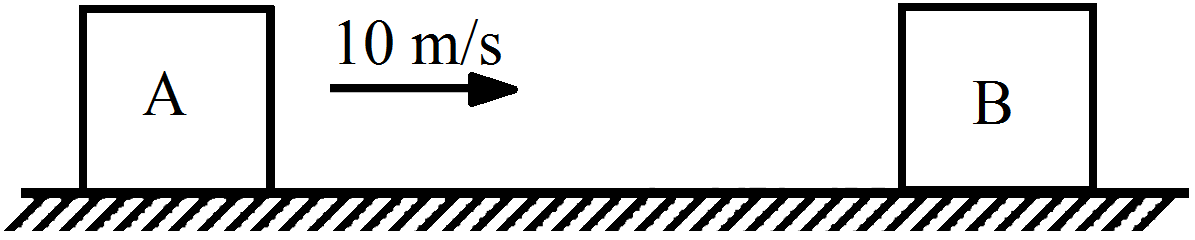
The blocks shown in figure have equal masses. blocks in the process. The surface of A is smooth but that of B has a friction coefficient of 0.10 with the floor. Block A is moving at a speed of 10m/s towards B which is kept at rest. Find the distance travelled by B if
  1. The collision is perfectly elastic
  2. The collision is perfectly inelastic. (Take $g = 10m/s^2)$
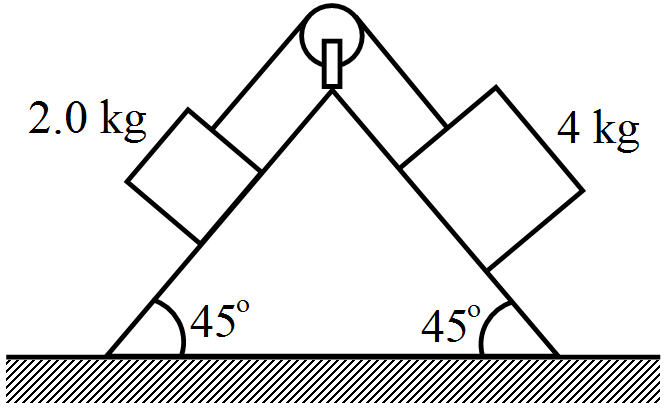
The pulley shown in figure has a radius $10cm$ and moment of inertia $0.5kg-m^2$ about its axis. Assuming the inclined planes to be frictionless, calculate the acceleration of the $4.0kg$ block.
Given below are some functions of x and t to represent the displacement of an elastic wave.$​​​​\text{y}=100\cos(100\pi\text{t+0.5x})$