Question
Explain with example α-decay.
${ }_2^4 He$.
iii. In the $\alpha$-decay process, the parent nucleus ${ }_{ Z }^{ A X}$ emits an $\alpha$-particle and produces daughter nucleus $Y$. The parent nucleus thus loses two protons (charge +2 ) and two neutrons. The total mass lost is $4 u$. The daughter nucleus will therefore, have mass 4 units less and charge 2 units less than its parent.
iv. General equation for α-decay process can be given as:
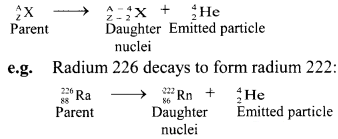
In α-decay process of radium, radon (daughter nuclei) is formed with loses of two protons (charge +2) and two neutrons. The total mass lost is 4 u.
Thus, radon has a mass of 4 units less and charge 2 units less than its parent radium.
Question H.
Energy produced in nuclear fusion is much larger than that produced in nuclear fission. Why is it difficult to use fusion to produce energy ?
Answer:
Generate a complete, print-ready paper with questions like this in minutes — across 16+ boards, with answer keys.