Explain with the help of a diagram, why a pencil partly immersed in water appears to be bent at the water surface.
CBSE DELHI - SET 1 2008
Download our app for free and get started
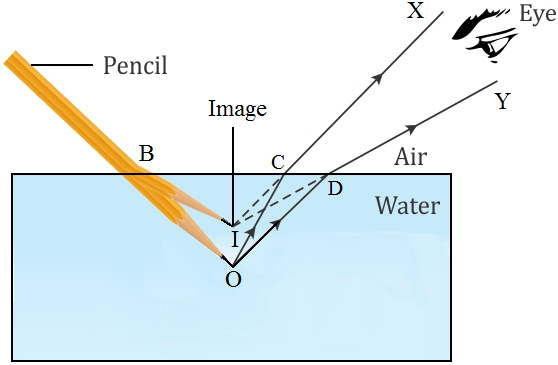 A pencil half immersed in water at an angle apperas bent due to refraction of light ar the air water surface. Figure shows a straight pencil AO whose lower portion BO is immersed in water. it appears to be bent at point B in the direction BI. A ray of light OC coming from the lower end O passes from water into air at C and gets refracted away from the normal in the direction CX Another ray OD gets refracted in the direction DY. The two refracted ray CX and DY, when produced backward, appear to meet at point I, nearer to the water surface than O Similarly each part of the immersed portion of the pencil raides. As A result immersed portion of the pencil appears to be bent when viewed at an angle from outside.
Alternate Answer
Incident rays from pecil travel form water to air, and they bend away from normal, To an observer image of the immersed part of the pencil forms at a different position and pencil appears to be bent.

Download our appand get started for free
Experience the future of education. Simply download our apps or reach out to us for more information. Let's shape the future of learning together!No signup needed.*
Similar Questions
- 1View SolutionAn object is placed at a distance of 12cm in front of a concave mirror of radius of curvature 30cm. List four characteristics of the image formed by the mirror.
- 2View SolutionA student places a candle flame at a distance of about 60 cm from a convex lens of focal length 10 cm and focuses the image of the flame on a screen. After that he gradually moves the flame towards the lens and each time focuses the image on the screen.
- In which direction-toward or away from the lens, does he move the screen to focus the image?
- How does the size of the image change?
- How does the intensity of the image change as the flame moves towards the lens?
- Approximately for what distance between the flame and the lens, the image formed on the screen is inverted and of the same size?
- 3View SolutionWhy can you not use a concave mirror as a rear-view mirror in vehicles?
- 4View SolutionIf the magnification of a body of size 1m is 2, what is the size of the image?
- 5View SolutionWhat is meant by:
Draw diagram to show the action of convex mirror on a beam of parallel light rays. Mark on this diagram principal axis, focus F, centre of curvature C, pole P and focal length ƒ, of the convex mirror. - 6View SolutionThe focal length of a lens is +150mm. What kind of lens is it and what is its power?
- 7View SolutionDraw ray diagrams showing the image formation by a convex lens when an object is placed:At twice the focal length of the lens.
- 8View SolutionDraw a ray diagram to show the formation of a real diminished image of an object by a convex lens. In your diagram, the position of object and image with respect to the principal focus should be shown clearly.
- 9View SolutionDraw ray diagrams showing the image formation by a concave mirror when an object is placed:
Between pole and focus of the mirror. - 10View Solution“A concave mirror of focal length ‘f’ can form a magnified erect as well as an inverted image of an object placed in front of it.” Justify this statement stating the position of the object with respect to the mirror in each case for obtaining these images.