Question
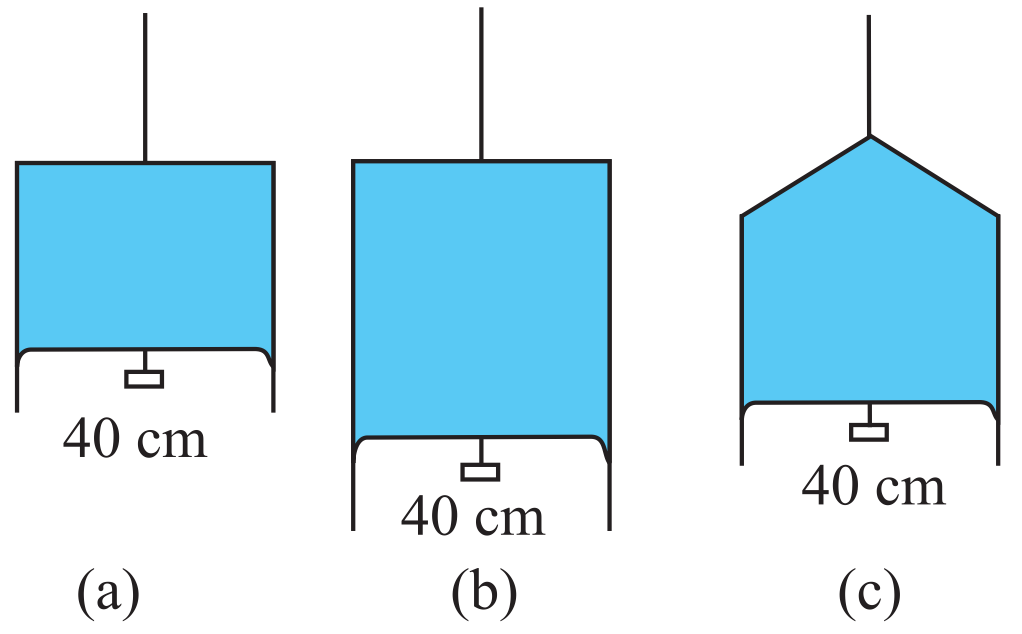
Figure (a) shows a thin liquid film supporting a small weight = $4.5 \times 10^{–2}N$. What is the weight supported by a film of the same liquid at the same temperature in Fig. (b) and (c)? Explain your answer physically.
Answer

Take case (a): The length of the liquid film supported by the weight, l = 40cm = 0.4cm The weight supported by the film, $W = 4.5 \times 10^{–2}N$ A liquid film has two free surfaces. Surface tension $=\frac{\text{W}}{2\text{l}}=4.5\times\frac{10^{-2}}{2\times0.4}=5.625\times10^{-2}\text{Nm}^{-1}$ In all the three figures, the liquid is the same. Temperature is also the same for each case. Hence, the surface tension in figure (b) and figure (c) is the same as in figure (a), i.e., $5.625 \times 10^{–2}N m^{–1}$. Since the length of the film in all the cases is 40cm, the weight supported in each case is $4.5 \times 10^{–2}N$.

Need a full question paper?

Generate a complete, print-ready paper with questions like this in minutes — across 16+ boards, with answer keys.

Start Generating Free

Similar questions

k transparent slabs are arranged one over another. The refractive indices of the slabs are $\mu_1,\mu_2,\mu_3, \ ...\mu_{\text{k}}$ and the thicknesses are $t_1, t_2, t_3, ... t_k$. An object is seen through this combination with nearly perpendicular light. Find the equivalent refractive index of the system which will allow the image to be formed at the same place.
Three particles of masses 1.0kg, 2.0kg and 3.0kg are placed at the corners A, B and C respectively of an equilateral triangle ABC of edge 1m. Locate the centre of mass of the system.
A balloon partially filled with Helium has a volume of $30m^3$, at the earth's surface, where pressure is $76cm$ of Hg and temperature is $27°C$. What will be the increase in volume of gas if balloon rises to a height, where pressure is $7.6cm$ of Hg and temperature is $-54°C$?
Consider a one-dimensional motion of a particle with total energy E. There are four regions A, B, C and D in which the relation between potential energy V, kinetic energy (K) and total energy E is as given below: Region A : V > E Region B : V < E Region C : K > E Region D : V > K State with reason in each case whether a particle can be found in the given region or not.
A source of sound operates at $2.0kHz, 20W$ emitting sound uniformly in all directions. The speed of sound in air is $340m/s$ and the density of air is $1.2kg/m^3$.
  1. What is the intensity at a distance of 6.0m from the source?
  2. What will be the pressure amplitude at this point?
  3. What will be the displacement amplitude at this point ?
Explain static friction and dynamic friction in detail.
Prove that the total mechanical energy remains constant for a ball of mass m dropped from a towe of height h.
Derive an expression for the moment of inertia of a thin uniform rod about an axis passing through its one end and perpendicular to its length. Also determine the radius of gyration about the same axis.
A particle executes simple harmonic motion with an amplitude of 10cm and time period 6s. At t = 0 it is at position x = 5cm going towards positive x-direction. Write the equation for the displacement x at time t. Find the magnitude of the acceleration of the particle at t = 4s.
$\hat{\text{i}}$ and $\hat{\text{j}}$ are unit vectors along x- and y- axis respectively. What is the magnitude and direction of the vectors $\hat{\text{i}}+\hat{\text{j}},$ and $\hat{\text{i}}-\hat{\text{j}}$? What are the components of a vector $\text{A}=2\hat{\text{i}}+3\hat{\text{j}}$ along the directions of $\hat{\text{i}}+\hat{\text{j}}$ and $\hat{\text{i}}-\hat{\text{j}}$? [You may use graphical method]