A paperweight in the form of a hemisphere of radius 3.0cm is used to hold down a printed page. An observer looks at the page vertically through the paperweight. At what height above the page will the printed letters near the centre appear to the observer?
Download our app for free and get started
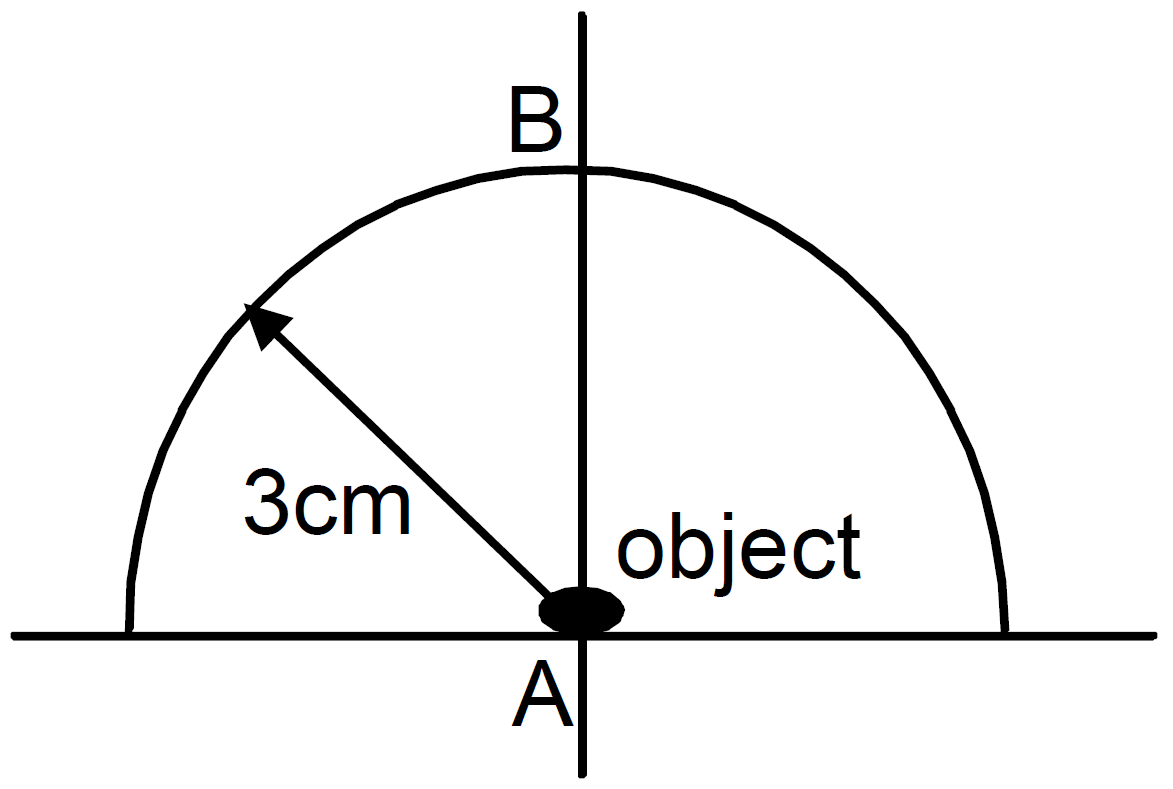
In the first refraction at A.
$\mu_2=\frac{3}{2}, \ \mu_1=1, \ \text{u}=0, \ \text{R}=\infty$
So, $\frac{\mu_2}{\text{v}}-\frac{\mu_1}{\text{u}}=\frac{\mu_2-\mu_1}{\text{R}}$
$\Rightarrow \frac{\frac{3}{2}}{\text{v}}-\frac{1}{0}=\frac{\mu_2-\mu_1}{\infty}$
$\Rightarrow\text{v}=0$ since $\big(\text{R}\Rightarrow\infty \ \text{and} \ \text{u}=0\big)$
$\therefore$ The image will be formed at the point, Now for the second refraction at B,
$\frac{\mu_2}{\text{v}}-\frac{\mu}{\text{u}}=\frac{\mu_2-\mu_1}{\text{R}}$
$\text{u}=-3\text{cm}, \ \text{R}=-3\text{cm}, \ \mu_1=\frac{3}{2}, \ \mu_2=1$
So, $\frac{1}{\text{v}}+\frac{3}{2\times3}=\frac{1-1.5}{-3}=\frac{1}{6}$
$\Rightarrow\frac{1}{\text{v}}=\frac{1}{6}-\frac{1}{2}=-\frac{1}{3}$
$\Rightarrow \text{v}=-3\text{cm},$
$\therefore$ There will be no shift in the final image.

Download our appand get started for free
Experience the future of education. Simply download our apps or reach out to us for more information. Let's shape the future of learning together!No signup needed.*
Similar Questions
- 1View SolutionA professor reads a greeting card received on his 50th birthday with +2.5D glasses keeping the card 25cm away. Ten years later, he reads his farewell letter with the same glasses but he has to keep the letter 50cm away. What power of lens should he now use?
- 2View SolutionA man with normal near point (25 cm) reads a book with small print using a magnifying glass: a thin convex lens of focal length 5 cm.
- What is the closest and the farthest distance at which he should keep the lens from the page so that he can read the book when viewing through the magnifying glass?
- What is the maximum and the minimum angular magnification (magnifying power) possible using the above simple microscope?
- 3A point object 'O' is kept in a medium of refractive index $n_1$ in front of a convex spherical surface of radius of curvature R which separates the second medium of refractive index $n_2$ from the first one, as shown in the figure.View Solution
- Draw the ray diagram showing the image formation and deduce the relationship between the object distance and the image distance in terms of $n_1, n_2$ and R.
- When the image formed above acts as a virtual object for concave spherical, surface separating the medium $n_2$ from $n_1 (n_2> n_1)$, draw this ray diagram and write the similar (similar to (a) relation. Hence obtain the expression for the lens maker's formula.
- 4Three immiscible liquids of densities $d_1 > d_2 > d_3$ and refractive indices $\mu _1 > \mu _2 > \mu _3$ are put in a beaker. The height of each liquid column is $\frac{\text{h}}{3}$. A dot is made at the bottom of the beaker. For near normal vision, find the apparent depth of the dot.View Solution
- 5View SolutionAn angular magnification (magnifying power) of 30X is desired using an objective of focal length 1.25 cm and an eyepiece of focal length 5 cm. How will you set up the compound microscope?
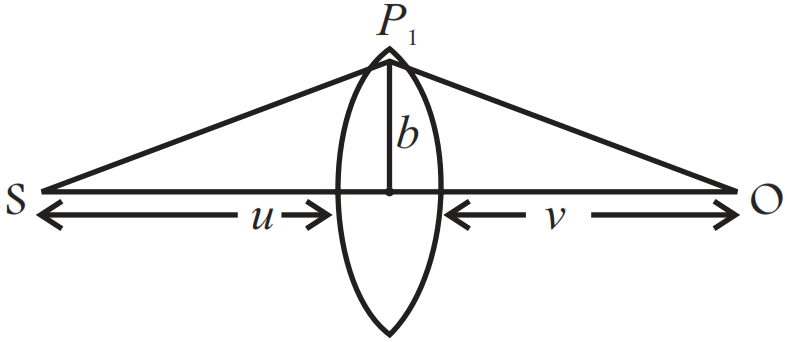
- 6Consider a thin lens placed between a source (S) and an observer (O) (Fig). Let the thickness of the lens vary as $\text{w}\text{(b)}=\text{w}_0-\frac{\text{b}^2}{\alpha}$, where b is the verticle distance from the pole. $w_0$ is a constant. Using Fermat’s principle i.e. the time of transit for a ray between the source and observer is an extremum, find the condition that all paraxial rays starting from the source will converge at a point O on the axis. Find the focal length.View Solution
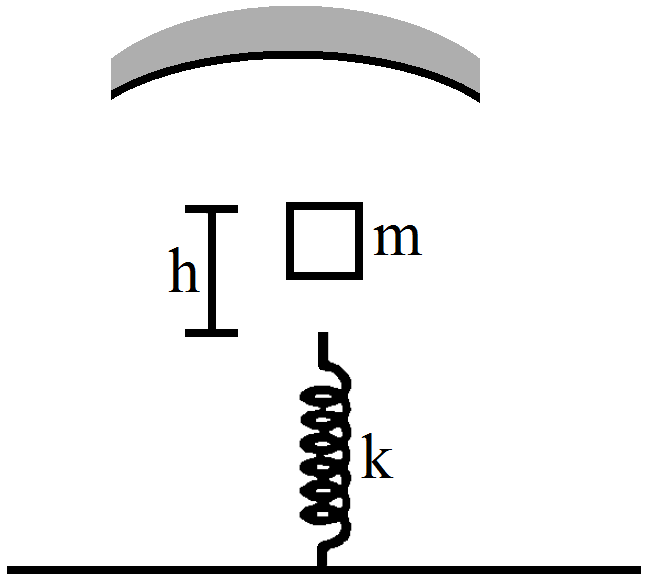
- 7View SolutionA mass m = 50g is dropped on a vertical spring of spring constant 500N/m from a height h = 10cm as shown in figure. The mass sticks to the spring and executes simple harmonic oscillations after that. A concave mirror of focal length 12cm facing the mass is fixed with its principal axis coinciding with the line of motion of the mass, its pole being at a distance of 30cm from the free end of the spring. Find the length in which the image of the mass oscillates.
- 8View Solution
- State Huygen’s principle. Using this principle draw a diagram to show how a plane wave front incident at the interface of the two media gets refracted when it propagates from a rarer to a denser medium. Hence verifiy Snell’s law of refraction.
- When monochromatic light travels from a rarer to a denser medium, explain the following, giving reasons:
- Is the frequency of reflected and refracted light same as the frequency of incident light?
- Does the decrease in speed imply a reduction in the energy carried by light wave?
- 9View SolutionAn eye can distinguish between two points of an object if they are separated by more than 0.22mm when the object is placed at 25cm from the eye. The object is now seen by a compound microscope having a 20D objective and 10D eyepiece separated by a distance of 20cm. The final image is formed at 25cm from the eye. What is the minimum separation between two points of the object which can now be distinguished?
- 10View Solution
- Draw a ray diagram to show the image formation by a combination of two thin convex lenses in contact. Obtain the expression for the power of this combination in terms of the focal lengths of the lenses.
- A ray of light passing from air through an equilateral glass prism undergoes minimum deviation when the angle of incidence is $\frac{3}{4}^{th}$ of the angle of prism. Calculate the speed of light in the prism.