Question
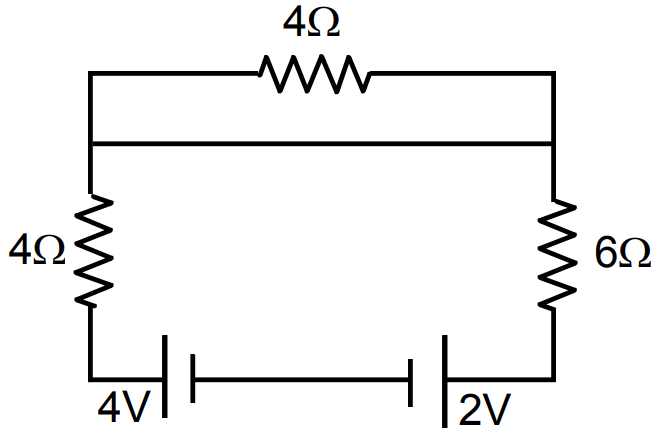
Find the currents through the three reaiators shown in figure.

Answer


  1. Current through (1) $4\Omega$ resistor = 0
  2. Current through (2) and (3)
net E = 4V - 2V = 2V

(2) and (3) are in series,

$\text{R}_\text{eff}=4+6=10\Omega$

$\text{i}=\frac{2}{10}=0.2\text{A}$

Current through (2) and (3) are 0.2A.

Need a full question paper?

Generate a complete, print-ready paper with questions like this in minutes — across 16+ boards, with answer keys.
Start Generating Free

Similar questions

  1. Draw the circuit diagrams of a p-n junction diode in (i) forward bias, (ii) reverse bias. How are these circuits used to study the V - I characteristics of a silicon diode? Draw the typical V - I characteristics.
  2. What is a light emitting diode (LED)? Mention two important advantages of LEDs over conventional lamps.
When a proton is released from rest in a room, it starts with an initial acceleration $a_0$​​​​​​​ towards west. When it is projected towards north with a speed $v_0$, it moves with an initial acceleration $3a_0$ towards west. Find the electric field and the maximum possible magnetic field in the room.
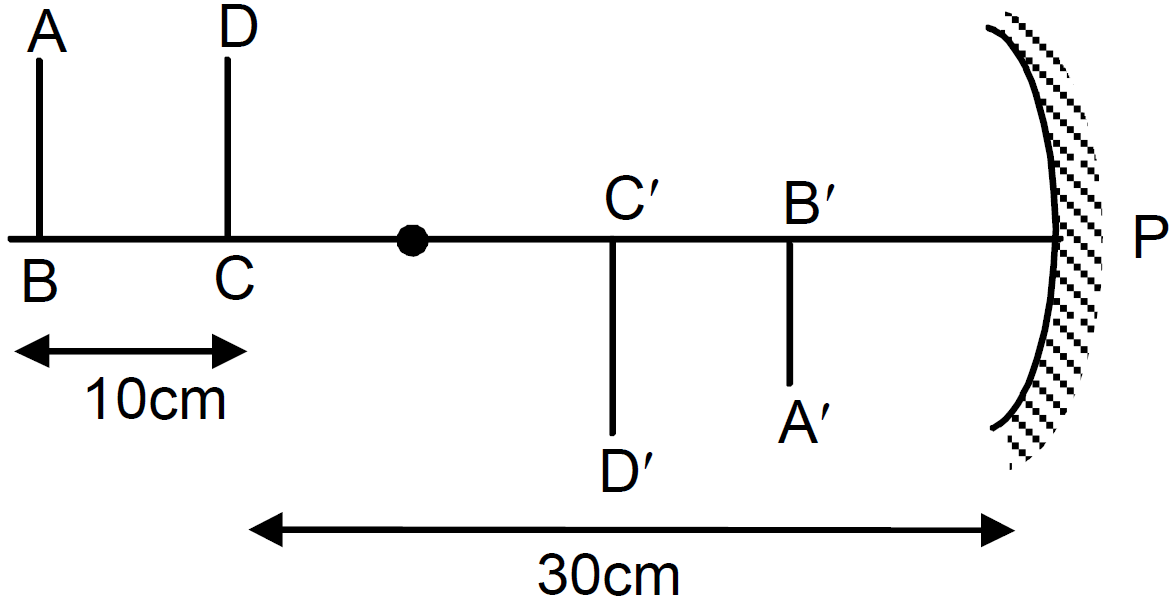
A U-shaped wire is placed before a concave mirror having radius of curvature 20cm. Find the total length of the image.
Two wires of equal length, one of aluminium and the other of copper have the same resistance. Which of the two wires is lighter? Hence explain why aluminium wires are preferred for overhead power cables.
$(\rho_{\text{A}1}=2.63\times10^{-8}\Omega\ \text{m,}\ \text{Relative density of Al}=2.7,\ \text{of Cu}=8.9)$
What will be the path difference between two light waves $y_1=a_1 \sin \omega t$ and $y_2=a_2 \cos (\omega t+$ $\phi)$ ?
Two equal charges, $2.0 \times 10^{-7}C$ each, are held fixed at a separation of 20cm. A third charge of equal magmtude is placed midway between the two charges. It is now moved to a point 20cm from both the charges. How much work is done by the electric field durmg the process?
  1. With the help of a suitable ray diagram, derive the mirror formula for a concave mirror.
  2. The near point of a hypermetropic person is 50 cm from the eye. What is the power of the lens required to enable the person to read clearly a book held at 25 cm from the eye?
Find the rms speed of hydrogen molecules in a sample of hydrogen gas at 300K. Find the temperature at which the rms speed is double the speed calculated in the previous part.
Briefly explain the principle of a capacitor. Derive an expression for the capacitance of a parallel plate capacitor, whose plates are separated by a dielectric medium.
Find the magnitude of the electric field at a point 4cm away from a line charge of density $2 \times 10^{-6}Cm^{-1}.$