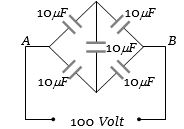
Five capacitors of $10\,\mu F$ capacity each are connected to a $d.c.$ potential of $100\;volts$ as shown in the adjoining figure. The equivalent capacitance between the points $A$ and $B$ will be equal to..........$\mu F$
Medium
Download our app for free and get started
(d) In the given system, no current will flow through the branch $CD$ so it can be removed
Effective capacitance of the system $ = 5 + 5 = 10\,\mu F$
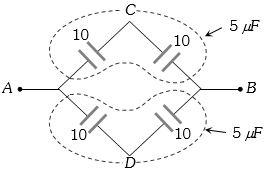
Effective capacitance of the system $ = 5 + 5 = 10\,\mu F$

Download our appand get started for free
Experience the future of education. Simply download our apps or reach out to us for more information. Let's shape the future of learning together!No signup needed.*
Similar Questions
- 1Two point charges $-q$ and $+q$ are located at points $(0, 0, -a)$ and $(0, 0, a),$ respectively. The potential at a point $(0, 0, z)$ where $z > a$ isView Solution
- 2Electric potential is given byView Solution
$V = 6x - 8x{y^2} - 8y + 6yz - 4{z^2}$
Then electric force acting on $2\,C$ point charge placed on origin will be......$N$
- 3In a certain reglon of space with volume $0.2\, m ^{3}$ the electric potential is found to be $5\, V$ throughout. The magnitude of electric field in this region is ______ $N/C$View Solution
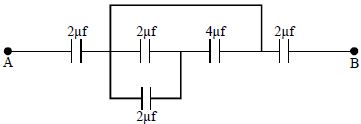
- 4Find the equivalent capacitance between $A$ and $B$.......$\mu f$View Solution
- 5View SolutionWork done in moving a positive charge on an equipotential surface is
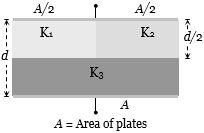
- 6A parallel plate capacitor of area $A$, plate separation $d$ and capacitance $C$ is filled with three different dielectric materials having dielectric constants ${k_1},{k_2}$ and ${k_3}$ as shown. If a single dielectric material is to be used to have the same capacitance $C$ in this capacitor, then its dielectric constant $k$ is given byView Solution
- 7The plates of a parallel plate capacitor of capacity $50\,\mu C$ are charged to a potential of $100\;volts$ and then separated from each other so that the distance between them is doubled. How much is the energy spent in doing soView Solution
- 8The given figure shows, two parallel plates $A$ and $B$ of charge densities $+\sigma$ and $-\sigma$ respectively. Electric intensity will be zero in regionView Solution

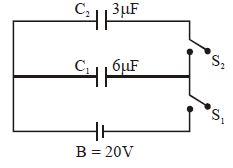
- 9In the circuit shown here $C_1 = 6\,\mu F, C_2 = 3 \,\mu F$ and battery $B = 20\,V$. The switch $S_1$ is first closed. It is then opened and afterwards $S_2$ is closed. What is the charge (in $\mu F$)finally on $C_2$ ?View Solution
- 10Three charges $Q,( + q)$ and $( + q)$ are placed at the vertices of an equilateral triangle of side l as shown in the figure. If the net electrostatic energy of the system is zero, then $Q$ is equal toView Solution