MCQ
For a certain gas, the ratio of specific heats is given to be $\gamma = 1.5$. For this gas
  • A
    ${C_v} = \frac{{3R}}{J}$
  • ${C_p} = \frac{{3R}}{J}$
  • C
    ${C_p} = \frac{{5R}}{J}$
  • D
    ${C_V} = \frac{{5R}}{J}$

Answer

Correct option: B.
${C_p} = \frac{{3R}}{J}$
b
${C_P} - {C_V} = \frac{R}{J}$

$\Rightarrow$  ${C_P} = \frac{R}{J} + {C_V} = \frac{R}{J} + \frac{R}{{J(\gamma  - 1)}}$

$\Rightarrow$  ${C_P} = \frac{R}{J}\left( {\frac{\gamma }{{\gamma  - 1}}} \right) = \frac{R}{J}\left( {\frac{{1.5}}{{1.5 - 1}}} \right) = \frac{{3R}}{J}$

Need a full question paper?

Generate a complete, print-ready paper with questions like this in minutes — across 16+ boards, with answer keys.
Start Generating Free

Similar questions

A rocket is ejecting $50\,g$ of gases per sec at a speed of $500\,m/s.$ The accelerating force on the rocket will be ............ $N$
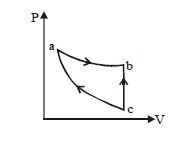
An ideal gas expands isothermally along $ab$ and does $600\,J$ of work. During the process
A particle of mass $2\, kg$ is moving such that at time $t$, its position, in meter, is given by $\overrightarrow r \left( t \right) = 5\hat i - 2{t^2}\hat j$ . The angular momentum of the particle at $t\, = 2\, s$ about the origin in $kg\, m^{-2}\, s^{-1}$ is
Two vectors $\overrightarrow A $and $\overrightarrow B $lie in a plane, another vector $\overrightarrow C $lies outside this plane, then the resultant of these three vectors i.e.,$\overrightarrow A + \overrightarrow B + \overrightarrow C $
Sound waves of wavelength $\pi$ travelling in a medium with a speed of $v\ m/ s$ enter into another medium where its speed is $2v\ m/ s$. Wavelength of sound waves in the second medium is:
Equal mass of three liquids are kept in three identical cylindrical vessels $A, B$ and $C$. The densities are $P_A, P_B, P_C$ with $P_A$   
When a ceiling fan is switched off, its angular velocity falls to half while it makes $36$ $rotations.$ How many more rotations will it make before coming to rest (Assume uniform angular retardation)
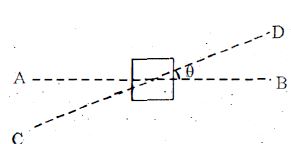
Let $I$ be the moment of inetia of a uniform square plate about an axis $AB$ that passes though its centre and is parallel to two of its sides. $CD$ is a line in the plane of the plate that passes through the centre of the plate and makes an angle $\theta $ with $AB$ . The moment of inertia of the plate about the axis $CD$ is then equal to
A body moves in a circular orbit of radius $R$ under the action of a central force. Potential due to the central force is given by $V(r)=k r$ ( $k$ is a positive constant). Period of revolution of the body is proportional to
Find the amount of heat supplied to decrease the volume of an ice water mixture by $1 \,\,cm^3$ without any change in temperature. $(\rho_ {ice} = 0.9 \rho_{water}, L_{ice} = 80 \,\,cal/gm).$ ......... $cal$