Two dielectric slab of dielectric constant $K_1$ and $K_2$ and of same thickness is inserted in parallel plats capacitor and $K_1 = 2K_2$ . Potential difference across slabs are $V_1$ and $V_2$ respectively then
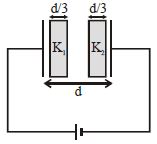
Medium
Download our app for free and get started

Download our appand get started for free
Experience the future of education. Simply download our apps or reach out to us for more information. Let's shape the future of learning together!No signup needed.*
Similar Questions
- 1Two condensers of capacities $2C$ and $C$ are joined in parallel and charged upto potential $V$. The battery is removed and the condenser of capacity $C$ is filled completely with a medium of dielectric constant $K$. The $p.d.$ across the capacitors will now beView Solution
- 2If $3$ charges are placed at the vertices of equilateral triangle of charge ‘$q$’ each. What is the net potential energy, if the side of equilateral triangle is $l\, cm$View Solution
- 3Three concentric metallic spherical shell $A, B$ and $C$ or radii $a, b$ and $c$ $(a < b < c)$ have surface charge densities $- \sigma , + \sigma ,$ and $- \sigma $ respectively. The potential of shell $A$ is :View Solution
- 4In the circuit shown in figure charge stored in the capacitor of capacity $5\ \mu f$ is......$ \mu C$View Solution
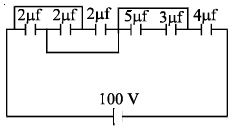
- 5A capacitor of capacitance $C$ is charged with the help of a $200 \,V$ battery. It is then discharged through a small coil of resistance wire embedded in a thermally insulated block of specific heat capacity $2.5 \times 10^2 \,J / kg$ and mass $0.1 \,kg$. If the temperature of the block rises by $0.4 \,K$, the value of $C$ isView Solution
- 6A parallel plate capacitor with plate separation $5$ $\mathrm{mm}$ is charged up by a battery. It is found that on introducing a dielectric sheet of thickness $2 \mathrm{~mm}$, while keeping the battery connections intact, the capacitor draws $25 \%$ more charge from the battery than before. The dielectric constant of the sheet is_____.View Solution
- 7$64$ drops of mercury each charged to a potential of $10\,V$. They are combined to form one bigger drop. The potential of this drop will be.......$V$ (Assume all the drops to be spherical)View Solution
- 8Two capacitances of capacity ${C_1}$ and ${C_2}$ are connected in series and potential difference $V$ is applied across it. Then the potential difference across ${C_1}$ will beView Solution
- 9View SolutionThe charge given to any conductor resides on its outer surface, because
- 10A charge of $10 \,\mu C$ is placed at the origin of $x-y$ coordinate system. The potential difference between two points $(0, a)$ and $(a, 0)$ in volt will beView Solution