Question
For the reaction : $2\text{NO}_\text{(g)}+\text{Cl}_{2\text{(g)}}\rightarrow2\text{NOCl}_\text{(g)},$ the following data were collected. All the measurements were taken at $263K.$
Experiment No.
Initial [NO] (M)
Initial $[Cl_2]$ (M)
Initial rate of disapp. of $Cl_2 $ (M/ min)
$1.$
$0.15$
$0.15$
$0.60$
$2.$
$0.15$
$0.30$
$1.20$
$3.$
$0.30$
$0.15$
$2.40$
$4.$
$0.25$
$0.25$
$?$
The following questions are multiple choice questions. Choose the most appropriate answer:
  1. The molecularity of the reaction is:
  1. $1$
  2. $2$
  3. $3$
  4. $4$
  1. The expression for rate law is:
  1. $\text{r}=\text{k}[\text{NO}][\text{Cl}_2]$
  2. $\text{r}=\text{k}[\text{NO}]^2[\text{Cl}_2]$
  3. $\text{r}=\text{k}[\text{NO}][\text{Cl}_2]^2$
  4. $\text{r}=\text{k}[\text{NO}]^2[\text{Cl}_2]^2$
  1. The overall order of the reaction is:
  1. $2$
  2. $0$
  3. $1$
  4. $3$
  1. The value of rate constant is:
  1. $150.32\ M^{-2} \min^{-1}$
  2. $200.08\ M^{-1} \min^{-1}$
  3. $177.77\ M^{-2} \min^{-1}$
  4. $155.75\ M^{-1} \min^{-1}$
  1. The initial rate of disappearance of $Cl_2$ in experiment $4$ is:
  1. $1.75M\ \min^{-1}$
  2. $3.23M\ \min^{-1}$
  3. $2.25M\ \min^{-1}$
  4. $2.77M\ \min^{-1}$

Answer

  1. (c) $3$
Explanation:
$2\text{NO}_\text{(g)}+\text{Cl}_{2\text{(g)}}\rightarrow2\text{NOCl}_\text{(g)}$
Molecularity $= 3$
  1. (b) $\text{r}=\text{k}[\text{NO}]^2[\text{Cl}_2]$
Explanation:
Let rate of this reaction, $\text{r}=\text{k}[\text{NO]}^\text{m}[\text{Cl}_2]^\text{n}$
then $\frac{\text{r}_1}{\text{r}_2}=\frac{0.60}{1.20}=\frac{\text{k}(0.15)^\text{m}(0.15)^\text{n}}{\text{k}(0.15)^\text{m}(0.30)^\text{n}}$
or, $\frac{1}{2}=\Big(\frac{1}{2}\Big)^\text{n}\Rightarrow\text{n}=1$
Again from $\frac{\text{r}_2}{\text{r}_3}=\frac{1.20}{2.40}=\frac{\text{k}(0.15)^\text{m}(0.30)^\text{n}}{\text{k}(0.30)^\text{m}(0.15)^\text{n}}$
or $\frac{1}{2}=\Big(\frac{1}{2}\Big)^\text{m}\cdot\frac{2}{1}$ or $\frac{1}{4}=\Big(\frac{1}{2}\Big)^\text{m}\Rightarrow\text{m}=2$
Hence, expression for rate law is
$\text{r}=\text{k}[\text{NO}]^2[\text{Cl}_2]^1$
  1. (d) $3$
Explanation:
As the order w.r.t. $NO$ is $2$ and order w.r.t. $Cl_2$ is $1,$ hence the overall order is $3.$
  1. (c) $177.77\ M^{-2}\ \min^{-1}$
Explanation:
Substituting the values of experiment 1 in rate law expression
$0.60M\ \min^{-1} = k(0.15M)^2 (0.15M)^1$
or $\text{k}=\frac{0.60\text{M min}^{-1}}{0.0225\times0.15\text{M}^3}=177.77\text{M}^{-2}\text{min}^{-1}$
  1. (d) $2.77  M\ \min^{-1}$​​​​​​​
Explanation:
$r = 177.7  M^{-2} \ \min^{-1} \times (0.25M)^2 (0.25M)$
$= 2.77  M \ \min^{-1}$

Need a full question paper?

Generate a complete, print-ready paper with questions like this in minutes — across 16+ boards, with answer keys.

Start Generating Free

Similar questions

Read the passage given below and answer the following questions:
Amines are basic in nature. The basic strength of amines can be expressed by their dissociation constant, $K_b$ or $pK_b$.
$\text{RNH}_2+\text{H}_2\text{O}\rightleftharpoons\text{RNH}^+_3+\text{OH}^-$
$\text{k}_\text{b}=\frac{[\text{RNH}^+_3][\text{OH}^-]}{[\text{RNH}_2]}\text{and}\text{ pk}_\text{b}=-\log\text{k}_\text{b}$
Greater the $K_b$ value or smaller the $pK_b$​​​​​​​ value, more is the basic strength of a mine. Aryl amines such as aniline are less basic than aliphatic amines due to the involvement of lone pair of electrons on N-atom with the resonance in benzene. In derivatives of aniline, the electron releasing groups increase the basic strength while electron withdrawing groups decrease the basic strength. The base weakening effect of electron withdrawing group and base strengthening effect of electron releasing group is more marked at p-position than at m-position. a-Substituted aniline is less basic than aniline due to ortho effect and is probable due to combination of electronic and steric effect.
The following questions are multiple choice questions. Choose the most appropriate answer:
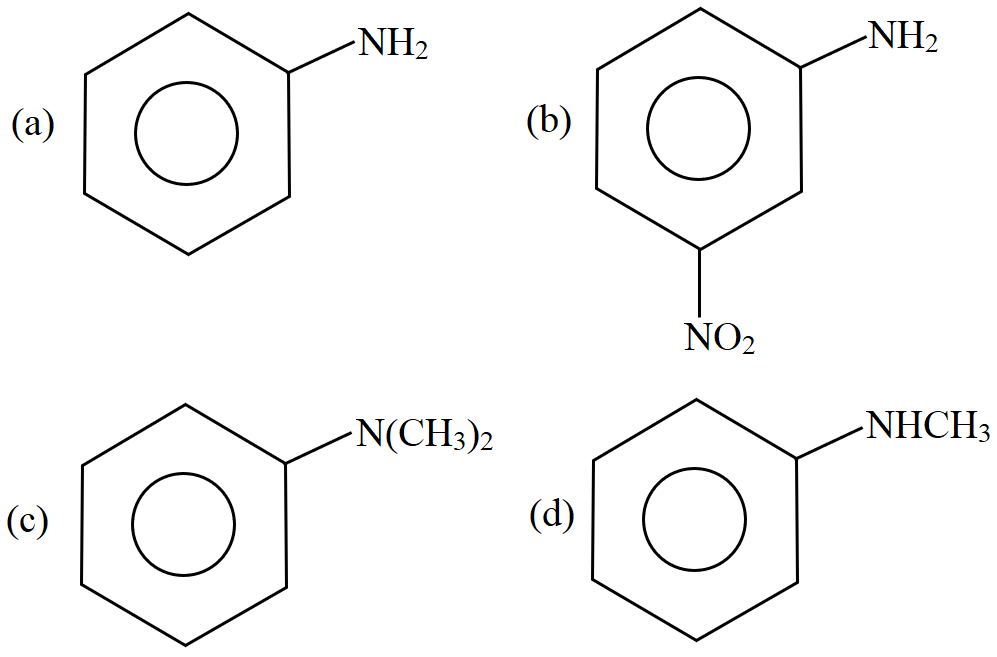
  1. Which of the following has lowest $pK_b$ value?
  1. The strongest base among the following is:
  1. $C_6H_5NH_2$
  2. $p-NO_2 - C_6H_4NH_2$
  3. $m-NO_2 - C_6H_4NH_2$
  4. $C_6H_5CH_2NH_2$
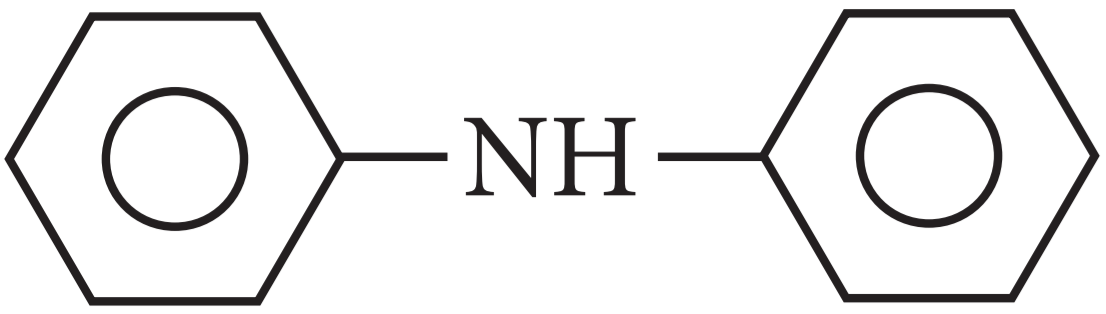
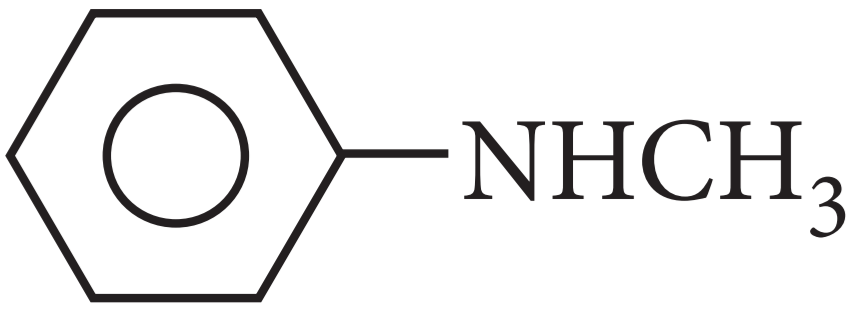
  1. Maximum $pK_b​​​​​​​$​​​​​​​ value of:
  1.  
  1.  
  1. $(CH_3CH_2)_2NH$
  2. $(CH_3)_2NH$
  1. The order of basic strength among the following amines in benzene solution is:
  1. Methylamine is more basic than $NH_3$.
  2. Amines form hydrogen bonds.
  3. Ethylamine has higher boiling point than propane.
  4. Dimethylamine is less basic than methylamine.
  1. $CH_3CH_2NH_2$ contains a basic $-NH_2$ group, but $CH_3CONH_2$​​​​​​​ does not because:
  1. Acetamide is amphoteric in character.
  2. In ethylamine the electron pair on N-atom is delocalised by resonance.
  3. In ethylamine there is no resonance while in acetamide the lone pair of electrons on N-atom is delocalised and is less available for protonation.
  4. None of these.
The electrochemical cell shown below is concentration cell.
$M \mid M ^{2+}$ (saturated solution of a sparingly soluble salt, $\left.MX _2\right)\left|\left| M ^{2+}\left(0.001 mol dm ^{-3}\right)\right| M\right.$ The emfof the cell depends on the difference in concentrations of $M ^{2+}$ ions at the two electrodes. The emf of the cell at 298 K is 0.059 V . The following questions are multiple choice questions. Choose the most appropriate answer:
  1. The solubility product ($K_{sp'} mol^3 dm^{-9})$ of $MX_2$ at 298 K based on the information available for the given concentration cell is $(\text{take }2.303 \times \text{R}\times \frac{298}{\text{F}} = 0.059)$
  1. $2 \times 10^{-15}$
  2. $4 \times 10^{-15}​​​​​​​$
  3. $3 \times 10^{-12}​​​​​​​$
  4. $1 \times 10^{-12}​​​​​​​$
  1. The value of $\triangle\text{G}$ (in kJ $mol^{-1}​​​​​​​$) for the given cell is (take $1 F = 96500 C mol^{-1})$
  1. 3.7
  2. -3.7
  3. 10.5
  4. -11.4
  1. The equilibrium constant for the foUowing reaction is:
$\text{Fe}^{2+}+\text{Ce}^{4+}\rightleftharpoons\text{Ce}^{3+}+\text{Fe}^{3+}$

(Given, $\text{E}^\circ_\frac{\text{Ce}^{4+}}{\text{Ce}^{3+}}=1.44\text{V}$ and $\text{E}^\circ_\frac{\text{Fe}^{3+}}{\text{Fe}^{2+}}=0.68\text{V}$)
  1. $7.6 \times 10^{12}$​​​​​​​
  2. $6.5 \times 10^{10}$
  3. $5.2 \times 10^9$
  4. $3.4 \times 10^{12}​​​​​​​$
  1. The solubility product of a saturated solution of $Ag_2CrO_4 $in water at 298 K if the emf of the cell
$Ag|Ag^+ (satd. Ag_2CrO_4 soln) || Ag^+ (0.1 M) | Ag$

is 0.164V at 298 K, is:
  1. $3.359 \times 10^{-12} mol^3 L^{-3}$​​​​​​​
  2. $2.287 \times 10^{-12} mol^3 L^{-3}$
  3. $1.158 \times 10^{-12} mol^3 L^{-3}$
  4. $4.135 \times 10^{-12} mol^3 L^{-3}$
  1. To calculate the emf of the cell, which of the foUowing options is correct?
  1. emf $= E_{cathode}- E_{anode}$​​​​​​​
  2. emf $= E_{anode}- E_{cathode}$
  3. emf $= E_{anode} + E_{cathode}$
  4. None of these.
Read the passage given below and answer the following questions:
Coordination compounds are formulated and named according to the IUPAC system.
Few rules for naming coordination compounds are:
  1. In ionic complex, the cation is named first and then the anion.
  2. In the coordination entity, the ligands are named first and then the central metal ion.
  3. When more than one type of ligands are present, they are named in alphabetical order of preference without any consideration of charge.
The following questions are multiple choice questions. Choose the most appropriate answer:
  1. The IUPAC name of the complex $[Pt(NH_3)_3Br(NO_2)Cl]Cl$ is:
  1. Triamminechlorobromonitroplatinum (IV) chloride.
  2. Triamminebromonitrochloroplatinum (IV) chloride.
  3. Triamminebromidochloridonitroplatinum (IV) chloride.
  4. Triamminenitrochlorobromoplatinum (IV) chloride.
  1. The IUPAC name of $[Ni(CO)_4]$ is:
  1. Tetracarbonylnickel (II).
  2. Tetracarbonylnickel (0).
  3. Tetracarbonylnickelate (II).
  4. Tetracarbonylnickelate (0).
  1. As per IUPAC nomenclature, the name of the complex $[Co(H_2O)_4(NH_3)_2]Cl_3$ is:
  1. Tetraaquadiamminecobalt (II) chloride.
  2. Tetraaquadiamminecobalt (III) chloride.
  3. Diamminetetraaquacobalt (II) chloride.
  4. Diamminetetraaquacobalt (III) chloride.
  1. Which of the following represents correct formula of dichloridobis(ethane -1, 2-diamine)cobalt (III) ion?
  1. $[CoCl_2(en)]^{2+}$
  2. $[CoCl_2(en)_2]^{2+}$
  3. $[CoCl_2(en)]^+$
  4. $[CoCl_2(en)_2]^+$
  1. Correct formula of pentaamminenitro$-O-$cobalt (III) sulphate is:
  1. $[Co(NO_2)(NH_3)_5]SO_4$
  2. $[Co(ONO)(NH_3)_5]SO_4$
  3. $[Co(NO_2)(NH_3)_4](SO_4)_2$
  4. $[Co(ONO)(NH_3)_4](SO_4)_2$
Dependence of the rate of reaction on the concentration of reactants, temperature, and other factors is the most general method for weeding out unsuitable reaction mechanisms. The term mechanism means all the individual collisional or elementary processes involving molecules $($atoms, radicals, and ions included$)$ that take place simultaneously or consecutively to produce the observed overall reaction. For example, when hydrogen gas reacts with bromine, the rate of the reaction was found to be proportional to the concentration of $H_2$ and to the square root of the concentration of $Br_2.$ Furthermore, the rate was inhibited by increasing the concentration of $HBr$ as the reaction proceeded. These observations are not consistent with a mechanism involving bimolecular collisions of a single molecule of each kind. The currently accepted mechanism is considerably more complicated, involving the dissociation of bromine molecules into atoms followed by reactions between atoms and molecules: It is clear from this example that the mechanism cannot be predicted from the overall stoichiometry. $($source: Moore, $J. W.,$ Pearson, $R. G. (1981).$ Kinetics and mechanism. John Wiley Sons.$)$
$(a).$ Predict the expression for the rate of reaction and order for the following:
$H_2 + Br_2 \rightarrow 2 HBr$
What are the units of rate constant for the above reaction?
$(b).$ How will the rate of reaction be affected if the concentration of $Br_2$ is tripled?
Read the passage given below and answer the following questions:
Nucleophilic substitution reactions are of two types; substitution nucleophilic bimolecular $(S_N2)$ and substitution nucleophilic unimolecular $(S_N1)$ depending on molecules taking part in determining the rate of reaction. Reactivity of alkyl halide towards $S_N1$ and $S_N2$ reactions depends on various factors such as steric hindrance, stability of intermediate or transition state, and polarity of solvent. $S_N2$ reaction mechanism is favoured mostly by primary alkyl halide then secondary and then tertiary. This order is reversed in case of $S_N1$ reactions.
The following questions are multiple choice questions. Choose the most appropriate answer:
  1. Which of the following is most reactive towards nucleophilic substitution reaction?
  1. $C_6H_5Cl$
  2. $CH_2 = CHCl$
  3. $ClCH_2CH = CH_2$
  4. $CH_3CH = CHCl$
  1. Isopropyl chloride undergoes hydrolysis by:
  1. $S_N1$ mechanism.
  2. $S_N2$ mechanism.
  3. $S_N1$ and $S_N2$ mechanism.
  4. Neither $S_N1$ nor $S_N2$ mechanism.
  1. The most reactive nucleophile among the following is:
  1. $CH_3O^-$
  2. $C_6H_5O^-$
  3. $(CH_3)_2CHO^-$
  4. $(CH_3)_3CO^-$
  1. Tertiary alkyl halides are practically inert to substitution by $S_N2$ mechanism because of:
  1. Insolubility.
  2. Instability.
  3. Inductive effect.
  4. Stearic hindrance.
  1. Which of the following is the correct order of decreasing $S_N2$ reactivity?
  1. $RCH_2X > R_2CHX > R_3CX$
  2. $R_3CX > R_2CHX > RCH_2X$
  3. $R_2CHX > R_3CX > RCH_2X$
  4. $RCH_2X > R_3CX > R_2CHX$
Read the passage given below and answer the following questions:
The halogen elements show great resemblances to one another in their chemical behaviour and properties of their compounds with other elements. There is, however, a progressive change in properties from F through $Cl, Br,$ and I to At. F is most reactive among the halogens and in fact, from all other elements and it has certain other properties that set it apart from the other halogens.
In these questions (Q.No. i - iv), a statement of assertion followed by a statement of reason is given. Choose the correct answer out of the following choices.
  1. Assertion and reason both are correct statements and reason is correct explanation for assertion.
  2. Assertion and reason both are correct statements but reason is not correct explanation for assertion.
  3. Assertion is correct statement but reason is wrong statement.
  4. Assertion is wrong statement but reason is correct statement.
  1. Assertion: $F_2 $ has high reactivity.
Reason: $F_2$ has low bond dissociation enthalpy.
  1. Assertion: The bond between $F - F$ is weaker than between $Cl - Cl.$
Reason: Atomic size of $F$ is smaller than that of $Cl.$
  1. Assertion: Fluoride does not show oxidation number greater than zero.
Reason: The halogens chlorine, bromine and iodine can show positive oxidation state of $+1, +3$ and $+7.$
  1. Assertion: F atom has less negative electron affinity than Cl atom.
Reason: Additional electrons are repelled more effectively by $3p-$electrons in $Cl$ than by $2p-$electrons in Fatom.
  1. Assertion: Fluorine is strongest oxidising agent in halogens.
Reason: It displaces other halogens from its aqueous solution.

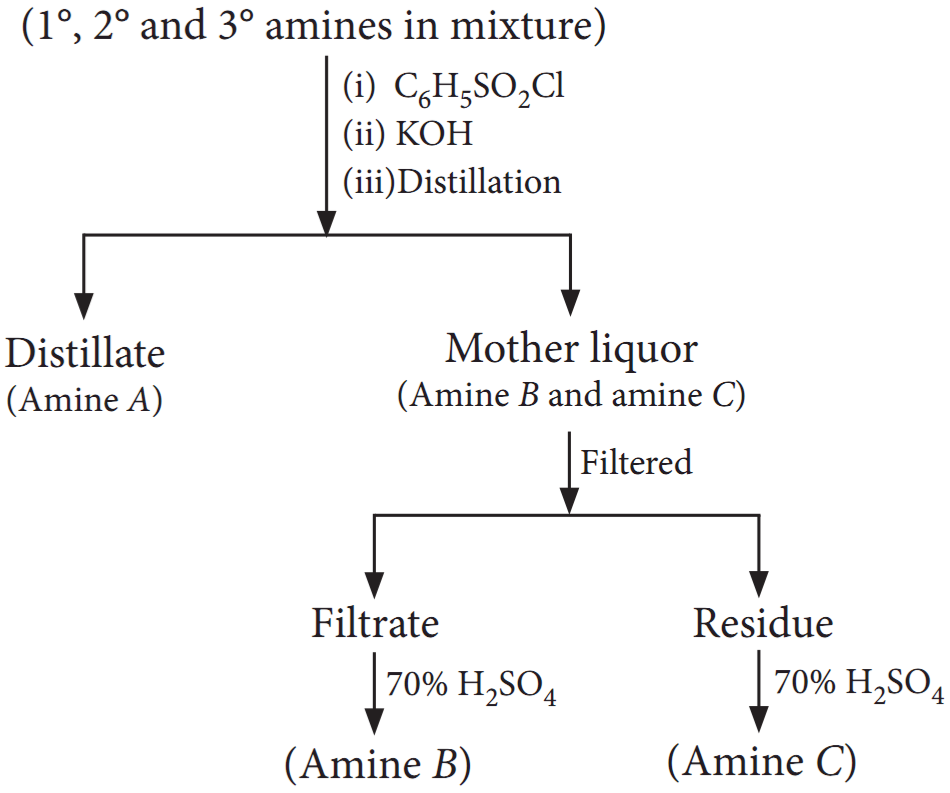
When the mixture contains the three amine salts (1º, 2º and 3º) along with quaternary salt, it is distilled with KOH solution. The three amines distill, leaving the quaternary salt unchanged in the solution. Then the mixture of amines is separated by fractional distillation, Hinsberg's method and Hoffmann's method.

The following questions are multiple choice questions. Choose the most appropriate answer:
  1. Hinsberg reagent is:
  1. Aliphatic sulphonyl chloride.
  2. Phthalamide.
  3. Aromatic sulphonyl chloride.
  4. Anhydrous ZnCl2 + cone. HCI.
  1. Primary amine with Hinsberg's reagent forms:
  1. N-alkyl benzene sulphonamide soluble in KOH solution.
  2. N-alkyl benzene sulphonamide insoluble in KOH solution.
  3. N, N-alkyl benzene sulphonamide soluble in KOH solution.
  4. N, N-alkyl benzene sulphonamide insoluble in KOH solution.
  1. Secondary amine with Hinsberg's reagent forms:
  1. N-alkyl benzene sulphonamide soluble in KOH solution.
  2. N-alkyl benzene sulphonamide insoluble in KOH solution.
  3. N,N-dialkyl benzene sulphonamide soluble in KOH solution.
  4. N,N-dialkyl benzene sulphonamide insoluble in KOH solution.
  1. To separate amines in a mixture Hoffmann's method is used. The Hoffman n's reagent is:
  1. Benzenesulphonyl chloride.
  2. Diethyl oxalate.
  3. Benzeneisocyanide.
  4. P-toulenesulphonic acid.
  1. 3º amines with Hinsberg's reagent give:
  1. No reaction.
  2. Product which is same as that of 1° amine.
  3. Product which is same as that of 2° amine.
  4. Products which is a quaternary salt.
What change in the concentration of H₂ will triple the rate of reaction?
(c). Suppose a reaction between A and B, was experimentally found to be first order with respect to both A and B. So the rate equation is:
Rate = k[A][B]
Which of these two mechanisms is consistent with this experimental finding? Why?
Mechanism 1
A → C + D (slow)
B+C → E (fast)
Mechanism 2
A+B →C + D (slow)
C → E (fast)

Read the passage given below and answer the following questions:
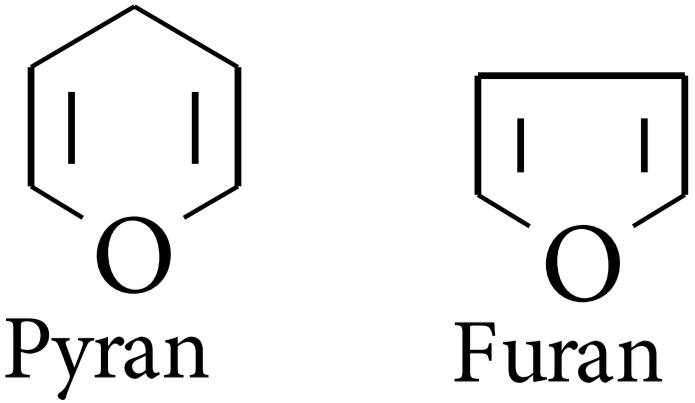
Pentose and hexose undergo intramolecular hemiacetal or hemiketal formation due to combination of the –OH group with the carbonyl group. The actual structure is either of five or six membered ring containing an oxygen atom. In the free state all pentoses and hexoses exist in pyranose form (resembling pyran). However,inthe combined state some of them exist as five membered cyclic structures, called furanose (resembling furan).

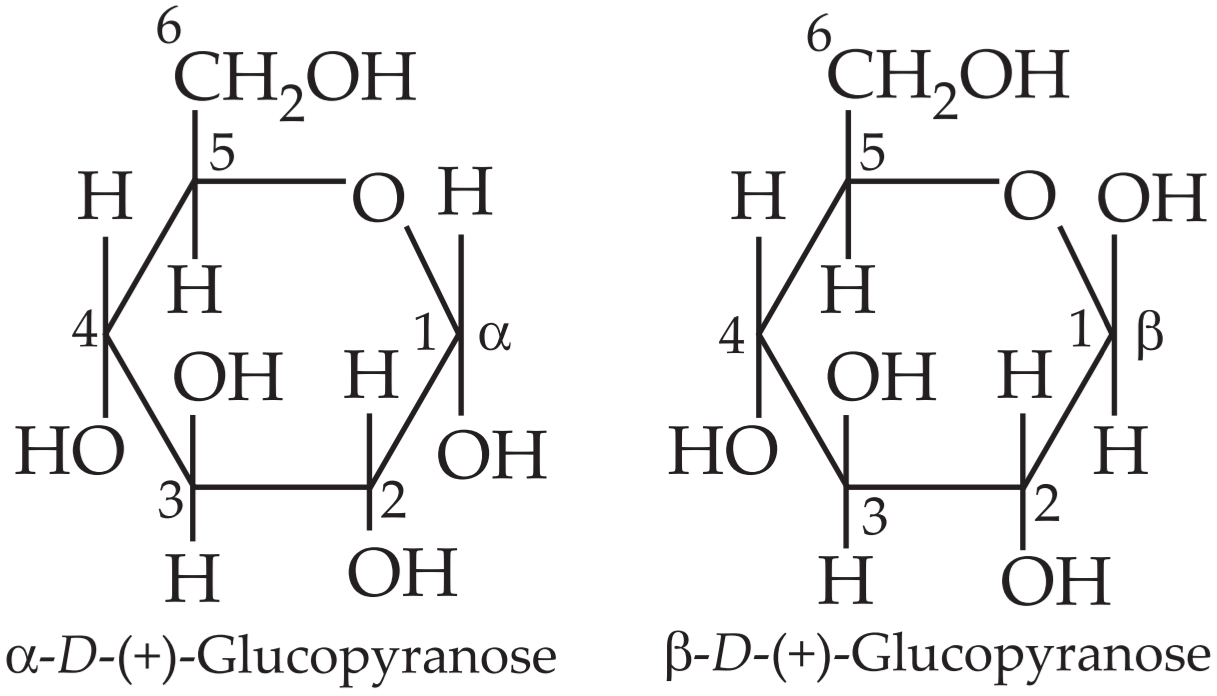
The cyclic structure of glucose is represented by Haworth structure:

$\alpha$ and $\beta$ D-glucose have different configuration at anomeric (C-1) carbon atom, hence are called anomers and the C-1 carbon atom is called anomeric carbon (glycosidic carbon).
The six membered cyclic structure of glucose is called pyranose structure.
The following questionsare multiple choice questions. Choose the most appropriate answer:
  1. $\alpha$ D(+)-glucose and $\beta$ D(+)glucose are:
  1. Enantiomers.
  2. Conformers.
  3. Epimers.
  4. Anomers.
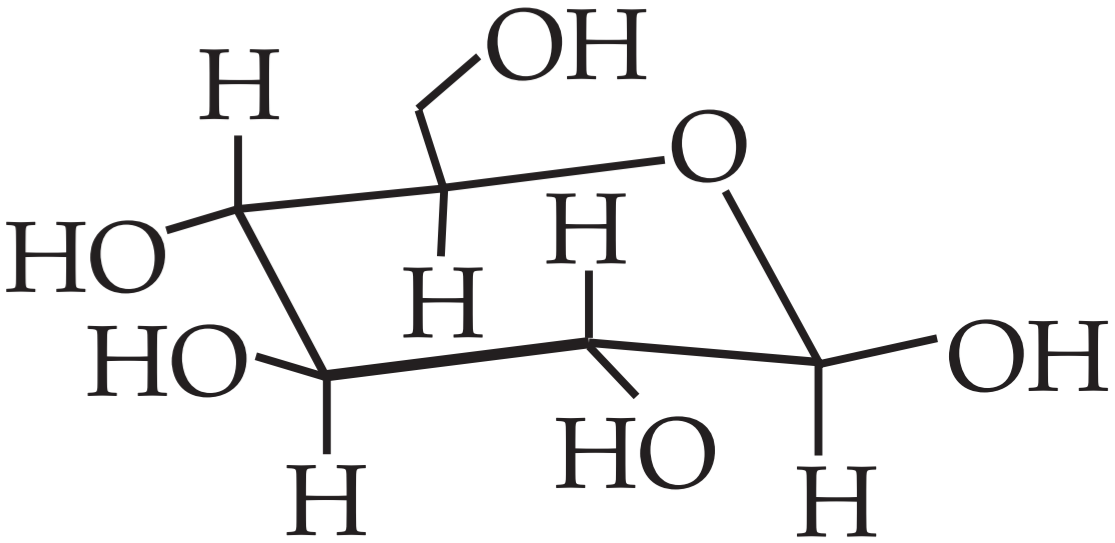
  1. The following carbohydrate is:
  1. A ketohexose.
  2. An aldohexose.
  3. An n-furanose.
  4. An $\alpha$-pyranose.
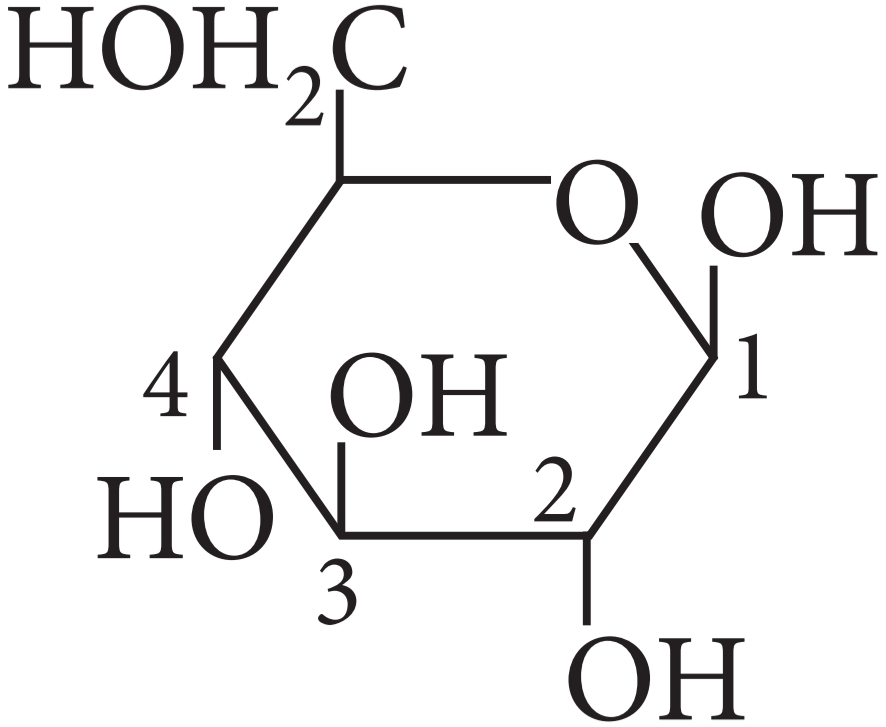
  1. In the following structure, anomeric carbon is:
  1. C-1
  2. C-2
  3. C-3
  4. C-4
  1. The term anomers of glucose refers to:
  1. Isomers of glucose that differ in configurations at carbons one and four (C-1 and C-4).
  2. A mixture of (D)-glucose and (L)-glucose.
  3. Enantiomers of glucose.
  4. Isomers of glucose that differ in configuration at carbon one (C-1).
  1. What percentage of $\beta$-D-(+) glucopyranose is found at equilibrium in the aqueous solution?
  1. 50%
  2. $\approx100%$
  3. 36%
  4. 64%
Read the passage given below and answer the following questions:
Transition metal oxides are compounds fanned by the reaction of metals with oxygen at high temperature. The highest oxidation number in the oxides coincides with the group number. In vanadium, there is a gradual change from the basic $V_2O_3$ to less basic $V_2O_4$ and to amphoteric $V_2O_5· V_2O_4$ dissolves in acids to give $VO^{2+}$ salts. Transition metal oxides are commonly utilized for their catalytic activity and semi conductive properties. Transition metal oxides are also frequently used as pigments in paints and plastic. Most notably titatnium dioxide. One of the earliest application of transition metal oxides to chemical industry involved the use of vanadium oxide for catalytic oxidation of sulfur dioxide to sulphuric acid. Since then, many other applications have emerged, which include benzene oxidation to maleic anhydride on vandium oxides; cyclohexane oxidation to adipic acid on cobalt oxides. An important property of the catalyst material used in these processes is the ability of transition metals to change their oxidation state under a given chemical potential of reductants and oxidants.
The following questions are multiple choice questions. Choose the most appropriate answer:
  1. Which oxide of vanadium is most likely to be basic and ionic?
  1. $VO$
  2. $V_2O_3$
  3. $VO_2$
  4. $V_2O_5$
  1. Vanadyl ion is:
  1. $\text{VO}^{2+}$
  2. $\text{VO}^{+}_2$
  3. $\text{V}_{2}\text{O}^+$
  4. $\text{VO}^{3-}_4$
  1. Which of the following statements is false?
  1. With fluorine vanadium can form $VF_5.$
  2. With chlorine vanadium can form $VCl^5.$
  3. Vanadium exhibits highest oxidation state in oxohalides $VOCl_3, VOBr_3$ and fluoride $VF_5.$
  4. With iodine vanadium cannot form $Vl_5$ due to oxidising power of $V^{5+}$ and reducing nature of $I^-.$
  1. The oxidation state of vanadium in $V_2O_5$ is:
  1. $\frac{+5}{2}$
  2. $+7$
  3. $+5$
  4. $+6$
  1. Identify the oxidising agent in the following reaction.
$V_2O_5+ 5Ca \rightarrow 2V + 5CaO$
  1. $V_2O_5$
  2. $Ca $
  3. $V$
  4. None of these.