For which of the following the resistance decreases on increasing the temperature
Easy
Download our app for free and get started
(c) For semiconductors, resistance decreases on increasing the temperature.

Download our appand get started for free
Experience the future of education. Simply download our apps or reach out to us for more information. Let's shape the future of learning together!No signup needed.*
Similar Questions
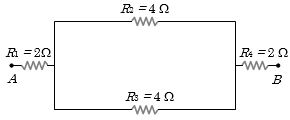
- 1In the given figure, the equivalent resistance between the points $A$ and $B$ is ............ $\Omega$View Solution
- 2There is a current of $1.344\, amp$ in a copper wire whose area of cross-section normal to the length of the wire is $1\,m{m^2}$. If the number of free electrons per $c{m^3}$ is $8.4 \times {10^{22}}$, then the drift velocity would beView Solution
- 3A cell of emf $6\, V$ and resistance $0.5\, ohm$ is short circuited. The current in the cell is ............... $amp$View Solution
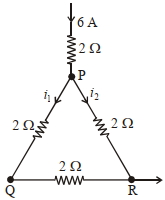
- 4A current of $6\, A$ enters one corner $P$ of an equilateral triangle $PQR$ having $3$ wires of resistance $2 \,\Omega$ each and leaves by the corner $R$. The currents $i_{1}$ in ampere is ........ .View Solution
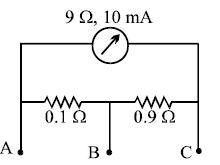
- 5A milliammeter of range $10\, mA$ and resistance $9\, \Omega$ is joined in a circuit as shown. The meter gives full-scale deflection for current $I$ when $A$ and $B$ are used as its terminals, i.e., current enters at $A$ and leaves at $B$ ($C$ is left isolated). The value of $I$ isView Solution
- 6When a potential difference $V$ is applied across a wire of resistance $R$, it dissipates energy at a rate $W$. If the wire is cut into two halves and these halves are connected mutually parallel across the same supply, the same supply, the energy dissipation rate will become:View Solution
- 7View SolutionWhich of the following statement is false
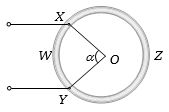
- 8A wire of resistor $R$ is bent into a circular ring of radius $r$. Equivalent resistance between two points $X$ and $Y$ on its circumference, when angle $XOY$ is $\alpha$, can be given byView Solution
- 9Two resistances $r_1$ and $r_2\left(r_1 < r_2\right)$ are joined in parallel. The equivalent resistance $R$ is such thatView Solution
- 10Assertion : The current density $\vec J$ at any point in ohmic resistor is in direction of electric field $\vec E$ at that point.View Solution
Reason : A point charge when released from rest in a region having only electrostatic field always moves along electric lines of force.