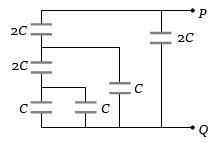
Seven capacitors, each of the capacitance $2\,\mu F$, are to be connected in a configuration to obtain an effective capacitance of $\left( {\frac{6}{{13}}} \right)\,\mu F$. Which of the combinations, shown in figures below, will achieve the desired value ?
- A
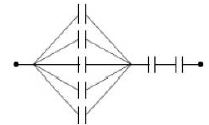
- B
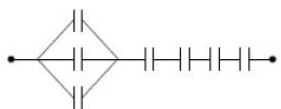
- C
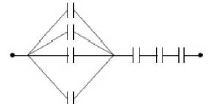
- D
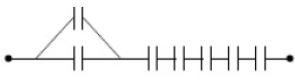
JEE MAIN 2019, Diffcult

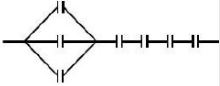

Download our appand get started for free
Experience the future of education. Simply download our apps or reach out to us for more information. Let's shape the future of learning together!No signup needed.*
Similar Questions
- 1A capacitor stores $60\,\mu C$ charge when connected across a battery. When the gap between the plates is filled with dielectric, a charge of $120\,\mu C$ flows through the battery. The dielectric constant of the dielectric inserted isView Solution
- 2Two identical capacitors are connected in parallel across a potenial difference $V$. After they are fully charged, the positive plate of first capacitor is connected to negative plate of second and negative plate of first is connected to positive plate of other. The loss of energy will beView Solution
- 3The electric field between the two parallel plates of a capacitor of $1.5 \mu \mathrm{F}$ capacitance drops to one third of its initial value in $6.6 \mu \mathrm{s}$ when the plates are connected by a thin wire. The resistance of this wire is. . . . . . . .$\Omega$. (Given, $\log 3=1.1)$View Solution
- 4Two positive point charges of $12\,\mu C$ and $8\,\mu C$ are $10\,cm$ apart. The work done in bringing them $4\, cm$ closer isView Solution
- 5View SolutionThe potential to which a conductor is raised, depends on
- 6The insulated spheres of radii ${R_1}$ and ${R_2}$ having charges ${Q_1}$and ${Q_2}$ respectively are connected to each other. There isView Solution
- 7The give graph shown variation (with distance $r$ from centre) ofView Solution
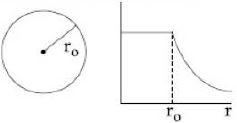
- 8Sixty-four drops are jointed together to form a bigger drop. If each small drop has a capacitance $C$, a potential $V$, and a charge $q$, then the capacitance of the bigger drop will beView Solution
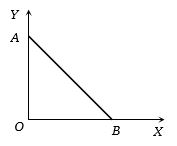
- 9As per this diagram a point charge $ + q$ is placed at the origin $O$. Work done in taking another point charge $ - Q$ from the point $A$ [co-ordinates $(0,\,a)$] to another point $B$ [co-ordinates $(a, 0)$] along the straight path $AB$ isView Solution
- 10View SolutionThe resultant capacitance of given circuit is