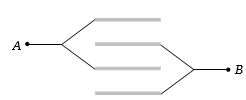
Four plates of the same area of cross-section are joined as shown in the figure. The distance between each plate is $d$. The equivalent capacity across $A$ and $B$ will be
Medium
Download our app for free and get started
(b) The given arrangement is equivalent to the parallel combination of three identical capacitors. Hence equivalent capacitance $ = 3C = 3\frac{{{\varepsilon _0}A}}{d}$

Download our appand get started for free
Experience the future of education. Simply download our apps or reach out to us for more information. Let's shape the future of learning together!No signup needed.*
Similar Questions
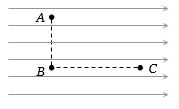
- 1Figure shows three points $A$, $B$ and $C$ in a region of uniform electric field $\overrightarrow E $. The line $AB$ is perpendicular and $BC$ is parallel to the field lines. Then which of the following holds good. Where ${V_A} > {V_B}$ and ${V_C}$ represent the electric potential at points $A$, $B$ and $C$ respectivelyView Solution
- 2A parallel plate capacitor is charged and then disconnected from the source steady $E.M.F.$ The plates are then drawn apart farther. Again it is connected to the same source. Then :View Solution
- 3A hollow metallic sphere of radius $R$ is given a charge $Q$. Then the potential at the centre isView Solution
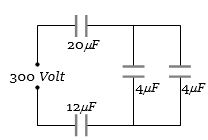
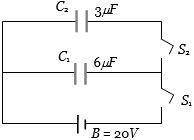
- 4In the circuit shown here ${C_1} = 6\,\mu F,\;{C_2} = 3\,\mu F$ and battery $B = 20\,V$. The switch ${S_1}$ is first closed. It is then opened and afterwards ${S_2}$ is closed. What is the charge finally on ${C_2}$.......$\mu C$View Solution
- 5Ten capacitor are joined in parallel and charged with a battery up to a potential $V$. They are then disconnected from battery and joined again in series then the potential of this combination will be.......$V$View Solution
- 6Two insulated metallic spheres of $3\,\mu F$ and $5\,\mu F$ capacitances are charged to $300\, V$ and $500\,V$ respectively. The energy loss, when they are connected by a wire isView Solution
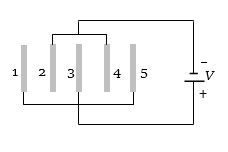
- 7Five identical plates each of area $A$ are joined as shown in the figure. The distance between the plates is $d$. The plates are connected to a potential difference of $V\;volts$. The charge on plates $1$ and $4$ will beView Solution
- 8Ten charges are placed on the circumference of a circle of radius $R$ with constant angular separation between successive charges. Alternate charges $1,3,5,7,9$ have charge $(+q)$ each, while $2,4,6,8,10$ have charge $(-q)$ each. The potential $V$ and the electric field $E$ at the centre of the circle are respectivelyView Solution
(Take $V =0$ at infinity $)$
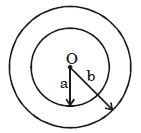
- 9If electric potential of the inner sphere is $10\, volt$ and that of the outer shell is $50\, volt$ then potential at common centre is :-......$V$View Solution
- 10In the adjoining figure, four capacitors are shown with their respective capacities and the $P.D.$ applied. The charge and the $P.D.$ across the $4\,\mu F$ capacitor will beView Solution