MCQ
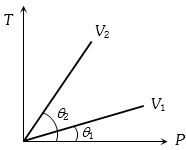
From the following $P-T$ graph what interference can be drawn
  • ${V_2} > {V_1}$
  • B
    ${V_2} < {V_1}$
  • C
    ${V_2} = {V_1}$
  • D
    None of the above

Answer

Correct option: A.
${V_2} > {V_1}$
a
${\theta _2} > {\theta _1}$

$\Rightarrow$ $\tan {\theta _2} > \tan {\theta _1}$ 

$\Rightarrow$ ${\left( {\frac{T}{P}} \right)_2} > {\left( {\frac{T}{P}} \right)_1}$

and $PV = \mu RT$ से $\frac{T}{P} \propto V$ 

$\Rightarrow$ ${V_2} > {V_1}$

Need a full question paper?

Generate a complete, print-ready paper with questions like this in minutes — across 16+ boards, with answer keys.
Start Generating Free

Similar questions

A ball is thrown vertically upward with an initial velocity of $150\,m / s$. The ratio of velocity after $3\,s$ and $5\,s$ is $\frac{x+1}{x}$. The value of $x$ is $...........$ Take $\left(g=10\,m / s ^2\right)$
A stream of glass beads, each with a mass of $15\  gram$, comes out of a horizontal tube at a rate of $100\  per second$. The beads fall a distance of $5\  m$ to a balance pan and bounce back to their original height. How much mass(in $kg$) must be placed in the other pan of the balance to keep the pointer at zero?
A small boy is throwing a ball towards a wall $6 \,m$ in front of him. He releases the ball at a height of $1.4 \,m$ from the ground. The ball bounces from the wall at a height of $3 \,m$, rebounds from the ground and reaches the boy's hand exactly at the point of release. Assuming the two bounces (one from the wall and the other from the ground) to be perfectly elastic, .......... $m$ far ahead of the boy did the ball bounce from the ground
Two particles $P$ and $Q$ simultaneously start moving from point $A$ with velocities $15\,m / s$ and $20\,m / s$ respectively. The two particles move with accelerations equal in magnitude but opposite in direction. When $P$ overtakes $Q$ at $B$, then its velocity is $30\,m / s$. The velocity of $Q$ at point $B$ will be $..........\,m/s$
A soap bubble in vacuum has a radius of $3 \,cm$ and another soap bubble in vacuum has a radius of $4 \,cm$. If the two bubbles coalesce under isothermal condition, then the radius of the new bubble is ....... $cm$
A projectile thrown with velocity $v$ making angle $\theta$ with vertical gains maximum height $H$ in the time for which the projectile remains in air, the time period is
Which of the following can be the basis of sesparating a mixture of gases?
A stretched rubber has
The two thigh bones (femures), each of cross-sectional area $10 \,cm ^2$ support the upper part of a person of mass $50 \,kg$. The average pressure sustained by the femures is ............. $N / m ^2$
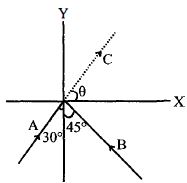
Two particles $A$ and $B$ of equal mass $M$ are moving with the same speed $v$ as shown in the figure . They collide completely inelastically and move as a single particle $C$. The angle $\theta $ that the path of $C$ makes with the $X-$ axis is given by