Gauss is unit of which quantity
Easy


Download our appand get started for free
Experience the future of education. Simply download our apps or reach out to us for more information. Let's shape the future of learning together!No signup needed.*
Similar Questions
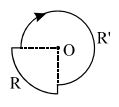
- 1A current of $i$ ampere is flowing through each of the bent wires as shown the magnitude and direction of magnetic field at $O$ isView Solution
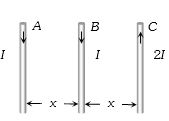
- 2$A, B$ and $C$ are parallel conductors of equal length carrying currents $I, I$ and $2I$ respectively. Distance between $A$ and $B$ is $x$. Distance between $B$ and $C$ is also $x$. ${F_1}$ is the force exerted by $B$ on $A$ and $F_2$ is the force exerted by $B$ on $A$ choose the correct answerView Solution
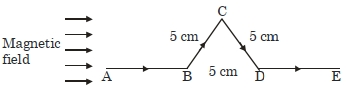
- 3A triangular shaped wire carrying $10 A$ current is placed in a uniform magnetic field of $0.5\,T$, as shown in figure. The magnetic force on segment $CD$ is $....N$ $($ Given $BC = CD = BD =5\,cm )$.View Solution
- 4A galvanometer coil has $500$ turns and each turn has an average area of $3 \times 10^{-4}\, m ^{2}$. If a torque of $1.5\,Nm$ is required to keep this coil parallel to magnetic field when a current of $0.5\, A$ is flowing through it, the strength of the field (in $T )$ isView Solution
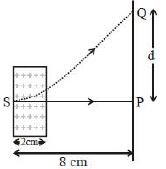
- 5An electron, moving along the $x-$ axis with an initial energy of $100\, eV$, enters a region of magnetic field $\vec B = (1.5\times10^{-3}T)\hat k$ at $S$ (See figure). The field extends between $x = 0$ and $x = 2\, cm$. The electron is detected at the point $Q$ on a screen placed $8\, cm$ away from the point $S$. The distance $d$ between $P$ and $Q$ (on the screen) is :......$cm$ (electron's charge $= 1.6\times10^{-19}\, C$, mass of electron $= 9.1\times10^{-31}\, kg$)View Solution
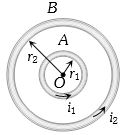
- 6$A$ and $B$ are two concentric circular conductors of centre $O$ and carrying currents ${i_1}$ and ${i_2}$ as shown in the adjacent figure. If ratio of their radii is $1 : 2$ and ratio of the flux densities at $O$ due to $A$ and $B$ is $1 : 3$, then the value of ${i_1}/{i_2}$ isView Solution
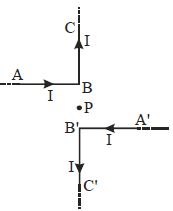
- 7Current through $ABC$ and $A'B'C'$ is $I$. What is the magentic field at $P$ ? $BP = PB' = r$ (Here $C'B'PBC$ are collinear)View Solution
- 8View SolutionA particle moving in a magnetic field increases its velocity, then its radius of the circle
- 9A particle of mass $m$ and charge $q$ moves with a constant velocity $v$ along the positive $x$ direction. It enters a region containing a uniform magnetic field $B$ directed along the negative $z$ direction, extending from $x = a$ to $x = b$. The minimum value of $v$ required so that the particle can just enter the region $x > b$ isView Solution
- 10When a current of $5\ mA$ is passed through a galvanometer having a coil of resistance $15\ \Omega$, it shows full scale deflection. The value of the resistance to be put in series with the galvanometer to convert it into to voltmeter of range $0 - 10\ V$ isView Solution