MCQ
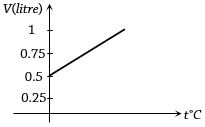
Graph between volume and temperature for a gas is shown in figure. If $\alpha$ = Volume coefficient of gas = $\frac{1}{273}$ per $^o C$,then what is the volume of gas at a temperature of $819 ^o C$
  • A
    $1 \times {10^{ - 3}}$ ${m^3}$
  • $2 \times {10^{ - 3}}$ ${m^3}$
  • C
    $3 \times {10^{ - 3}}$ ${m^3}$
  • D
    $4 \times {10^{ - 3}}$ ${m^3}$

Answer

Correct option: B.
$2 \times {10^{ - 3}}$ ${m^3}$
b
(b) ${V_t} = {V_0}(1 + \alpha t) = 0.5\left( {1 + \frac{1}{{273}} \times 819} \right)$

$ = 2$ litre=$2 \times {10^{ - 3}}$${m^3}$

Need a full question paper?

Generate a complete, print-ready paper with questions like this in minutes — across 16+ boards, with answer keys.

Start Generating Free

Similar questions

The motion of a particle varies with time according to the relation $y = a(\sin \omega \,t + \cos \omega \,t)$, then
A charge particle $q_0$ of mass $m_0$ is projected along the $y-$axis at $t = 0$ from origin with a velocity $V_0.$ If a uniform electron field $E_0$ also exists along the $x-$ axis, then the time at which de-broglie wavelength of the particle  becomes half of the initial value is
Velocity of sound measured in hydrogen and oxygen gas at a given temperature will be in the ratio
Select the correct statement for work, heat and change in internal energy.
For a certain organ pipe, three successive resonance frequencies are observed at $425,595,$ and $765 \,Hz$ respectively, Taking the speed of sound in air to be $340 \,m / s$ the fundamental frequency of the pipe (in $Hz$ ) is .........
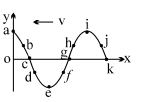
The figure represents the instantaneous picture of a longitudinal harmonic wave travelling along the negative $x$-axis. Identify the correct statement $(s)$ related to the movement of the points shown in the figure. The points moving in the direction of wave are
The unit of permittivity of free space is
A particle moving with uniform acceleration travels $24\, m$ and $64\, m$ in the first two consecutive intervals of $4\, sec$ each. Its initial velocity is.......$m/sec$
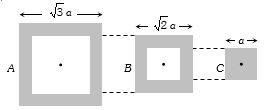
Following figure shows cross-sections through three long conductors of the same length and material, with square cross-section of edge lengths as shown. Conductor $B$ will fit snugly within conductor $A$, and conductor $C$ will fit snugly within conductor $B$. Relationship between their end to end resistance is
The following four wires are made of same material. Which one will have the largest elongation when subjected to the same tension ?