A student wants to project the image of a candle flame on a screen 90 cm in front of a mirror by keeping the flame at a distance of 15 cm from its pole.
- Suggest the type of mirror he should use.
- Determine the linear magnification in this case.
- Find the distance between the object and its image.
- Draw ray diagram to show the image formation in this case.
CBSE OUTSIDE DELHI - SET 3 2014
Download our app for free and get started
- Concave mirror.
- $\text{Linear magnification} = -\frac{\text{Image distance}}{\text{Object distance}}$
Object distance, u = -15 (u is always negative)
Image distance, v = -90 (-ve sign as the image is formed in front of the mirror on the screen)
$m = -\frac{(- 90)}{(-15)} \ \ \ \ \ \ \ \ \ \ \therefore m = -6$
- The distance between the object and its image is 75 cm.
- Ray diagram:
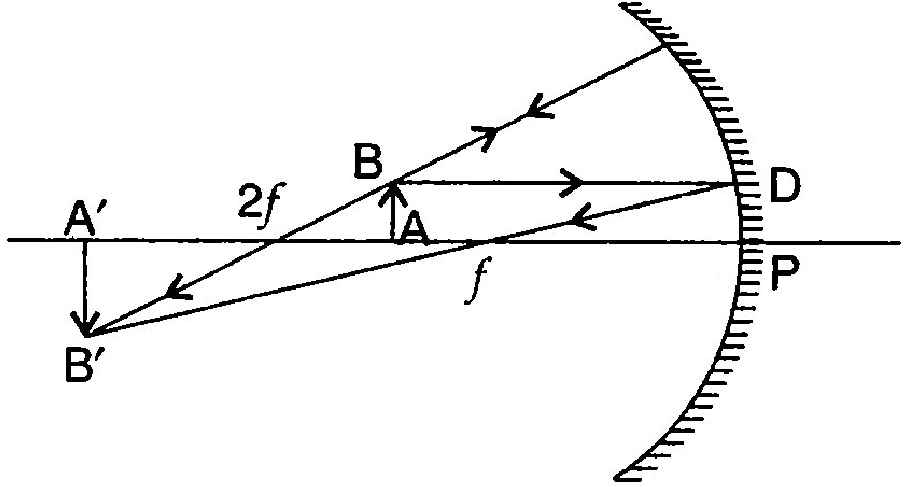

Download our appand get started for free
Experience the future of education. Simply download our apps or reach out to us for more information. Let's shape the future of learning together!No signup needed.*
Similar Questions
- 1View SolutionA spherical mirror produces an image of magnification -1.0 on a screen placed at a distance of 30 cm from the pole of the mirror.
- Write the type of mirror in this case.
- What is the focal length of the mirror?
- What is the nature of the image formed?
- Draw the ray diagram to show the image formation in this case.
- 2View SolutionA lens forms a real image 3cm high of an object 1cm high. If the separation of object and image is 15cm, find the focal length of the lens.
- 3View SolutionWhat is the advantage of using a convex mirror as a rear-view mirror in vehicles as compared to a plane mirror? Illustrate your answer with the help of labelled diagrams.
- 4View SolutionIf an object of 10cm height is placed at a distance of 36cm from a concave mirror of focal length 12cm, find the position, nature and height of the image.
- 5View SolutionThe image of a candle flame formed by a lens is obtained on a screen placed on the other side of the lens. If the image is three times the size of the flame and the distance between lens and image is 80cm, at what distance should the candle be placed from the lens? What is the nature of the image at a distance of 80cm and the lens?
- 6View SolutionWhat is the difference between regular reflection of light and diffuse reflection of light? What type of reflection of light takes place from:
- A cinema screen.
- A plane mirror.
- A cardboard.
- Still water surface of a lake
- 7View SolutionA convex lens of focal length 20cm can produce a magnified virtual as well as real image. Is this a correct statement? If yes, where shall the object be placed in each case for obtaining these images?
- 8View SolutionA concave lens of focal length 15 cm forms an image 10 cm from the lens. How far is the object placed from the lens? Draw the ray diagram.
- 9View SolutionDefine power of a lens. What is its unit? One student uses a lens of focal length 50cm and another of -50cm. What is the nature of the lens and its power used by each of them?
- 10View SolutionWe wish to obtain an erect image of an object, using a concave mirror of focal length 15 cm. What should be the range of distance of the object from the mirror? What is the nature of the image? Is the image larger or smaller than the object? Draw a ray diagram to show the image formation in this case.