MCQ
Identify the function which represents a periodic motion.
  • A
    $e ^{-\omega t}$
  • B
    $e ^{{\omega t }}$
  • C
    $\log _{ e }(\omega t )$
  • $\sin \omega t+\cos \omega t$

Answer

Correct option: D.
$\sin \omega t+\cos \omega t$
d
For periodic function

$f(t)=f(t+T)$

where $T$ is time period of function

$\sin (\omega t+2 \pi)+\cos (\omega t+2 \pi)$

$=\sin \omega t+\cos \omega t$

Need a full question paper?

Generate a complete, print-ready paper with questions like this in minutes — across 16+ boards, with answer keys.
Start Generating Free

Similar questions

Gravitational acceleration on the surface of a planet is $\frac{\sqrt 6}{11}g$ , where $g$ is the gravitational acceleration on the surface of the earth. The average mass  density of the planet is $\frac{2}{3}\, times$ that of the earth. If the escape speed on the surface of the earth is taken to be $11\, kms^{-1}$, the escape speed on the surface of  the  planet in $kms^{-1}$ will be
A cylinder contains $10\, kg$ of gas at pressure of ${10^7}\,\,N/{m^2}.$ The quantity of gas taken out of the cylinder, if final pressure is $2.5 \times {10^6}\,N/{m^2},$ will be ..... $kg$ (Temperature of gas is constant)
A ball hits a floor and rebounds after an inelastic collision. In this case:
  1. The momentum of the ball just after the collision is same as that just before the collision.
  2. The mechanical energy of the ball remains the same during the collision.
  3. The total momentum of the ball and the earth is conserved.
  4. The total energy of the ball and the earth remains the same.
The average velocity of a body moving with uniform acceleration travelling a distance of $3.06\, m$ is $ 0.34 ms^{-1}$. If the change in velocity of the body is $ 0.18ms^{-1}$ during this time, its uniform acceleration is.........$ms^{-2}$
A sample of ideal gas $(\gamma = 1.4)$ is heated at constant pressure. If an $100\, J$ is supplied to gas, the work done by the gas is ...... $J$
A vernier callipers has $20$ divisions on the vernier scale, which coincides with $19^{\text {th }}$ division on the main scale. The least count of the instrument is $0.1 \mathrm{~mm}$. One main scale division is equal to $. . .  . . ..$ $\mathrm{mm}$
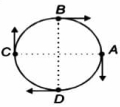
Four particles $A, B, C$ and $D$ are moving with constant speed $v$ each. At the instant shown relative velocity of $A$ with respect to $B, C$ and $D$ are in directions
Two vectors $\overrightarrow a $ and $\overrightarrow b $ are at an angle of $60^o$ with  each other. Their resultant makes an angle of $45^o$ with $\overrightarrow a $ . If $|\overrightarrow b | = 2\,units$ then $|\overrightarrow a |$ is:-
A stationary wave is represented by $y=A \sin (100 t) \cos (0.01 x)$, where $y$ and $A$ are in millimetres, $t$ is in second and $x$ is in metre. The velocity of the constituent wave is ........... $m / s$
The equation of state of some gases can be expressed as $\left( {P + \frac{a}{{{V^2}}}} \right) = \frac{{b\theta }}{l}$ Where $P$ is the pressure, $V$ the volume, $\theta $ the absolute temperature and $a$ and $b$ are constants. The dimensional formula of $a$ is