Question

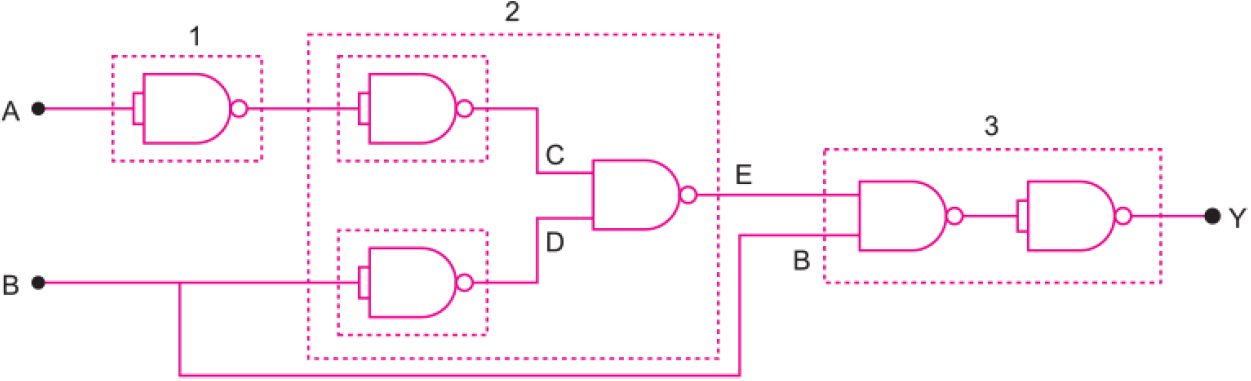
Identify which logic gate OR, AND and NOT is represented by the circuits in the dotted line boxes 1, 2 and 3. Give the truth table for the entire circuit for all possible values of A and B.
Answer

The dotted line box 1 represents NOT gate. The dotted line box 2 represents OR gate. The dotted line box 3 represents AND gate. The output of box 1 is $\bar{\text{A}}$ The inputs of box 2 are A and ?̅ As box 2 is OR gate, therefore, output of box 2 is $\text{E}=(\bar{\text{A}}+\text{B}).$ The inputs of box 3 are E and B Box 3 represents AND gate; therefore, output of box 3 is, $\text{Y}=\text{EB}=(\bar{\text{A}}+\text{B})\text{B}$ Truth table of the entire circuit is,
A
B
$\text{Y}=(\bar{\text{A}}+\text{B})\text{B}$
0
0
(1 + 0) . 0 = 0
1
0
(0 + 0) . 0 = 0
0
1
(1 + 1) . 1 = 1 . 1 = 1
1
1
(0 + 1) . 1 = 1 . 1 = 1

Need a full question paper?

Generate a complete, print-ready paper with questions like this in minutes — across 16+ boards, with answer keys.
Start Generating Free

Similar questions

$a.$ Explain why, for any charge configuration, the equipotential surface through a point is normal to the electric field at that point.
Draw a sketch of equipotential surfaces due to a single charge $(-q)$, depicting the electric field lines due to the charge.
$b.$ Obtain an expression for the work done to dissociate the system of three charges placed at the vertices of an equilateral triangle of side a as shown alongside.
A man with normal near point (25 cm) reads a book with small print using a magnifying glass: a thin convex lens of focal length 5 cm.
  1. What is the closest and the farthest distance at which he should keep the lens from the page so that he can read the book when viewing through the magnifying glass?
  2. What is the maximum and the minimum angular magnification (magnifying power) possible using the above simple microscope?
A rectangular current carrying loop is placed 1cm away from a long straight current-carrying conductor as shown.
  1. Will the net force acting on the loop due to straight conductor be attractive or repulsive in nature? Justify your answer. Calculate the magnitude of this force.
A person standing on the floor of an elevator drops a coin. The coin reaches the floor of the elevator in a time $t_1$ if the elevator is stationary and in time $t_2$ if it is moving uniformly. Then :
Answer the following question:
It is necessary to use satellites for long distance TV transmission. Why?
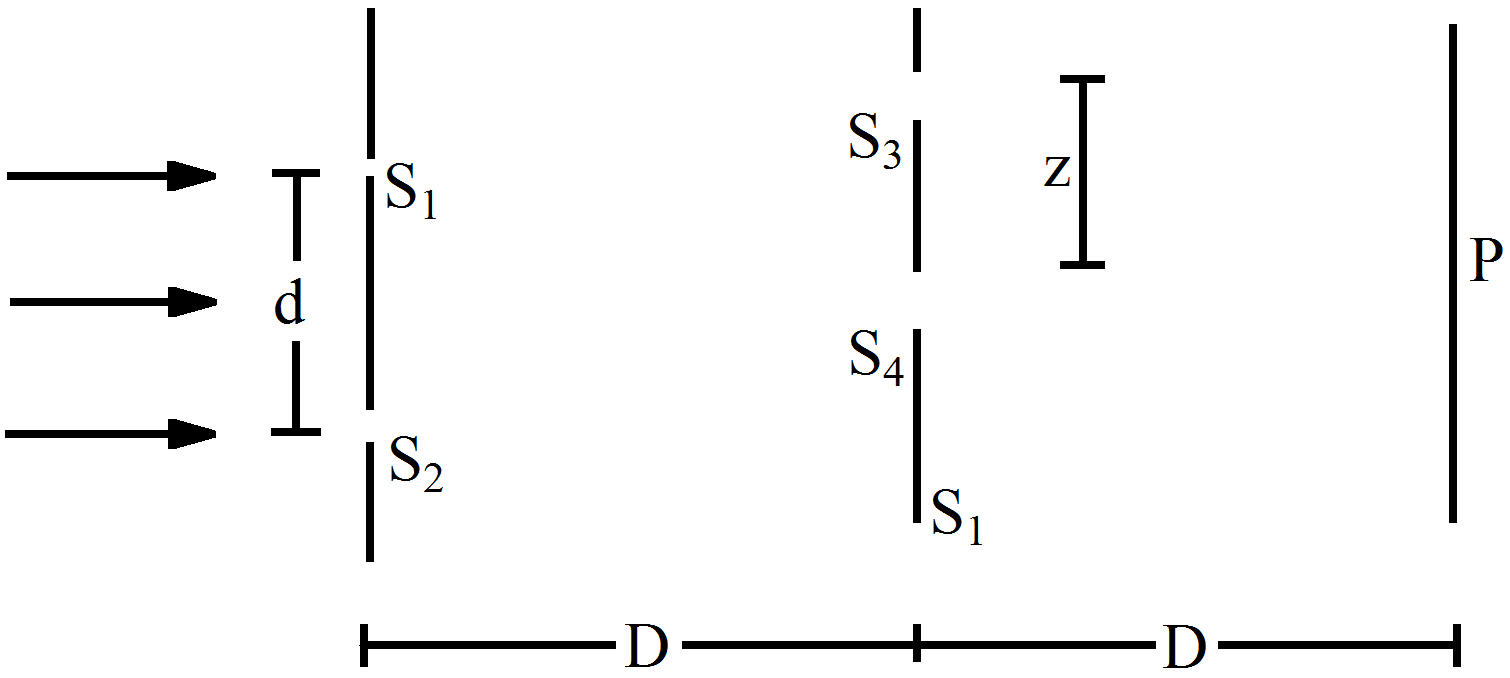
Consider the arrangement shown in figure. By some mechanism, the separation between the slits $S_3$ and $S_4$ can be changed. The intensity is measured at the point P which is at the common perpendicular bisector

of $S_1S_2$ and $S_3S_4$. When $\text{z}=\frac{\text{D}\lambda}{2\text{d}},$ intensity measured at P is I. Find this intensity when z is equal to:
  1. $\frac{\text{D}\lambda}{\text{d}}$
  2. $\frac{3\text{D}\lambda}{2\text{d}}$
  3. $\frac{2\text{D}\lambda}{\text{d}}$
Two charges -q each are fixed separated by distance 2d. A third charge q of mass m placed at the mid-point is displaced slightly by x (x < < d) perpendicular to the line joining the two fixed charged as shown in Fig. Show that q will perform simple harmonic oscillation of time period.

$\text{T}=\Big[\frac{8\pi^3\in_0\text{md}^3}{\text{q}^2}\Big]^\frac{1}{2}$.
Figure. shows a cylindrical tube of radius 5cm and length 20cm. It is closed by a tight-fitting cork. The friction coefficient between the cork and the tube is 0.20. The tube contains an ideal gas at a pressure of 1 atm and a temperature of 300K. The tube is slowly heated and it is found that the cork pops out when the temperature reaches 600K Let dN denote the magnitude of the normal contact force exerted by a small length dl of the cork along the periphery (see the figure). Assuming that the temperature of the gas is uniform at any instant, calculate $\frac{\text{dN}}{\text{dl}}.$
  1. Define mutual inductance and write its S.I. unit.
  2. Derive an expression for the mutual inductance of two long co-axial solenoids of same length wound one over the other.
  3. In an experiment, two coils $c_1 $ and $c_2$ are placed close to each other. Find out the expression for the emf induced in the coil $c_1$ due to a change in the current through the coil $c_2.$
  1. Draw a ray diagram to show the image formation by a combination of two thin convex lenses in contact. Obtain the expression for the power of this combination in terms of the focal lengths of the lenses.
  2. A ray of light passing from air through an equilateral glass prism undergoes minimum deviation when the angle of incidence is $\frac{3}{4}^{th}$ of the angle of prism. Calculate the speed of light in the prism.