MCQ
If a particle is executing simple harmonic motion, then acceleration of particle
  • A
    Is uniform
  • B
    Varies linearly with time
  • Is non uniform
  • D
    Both $(b)$ and $(c)$

Answer

Correct option: C.
Is non uniform
c
(c)

If a particle is executing S.H.M.

$a \alpha-\omega^2 x$

Hence it is not uniform and depends on $x$ rather than time.

Hence answer is $(c)$.

Need a full question paper?

Generate a complete, print-ready paper with questions like this in minutes — across 16+ boards, with answer keys.
Start Generating Free

Similar questions

Which of the following not correct about the electromagnetic force?
Learned Indian classical vocalists do not like the accompaniment of a harmonium because
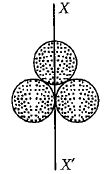
Three identical spherical shells, each of mass $m$ and radius $r$ are placed as shown in figure. Consider an axis $XX'$ which is touching to two shells and passing through diameter of third shell. Moment of inertia of the system consisting of these three spherical shells about $XX'$ axis is
Energy of all molecules of a monoatomic gas having a volume $V$ and pressure $P$ is $\frac{3}{2}PV$. The total translational kinetic energy of all molecules of a diatomic gas as the same volume and pressure is
An object is thrown along a direction inclined at an angle of ${45^o}$ with the horizontal direction. The horizontal range of the particle is equal to
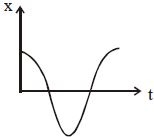
Dispacement time graph of a particle executing $SHM$ is as shown in the figure. Corresponding graph between $PE$ and time is
The coefficients of thermal conductivity of copper, mercury and glass are respectively $Kc, Km$ and $Kg$ such that $Kc > Km > Kg$ . If the same quantity of heat is to flow per second per unit area of each and corresponding temperature gradients are $Xc, Xm$ and $Xg$ , then
KE acquired by a mass $m$ in travelling a certain distance $d$, starting from rest, under the action of a constant force $F$ is ..........
A body thrown with an initial speed of $96\,ft/\sec $ reaches the ground after..........$sec$ $(g = 32ft/{\sec ^2})$
A source of sound $S$ of frequency $500 Hz$ situated between a stationary observer $O$ and a wall $W$, moves towards the wall with a speed of $2 m/s$. If the velocity of sound is $332 m/s$, then the number of beats per second heard by the observer is (approximately)