If a particle of charge ${10^{ - 12}}\,coulomb$ moving along the $\hat x - $ direction with a velocity ${10^5}\,m/s$ experiences a force of ${10^{ - 10}}\,newton$ in $\hat y - $ direction due to magnetic field, then the minimum magnetic field is
Medium
Download our app for free and get started
(d) $F = qvB\sin \theta $ $==>$ $B = \frac{F}{{qv\sin \theta }}$
${B_{\min }} = \frac{F}{{qv}}$(when $\theta$ = $90^o$)
$\therefore \;{B_{\min }} = \frac{F}{{qv}} = \frac{{{{10}^{ - 10}}}}{{{{10}^{ - 12}} \times {{10}^5}}} = {10^{ - 3}}$ $Tesla$ in $U = \frac{{{B^2}}}{{2{\mu _0}}},$ $\hat z - $ direction.
${B_{\min }} = \frac{F}{{qv}}$(when $\theta$ = $90^o$)
$\therefore \;{B_{\min }} = \frac{F}{{qv}} = \frac{{{{10}^{ - 10}}}}{{{{10}^{ - 12}} \times {{10}^5}}} = {10^{ - 3}}$ $Tesla$ in $U = \frac{{{B^2}}}{{2{\mu _0}}},$ $\hat z - $ direction.

Download our appand get started for free
Experience the future of education. Simply download our apps or reach out to us for more information. Let's shape the future of learning together!No signup needed.*
Similar Questions
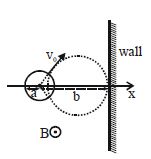
- 1An electron is projected normally from the surface of a sphere with speed $v_0$ in a uniform magnetic field perpendicular to the plane of the paper such that its strikes symmetrically opposite on the sphere with respect to the $x-$ axis. Radius of the sphere is $'a'$ and the distance of its centre from the wall is $'b'$ . What should be magnetic field such that the charge particle just escapes the wallView Solution
- 2In case Hall effect for a strip having charge $Q$ and area of cross-section $A$, the Lorentz force isView Solution
- 3A charged particle moves with velocity $v$ in a uniform magnetic field $\overrightarrow B $. The magnetic force experienced by the particle isView Solution
- 4A uniform conducting wire of length is $24 {a}$, and resistance ${R}$ is wound up as a current carrying coil in the shape of an equilateral triangle of side $'a'$ and then in the form of a square of side $'a'.$ The coil is connected to a voltage source ${V}_{0}$. The ratio of magnetic moment of the coils in case of equilateral triangle to that for square is $1: \sqrt{y}$ where $y$ is ..... .View Solution
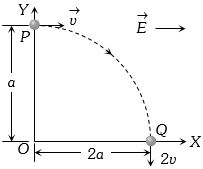
- 5A particle of charge $+q$ and mass $m$ moving under the influence of a uniform electric field $E\hat i$ and a uniform magnetic field $B\hat k$ follows trajectory from $P$ to $Q$ as shown in figure. The velocities at $P$ and $Q$ are $v\hat i$ and $ - 2v\hat j$ respectively. Which of the following statement(s) is/are correctView Solution
- 6A conducting circular loop of radius $r$ carries a constant current $i$. It is placed in uniform magnetic field $B$, such that $B$ is perpendicular to the plane of the loop. The net magnetic force acting on the loop isView Solution
- 7In hydrogen atom, the electron is making $6.6 \times {10^{15}}\,rev/\sec $ around the nucleus in an orbit of radius $0.528\, \mathop A\limits^o $. The magnetic moment $(A - {m^2})$ will beView Solution
- 8A circular coil of $20$ $turns$ and radius $10\, cm$ is placed in uniform magnetic field of $0.10\, T$ normal to the plane of the coil. If the current in coil is $5\, A$, then the torque acting on the coil will be...... $Nm$View Solution
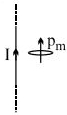
- 9View SolutionThe magnetic dipole pm is placed parallel to an infinitely long straight wire as shown in figure
- 10A circular coil having $200$ turns, $2.5 \times 10^{-4} \mathrm{~m}^2$ area and carrying $100 \mu \mathrm{A}$ current is placed in a uniform magnetic field of $1 \mathrm{~T}$. Initially the magnetic dipole moment $(\vec{M})$ was directed along $\vec{B}$. Amount of work, required to rotate the coil through $90^{\circ}$ from its initial orientation such that $\overrightarrow{\mathrm{M}}$ becomes perpendicular to $\vec{B}$, is. . . . $\mu \mathrm{J}$.View Solution